
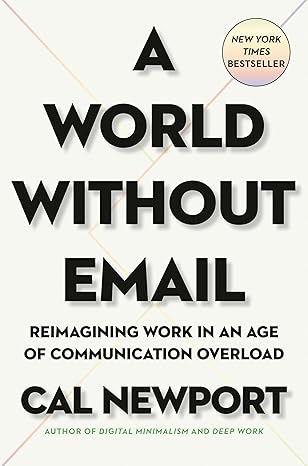
A World Without Email Summary
By Cal Newport
Reimagining Work in an Age of Communication Overload
Summary preview
Work was supposed to get easier. That was the promise. Once offices became digital, once messages could fly across buildings and continents in seconds, once every document lived in the cloud and every colleague sat one click away, we were meant to become faster, smarter, and less burdened by old friction. But that is not what happened. Instead, many of us now spend our days trapped inside an endless conversation. We check the inbox, answer a question, jump to chat, handle a request, return to the inbox, discover three more threads, attend a meeting to clarify the threads, then end the day feeling busy and strangely unaccomplished. We are exhausted, yet the important work often remains untouched. That is the problem this book takes seriously. A World Without Email is not really a book about deleting one tool. It is a book about rethinking the way knowledge work is organized. Email happens to be the most visible symbol of a deeper mess. The real issue is a way of working that depends on constant unscheduled communication. Everybody can send requests at any time. Everybody can shift obligations to everybody else with almost no cost. Small questions multiply into sprawling threads. Ambiguity leads to meetings. The day fragments into tiny pieces, and attention gets broken so often that concentration becomes rare. Cal Newport argues that we did not arrive here because this system is wise or efficient. We arrived here because digital communication spread faster than management theory. Offices adopted easy messaging tools before they built better processes for handling work. As a result, many organizations now run on what he calls the hyperactive hive mind, a workflow in which ongoing back and forth conversation becomes the main way tasks are assigned, organized, and completed. It feels flexible and modern, but it creates overload, stress, and a constant sense of reacting rather than leading. The book then does something more ambitious than complaint. It asks a liberating question. What if the way we work is not fixed? What if the inbox is not destiny? To answer that, the argument moves through history, economics, cognitive science, and a series of practical experiments. We meet software firms that replaced ad hoc messaging with clear processes. We look at factories and assembly systems that solved complexity with structure rather than chatter. We examine how attention works and why frequent switching drains the brain. And step by step, a new vision appears. The goal is not silence for its own sake. The goal is workflows that reduce chaos, protect focus, and let people produce valuable things without living inside a permanent digital scramble. What follows is both diagnosis and blueprint. It explains how we got stuck in this exhausting mode of work, why it persists, what it costs us, and how teams and individuals can begin escaping it. The result is not a fantasy of disappearing to a cabin. It is a practical case for making modern work humane, sustainable, and genuinely productive again.
Sign up to continue reading
Get access to full book summaries, audio of the summaries, and many more.
Similar Books
Books with a similar vibe—explore more like this.
Goals!
Brian Tracy
How to Get Everything You Want – Faster Than You Ever Thought Possible
4.8 (929)29 mins
The 7 Habits of Highly Effective People
Stephen R. Covey
Powerful Lessons in Personal Change
4.7 (2172)35 mins
Work Clean
Dan Charnas
The life-changing power of mise-en-place to organize your life, work, and mind
4.6 (368)23 mins
How to Be a Star at Work
Robert E. Kelley
9 Breakthrough Strategies You Need to Succeed
4.6 (34)28 mins
Die Empty
Todd Henry
Unleash Your Best Work Every Day
4.6 (40)22 mins
The Science of Intelligent Achievement
Isaiah Hankel
How Smart People Focus, Create and Grow Their Way to Success
4.5 (637)27 mins
Feel-Good Productivity
Ali Abdaal
How to Do More of What Matters to You
4.5 (1198)15 mins
High Performance Habits
Brendon Burchard
How Extraordinary People Become That Way
4.5 (829)27 mins
Mission Ready
Lindy Elkins-Tanton
How to Build Teams That Perform Under Pressure
4.5 (6)22 mins
The Art of Laziness
Library Mindset
Overcome Procrastination & Improve Your Productivity
4.5 (52) mins