
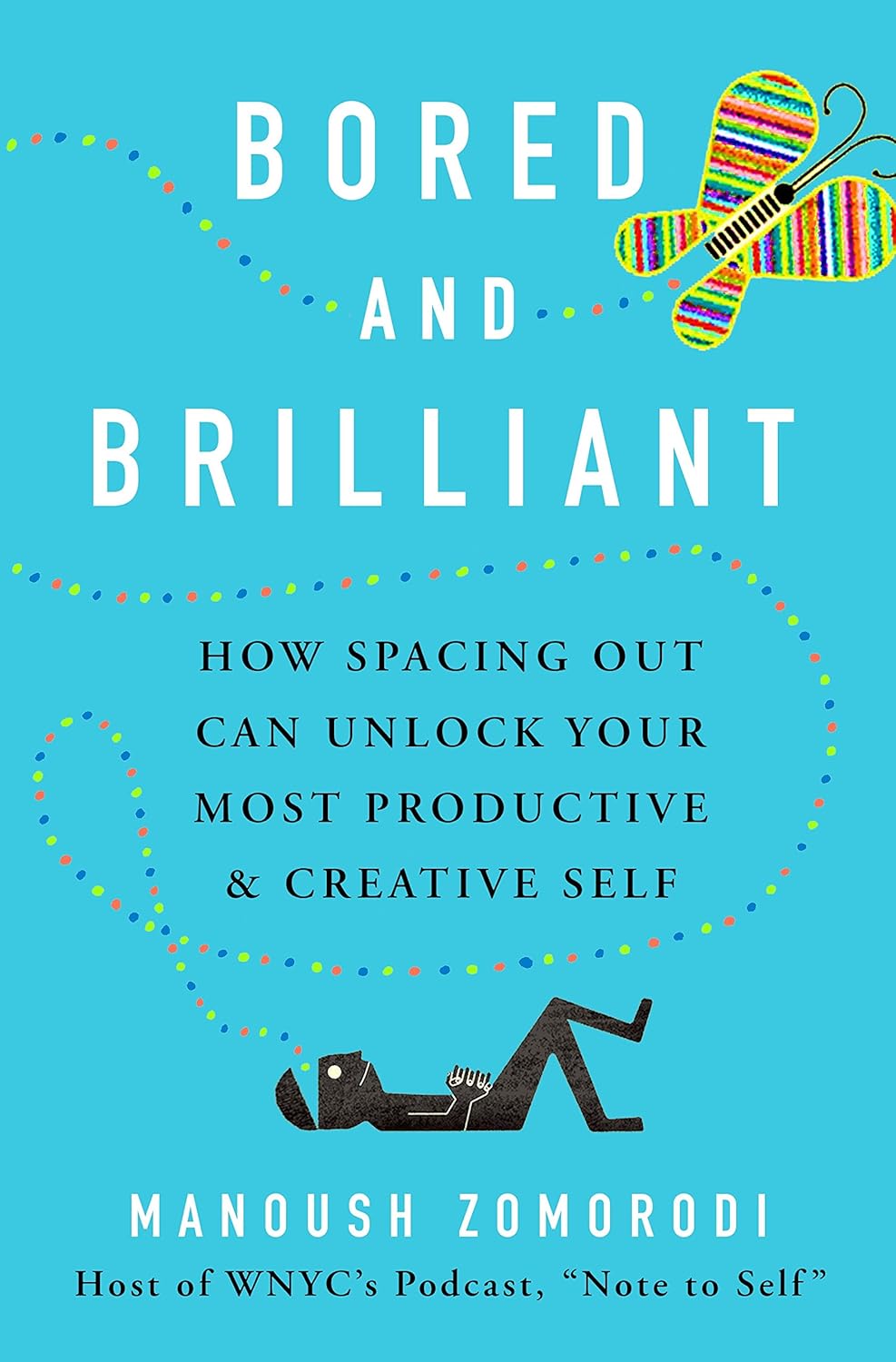
Bored and Brilliant Summary
By Manoush Zomorodi
How Spacing Out Can Unlock Your Most Productive and Creative Self
Summary preview
Most of us say we are too busy, too distracted, too pulled in a hundred directions to think clearly. We wake up and reach for the phone. We fill every small pause with a screen, a swipe, a tap, a scroll. We answer messages while walking, half listen while eating, and drift through our days in a fog of alerts and tiny demands. It can feel normal because everyone else is doing it too. But what if all that connection is quietly stealing something essential from us. What if our best ideas, our focus, our calm, and even our sense of self are being crowded out by constant digital noise. That is the question at the heart of Bored and Brilliant. Manoush Zomorodi begins with a problem that feels deeply modern and intensely personal. She noticed she could not stand in line at the grocery store or wait for the subway without reaching for her phone. She was not alone. Listeners of her podcast had the same habit, the same restlessness, the same sense that they were always “on” yet somehow not fully present. So she set out to explore a surprising possibility. Maybe boredom is not a nuisance to avoid. Maybe it is a doorway. The book is built around that bold idea. Boredom, far from being empty or useless, can help the mind wander, connect ideas, solve problems, and recover its creative power. When we remove every gap from our day, we also remove the space where reflection begins. The result is not just distraction. It is a kind of inner crowding. We become reactive instead of intentional. We consume more than we create. We feel informed but scattered. To test what happens when people reclaim those lost pauses, the book follows an experiment called the Bored and Brilliant Challenge. Thousands of people joined in for a series of daily assignments designed to loosen the grip of the smartphone and bring attention back to real life. The tasks sound simple at first. Keep your phone out of reach. Delete an app. Take a photo and do not post it. Let your mind wander. Yet each one reveals how deeply our devices shape our habits, moods, and relationships. Along the way, the book brings in neuroscience, psychology, design, business incentives, and everyday stories from people trying to live differently. It asks not whether technology is good or bad, but how we can use it with more awareness. It is practical, funny, curious, and often uncomfortably recognizable. Above all, it offers a hopeful message. You do not need to run away from the digital world. You do need to make room, on purpose, for your own mind to come back online.
Sign up to continue reading
Get access to full book summaries, audio of the summaries, and many more.
Similar Books
Books with a similar vibe—explore more like this.
Rest
Alex Soojung-Kim Pang
Why You Get More Done When You Work Less
4.6 (313)30 mins
Lifescale
Brian Solis
How to Live a More Creative, Productive, and Happy Life
4.6 (22)26 mins
How to Think More Effectively
The School of Life
A guide to greater productivity, insight and creativity
4.5 (909)23 mins
The Design Thinking Workbook
CJ Meadows, Charvi Parikh
Essential Skills for Creativity and Business Growth
4.5 (623)13 mins
The Innovator's Dilemma
Clayton Christensen
When New Technologies Cause Great Firms to Fail
4.4 (829)20 mins
Hyperfocus
Chris Bailey
How to Work Less to Achieve More
4.3 (535)28 mins
The Creativity Choice
Zorana Ivcevic Pringle
The Science of Making Decisions to Turn Ideas Into Action
4.2 (8)21 mins
Manage Your Day-To-Day
99U and Jocelyn K. Glei
Build Your Routine, Find Your Focus and Sharpen Your Creative Mind
4.2 (92)27 mins
Stealing Fire
Steven Kotler and Jamie Wheal
How Silicon Valley, the Navy SEALs, and Maverick Scientists Are Revolutionizing the Way We Live and Work
4.1 (226)31 mins
A Year of Creativity
Kathryn Jacob, Sue Unerman
52 Smart Ideas for Boosting Creativity, Innovation and Inspiration at Work
3.5 (15)22 mins