
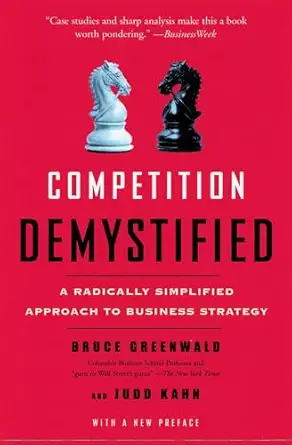
Competition Demystified Summary
By Bruce C. Greenwald & Judd Kahn
A Radically Simplified Approach to Business Strategy
Summary preview
Most books on strategy make competition sound like a grand chess match played by geniuses who can see ten moves ahead. This book takes a different path. It says that if you want to understand competition, stop staring at elegant theories that assume perfect markets, perfect information, and endless complexity. Start with the world as it really is. Start with ordinary businesses trying to earn returns above the cost of capital. Start with a simple question. Why do some companies manage to protect those returns while others are dragged back down to mediocrity? That is the heart of the argument from Bruce C. Greenwald & Judd Kahn. They strip strategy down to something practical and surprisingly human. They tell you that most of what matters in competition can be understood by looking for barriers to entry. If rivals can easily come in and copy what you do, then any success you have will be competed away. If they cannot, then you may have a genuine strategic position. It is not magic. It is not a buzzword. It is a barrier that keeps competitors from taking your customers, your margins, or your future. The book keeps returning to one central idea. There are only a few kinds of competitive advantage that truly matter, and they are usually local, specific, and limited. That point alone clears away a lot of confusion. You do not need to believe that every great company has an all purpose superpower. You do not need to assume a business can dominate everywhere just because it dominates somewhere. Competitive advantage often depends on customer captivity, production advantages, or economies of scale in a particular market. Those advantages are often narrow. They have edges. They can be measured. They can also disappear if managers misunderstand them. What makes the book vivid is that it does not stay in the clouds. It walks through real businesses and asks plain questions. Why is one newspaper stronger than another? Why can one local distributor flourish while a national giant struggles? Why do some consumer brands have pricing power while others are just expensive costumes on ordinary products? For example, the book looks closely at firms such as Wal Mart, Intel, and several media and manufacturing businesses to show how advantage works on the ground. Along the way, the authors challenge the fashionable obsession with growth, diversification, and managerial heroics. Growth is not always good. Bigger is not always better. A company that expands outside its protective boundaries can weaken the very advantage that made it successful. Good strategy, then, is less about conquest than about clarity. It is about understanding where your shelter comes from, where it ends, and what actions strengthen or endanger it. By the time you settle into this book, you begin to feel a pleasant change in perspective. Competition no longer looks mysterious. It looks disciplined. It looks like something you can analyze. And once you can analyze it, you can make better judgments about businesses, managers, investments,...
Sign up to continue reading
Get access to full book summaries, audio of the summaries, and many more.
Similar Books
Books with a similar vibe—explore more like this.
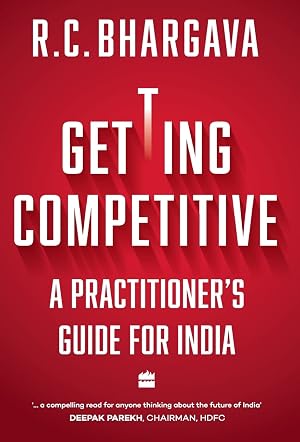
Getting Competitive
R C Bhargava
A Practitioner's Guide for India
3.6 (10) mins

The Brand Benefits Playbook
Allen Weiss, Debbie J. MacInnis
Why Customers Aren't Buying What You're Selling--And What to Do About It
4.8 (803)20 mins
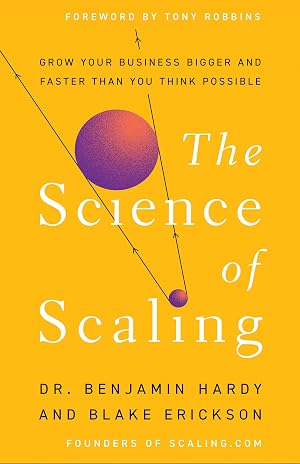
The Science of Scaling
Benjamin Hardy, Blake Erickson
Grow Your Business Bigger and Faster Than You Think Possible
4.8 (22) mins

The Heart of Transformation
Michael J. Leckie
Build the Human Capabilities That Change Organizations for Good
4.7 (64) mins
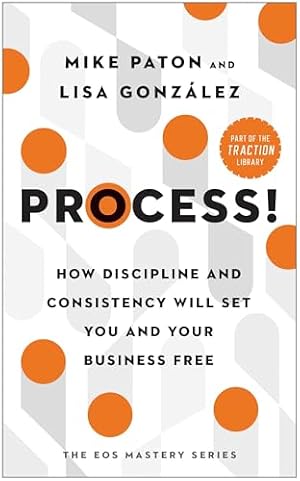
Process!
Mike Paton, Lisa González
How Discipline and Consistency Will Set You and Your Business Free
4.6 (5) mins
The Startup Lifecycle
Gregory Shepard
The Definitive Guide to Building a Startup from Idea to Exit
4.5 (346)21 mins

High Growth Handbook
Elad Gil
Scaling Startups from 10 to 10,000 People
4.5 (413)19 mins
7 Principles of Transformational Leadership
Hugh Blane
Create a Mindset of Passion, Innovation, and Growth
4.5 (14) mins

Grow the Pie
Alex Edmans
How Great Companies Deliver Both Purpose and Profit
4.5 (16) mins
The Diary of a CEO
Steven Bartlett
The 33 Laws of Business and Life
4.4 (628)25 mins