
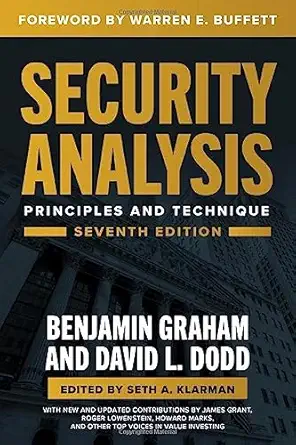
Security Analysis Summary
By Benjamin Graham & David Dodd
Principles and Techniques
Summary preview
There are books that promise to make you rich, and there are books that try to make you sensible. Security Analysis belongs firmly to the second kind. Benjamin Graham & David Dodd do not invite you into a world of glitter, prophecy, or market excitement. They invite you into a workshop. On the bench before you lie balance sheets, income accounts, bond indentures, dividend records, appraisals, and market quotations. The task is not to dream, but to judge. The point is not to guess what the crowd will do tomorrow. The point is to decide what a security is worth, what claims stand behind it, and how much protection the buyer truly has. The book was born from a hard lesson taught by financial history. Markets can become wild, hopeful, careless, and then cruel. Prices can rise far above reason and later collapse with shocking speed. When that happens, the investor who relied on fashion, easy assurances, or rosy forecasts finds that very little stands between him and loss. But the investor who examined facts, demanded a margin of safety, and understood the difference between investment and speculation has a far better chance of survival. That practical spirit runs through every chapter. You are asked again and again to return from appearances to substance, from quotations to assets, from promises to coverage, and from opinion to evidence. At the heart of the book is a simple but powerful idea. A security is not a piece of paper to be traded merely because its price moves. It is a claim. A bond is a claim on earnings and assets under stated terms. A preferred stock is a claim with its own rights and limits. A common stock is a partial ownership in a business, with all the risks and possibilities that ownership involves. Once you see securities this way, speculation begins to lose some of its magic. The question becomes not, Will someone pay more next month, but rather, What is here now, and how well am I protected if things go badly? That is why the book gives so much attention to financial strength, earnings stability, asset values, and the legal position of each class of claimant. It also explains why broad labels can be dangerous. A railroad bond, a utility bond, an industrial bond, a preferred share, a common stock with a long dividend record, and a common stock selling below net current assets may all demand different treatment. Sound analysis must be adapted to the nature of the issue and to the conditions surrounding it. Yet this is not dry bookkeeping for its own sake. It is a way of building independence of mind. The market may shout, brokers may praise, management may publish cheerful reports, and commentators may turn every fluctuation into a grand story. Still, you are urged to ask calm questions. What does the business earn over time? What does it own? How much debt stands ahead of me? What has happened in adversity? How...
Sign up to continue reading
Get access to full book summaries, audio of the summaries, and many more.