
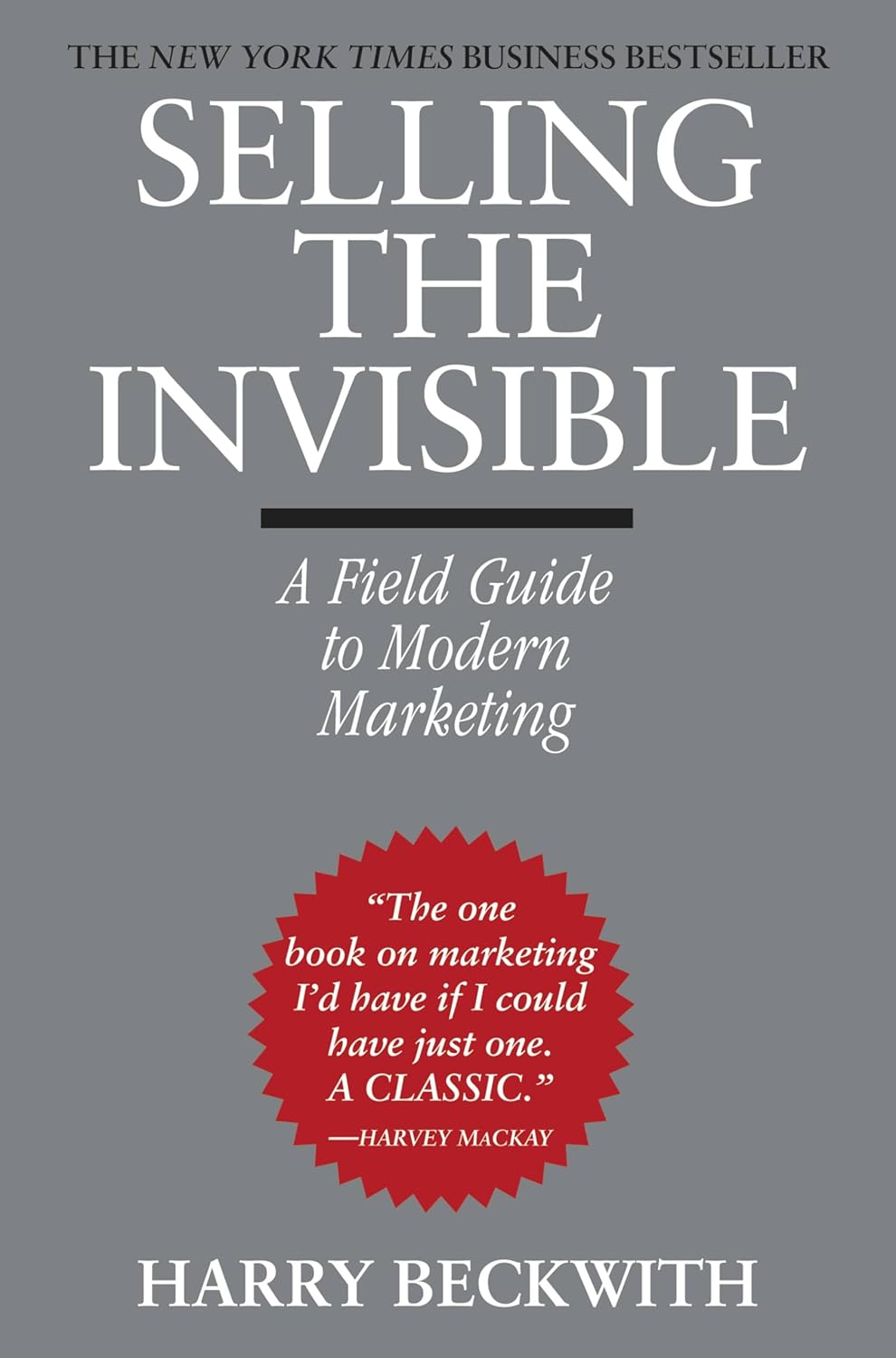
Selling the Invisible Summary
By Harry Beckwith
A Field Guide to Modern Marketing
Summary preview
Most people feel comfortable selling things they can point to. A car. A watch. A loaf of bread. You can hold it, test it, compare it, stack it on a shelf, and tell a neat little story about why yours is better. Services are different. You cannot touch consulting, accounting, design, legal advice, financial planning, health care, or advertising. You cannot put a service in a shopping cart and admire the shine. You buy a promise, a performance, a relationship, a hope. That is what makes service marketing both maddening and fascinating. Selling the Invisible is a practical guide to that challenge. Harry Beckwith argues that most of what modern economies sell is invisible, and yet many businesses still market services as if they were products. They focus on features when buyers are really looking for reassurance. They obsess over what they do and ignore how it feels to buy from them. They think quality speaks for itself, even though customers often cannot judge quality directly. So people use clues instead. They judge the office, the phone call, the website, the waiting room, the proposal, the confidence of the staff, the price, the stories they hear, and the promises that are made. The book keeps returning to one powerful idea. When buyers cannot evaluate the thing itself, they evaluate the signs around it. That means every detail markets your service. Your name markets it. Your clothes market it. Your punctuality markets it. The way you answer a question markets it. Even your silence markets it. In service businesses, marketing is not a department. It is the whole experience. What makes this book memorable is its style. It does not bury you under theory. It moves in quick, sharp insights. One moment you are reading about pricing, the next about trust, then about why being nice is not enough, then about why clients rarely choose the best option in some objective sense. They choose what feels safer, clearer, and easier to believe. For instance, a higher price can signal confidence and quality. A simple message can beat a technically accurate one. A strong reputation can do more than a clever campaign. The deeper purpose here is not just to help you get more customers. It is to help you see your business from the customer’s side. Buyers are uncertain. They are busy. They are often unable to compare one service with another in any meaningful way. They fear making a mistake. So the winning service firm does not merely perform well. It reduces anxiety. It makes the intangible more tangible. It gives people reasons to trust before they have proof. That is the heart of the book. If you sell something people cannot see, then your job is to make value visible, confidence natural, and the entire encounter feel true before it can ever be measured.
Sign up to continue reading
Get access to full book summaries, audio of the summaries, and many more.
Similar Books
Books with a similar vibe—explore more like this.
B2B Customer Experience
Paul Hague & Nicholas Hague
A Practical Guide to Delivering Exceptional CX
4.7 (4)26 mins
Relationship Currency
Ravi Rajani
Five Communication Habits For Limitless Influence and Success
4.7 (34)21 mins
Crucial Conversations
Kerry Patterson, Joseph Grenny, Ron McMillan, Al Switzler
Tools for Talking When Stakes Are High
4.3 (658)32 mins
Communicate in a Crisis
Kate Hartley
Understand, Engage and Influence Consumer Behaviour to Maximize Brand Trust
4.3 (312)29 mins
The Brand Benefits Playbook
Allen Weiss, Debbie J. MacInnis
Why Customers Aren't Buying What You're Selling--And What to Do About It
4.8 (803)20 mins
Cold Calling Sucks (And That's Why It Works)
Nick Cegelski, Armand Farrokh
A Step-by-Step Guide to Calling Strangers in Sales
4.8 (459)20 mins
The Science of Scaling
Benjamin Hardy, Blake Erickson
Grow Your Business Bigger and Faster Than You Think Possible
4.8 (22)20 mins

Made to Stick
Chip Heath and Dan Heath
Why Some Ideas Survive and Others Die
4.7 (573)34 mins

The Science of Selling
David Hoffeld
Proven Strategies to Make Your Pitch, Influence Decisions, and Close the Deal
4.7 (188)25 mins
The Leader Lab
Tania Luna and LeeAnn Renninger
Core Skills to Become a Great Manager, Faster
4.7 (79)24 mins