
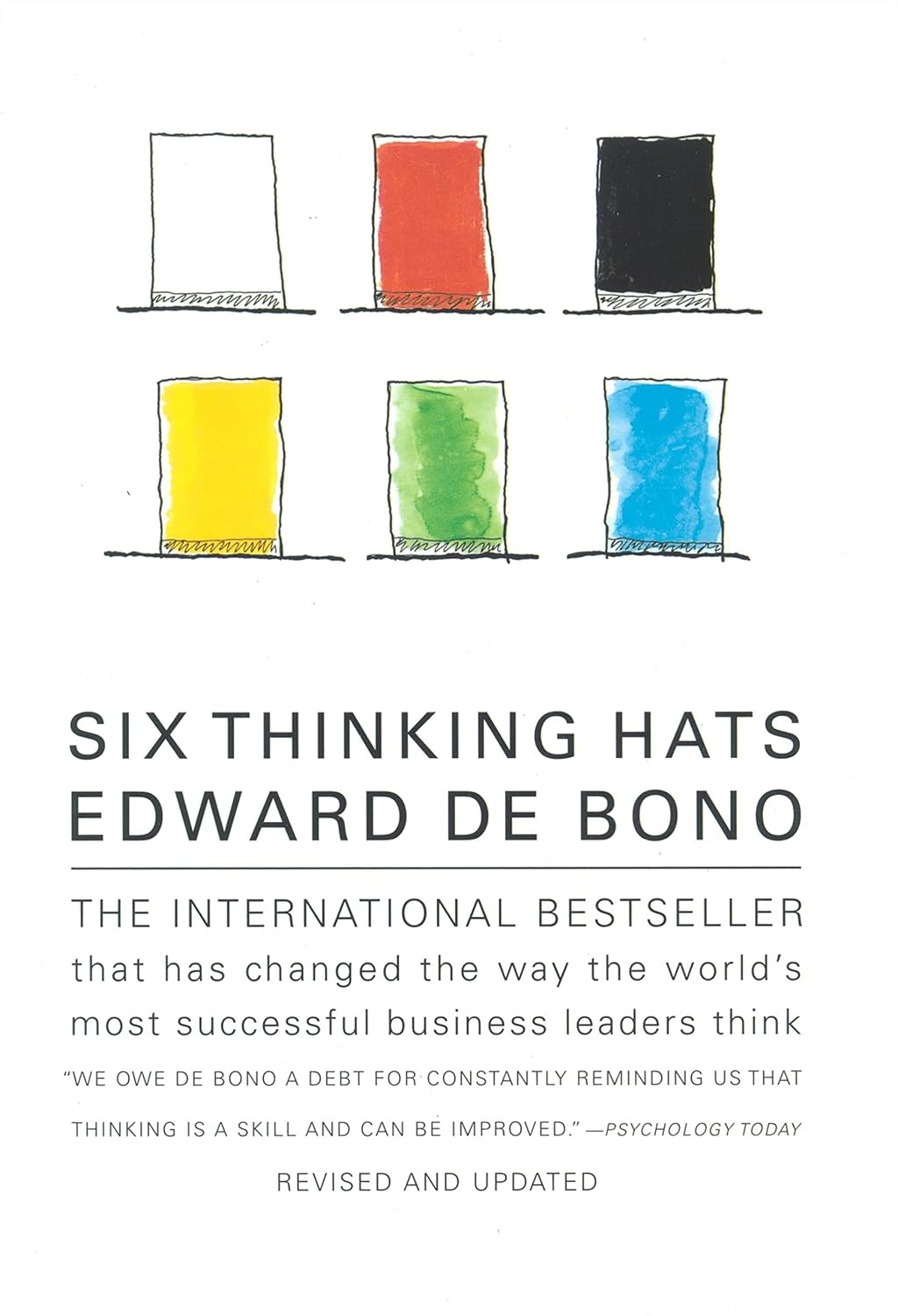
Six Thinking Hats Summary
By Edward de Bono
A revolutionary approach to get the most out of working in a group
Summary preview
Most people believe that thinking is something you simply do. You face a problem, you argue, you defend your view, and you hope that somewhere in the noise a good answer appears. But that usual way of thinking is clumsy, wasteful, and often downright foolish. We confuse ego with judgment. We mix feelings with facts without noticing. We jump to criticism before an idea has had a chance to breathe. We try to do everything at once, and because of that, we do very little well. The central purpose of Six Thinking Hats is to replace that confusion with a simple practical method. Edward de Bono offers a tool that helps people think together without the usual battles. Instead of using thought as a weapon, he asks us to use it as a map. The hats are not labels for people. They are directions for attention. At one moment, everyone looks at facts. At another moment, everyone explores risks. Then everyone searches for value, or generates possibilities, or notices feelings. By separating these modes, thinking becomes clearer, faster, and far more constructive. The idea is beautifully simple. Imagine that thinking has six distinct styles, and give each one a colored hat. White deals with information and what is known or needed. Red gives permission for emotion, intuition, and immediate reaction. Black looks for caution, difficulty, and why something may not work. Yellow seeks value, benefit, and reason for optimism. Green invites creativity, movement, and alternatives. Blue stands above the process and manages the thinking itself. Once you can deliberately put on one hat at a time, you stop being trapped by habit. This is not a theory for psychologists. It is a practical operating system for daily thinking, especially in meetings, conversations, decisions, and problem solving. It can be used by business leaders, teachers, families, governments, and children. That wide usefulness matters because bad thinking is expensive everywhere. It wastes time, hardens conflict, and blocks invention. Good thinking, by contrast, does not need to be mysterious. It can be designed. One of the most important shifts in the book is from argument to what is called parallel thinking. Instead of one person pushing one point while another pushes the opposite, everyone looks in the same direction at the same time. You can still disagree, but the structure changes the energy. The goal is not to win. The goal is to see. That is the promise running through the whole book. Thinking can be made visible. It can be taught. It can be simplified without being made simplistic. And once you learn to switch hats deliberately, you gain a freedom that ordinary discussion rarely gives you. You are no longer trapped inside one mood, one role, or one fixed position. You become able to think more completely, and just as important, to help others do the same.
Sign up to continue reading
Get access to full book summaries, audio of the summaries, and many more.
Similar Books
Books with a similar vibe—explore more like this.
Too Fast to Think
Chris Lewis
How to Reclaim Your Creativity in a Hyper-connected Work Culture
3.8 (16)20 mins
Believe It to Achieve It
Brian Tracy, Christina Stein
Overcome Your Doubts, Let Go of the Past, and Unlock Your Full Potential
4.8 (32)22 mins
Othello
William Shakespeare
Love, Betrayal, and the Fall of a Hero
4.8 (14)22 mins
We Have Always Lived in the Castle
Shirley Jackson
Enter a Disturbing Labyrinth of Family Secrets and Dark Neurosis
4.8 (5)14 mins
Presentation Advantage
Kory Kogon, Breck England and Julie Schmidt
How to Inform and Persuade Any Audience
4.7 (72)19 mins
The New Emotional Intelligence
Travis Bradberry
Master your emotional skills for lasting success
4.7 (48)22 mins
Write Your Book in a Flash
Dan Janal
The Paint-by-Numbers System to Write the Book of Your Dreams—FAST!
4.7 (31)27 mins
How to Think Like Leonardo da Vinci
Michael J. Gelb
Seven Steps to Genius Every Day
4.6 (180)25 mins
The Person You Mean to Be
Dolly Chugh
How Good People Fight Bias
4.6 (231)34 mins
The Human Edge
Greg Orme
How Curiosity And Creativity Are Your Superpowers In The Digital Economy
4.6 (595)26 mins