
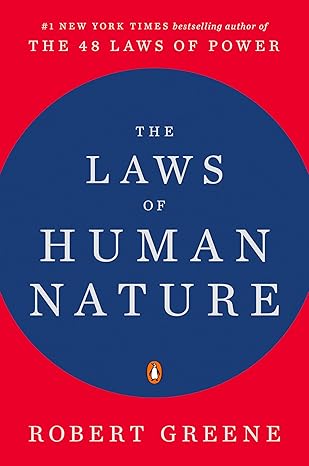
The Laws of Human Nature Summary
By Robert Greene
What affects your day-to-day life
Summary preview
Human beings like to imagine that they are rational, self aware, and mostly in control of what they do. That is the comforting story. But if you look closer at your own life, at politics, at love, at work, at war, at family drama, you see another picture. People are moved by emotions they do not understand, by wounds from childhood they never faced, by hidden desires, by envy, vanity, fear, aggression, and hunger for power. They make excuses after the fact and call it reason. They act out patterns again and again and call it fate. This is the territory of The Laws of Human Nature, where Robert Greene asks you to become a different kind of observer, less naive, less offended, less easily fooled, and far more capable of handling the strange creatures around you, including yourself. The book is built on a hard truth and a hopeful one. The hard truth is that human nature does not change much. Technology changes, customs change, words change, but beneath all of that people still crave status, still take things personally, still wear masks, still follow the crowd, still dream of power and recognition, still sabotage themselves through insecurity and emotion. The hopeful truth is that once you begin to see these forces clearly, you are no longer their passive victim. You can step back. You can read the moods of others. You can soften conflict before it explodes. You can resist manipulation. You can discover your own deeper motives and become more disciplined, more strategic, and more empathetic at the same time. What makes the book vivid is that it never stays in theory for long. It moves through stories of rulers, artists, generals, reformers, seducers, con artists, and ordinary people caught in emotional storms. For example, you meet figures such as Pericles, Queen Elizabeth the First, Martin Luther King Junior, Abraham Lincoln, Anton Chekhov, and many more, each of them revealing some recurring law of behavior. These stories are not decorative. They are the evidence. They show how the same patterns repeat across centuries and cultures. At the center of the book is a practical ambition. The goal is not to become cynical or cold. It is to become realistic and awake. You are meant to understand the irrational side of yourself, the masks people wear, the games of status, the dangers of envy and group madness, the traps of short sightedness, and the need to develop a larger sense of purpose. If you can do this, you gain a rare advantage. You stop reacting blindly. You stop taking every slight personally. You stop expecting people to be simpler and nobler than they are. And because you see more, you can influence more. You can navigate life with a calmer mind, a stronger character, and a deeper connection to reality.
Sign up to continue reading
Get access to full book summaries, audio of the summaries, and many more.
Similar Books
Books with a similar vibe—explore more like this.
Crucial Conversations
Kerry Patterson, Joseph Grenny, Ron McMillan, Al Switzler
Tools for Talking When Stakes Are High
4.3 (658)32 mins
The Psychology of Leadership
Sébastien Page
Timeless principles to perfect your leadership
4.0 (13)20 mins
Think Twice
Michael J. Mauboussin
Harnessing the Power of Counterintuition
3.8 (74)14 mins
Take Back Your Brain
Kara Loewentheil
How a Sexist Society Gets in Your Head - and How to Get It Out
3.6 (33) mins
Effective Decision-Making
Edoardo Binda Zane
How to Make Better Decisions Under Uncertainty and Pressure
3.6 (18)25 mins
Surrender to Lead
Jessica Kriegel, Joe Terry
The Counterintuitive Approach to Driving Extraordinary Results
4.9 (7) mins
Next Play
Alan Stein Jr.
Improve Team Performance, Productivity, and Fulfillment
4.9 (34)26 mins
The Gift of Struggle
Bobby Herrera
Life-Changing Lessons About Leading
4.8 (22)21 mins
The Opposite of Settling
Case Kenny
Get What You Want in Love and Life, Without Losing Your Spark
4.8 (13) mins
Believe It to Achieve It
Brian Tracy, Christina Stein
Overcome Your Doubts, Let Go of the Past, and Unlock Your Full Potential
4.8 (32) mins