
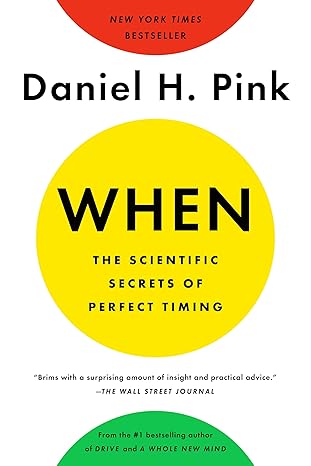
When Summary
By Daniel H. Pink
The Scientific Secrets of Perfect Timing
Summary preview
Most of us think timing is a side issue. We focus on what we do, how we do it, and who does it. Timing feels like the leftover question, the detail you deal with after the serious decisions are made. But the big idea of When is that timing is not a detail at all. It is a hidden force that shapes nearly everything we do. It affects when we wake, when we think clearly, when we make mistakes, when we get angry, when we solve problems, when we begin, and when we are ready to start again. We are all moving through time every day, yet many of us do it blindly. Daniel H. Pink takes that ordinary fact and turns it into something surprising and useful. He asks a simple question. What if the best moment to do something is not random or personal preference, but something we can understand with the help of research? What if there are better and worse times to hold a meeting, make a diagnosis, take a test, go to court, ask for a favor, quit a habit, begin a project, or end an experience? The answer, again and again, is yes. This book brings together findings from psychology, biology, economics, and sociology to show that timing has patterns. Those patterns do not control us completely, but they matter enough that ignoring them carries a real cost. You see this in schools where students perform differently depending on the hour of the exam. You see it in hospitals where dangerous errors rise at certain times of day. You see it in business, in sports, in relationships, and in personal change. The point is not that life can be reduced to a schedule. The point is that we can make wiser choices when we stop treating time as empty space. The book unfolds in three broad movements. First, it looks at the day itself and the way our internal clocks create rhythms of peak, trough, and recovery. Then it broadens to timing over a lifetime, asking why beginnings, midpoints, and endings have such power over motivation and meaning. Finally, it turns to how we can synchronize with other people, because timing is not only about the private self. It is also social. What makes this journey compelling is its mix of evidence and story. You get data, but you also get judges growing harsher before lunch, anesthesiologists using checklists to protect patients in the afternoon, school districts changing schedules, and people using fresh starts to transform their lives. The message is hopeful. We may not control time itself, but we can get better at choosing our moments. Once you see that, you begin to ask a different set of questions. Not just what should I do, but when should I do it. That question changes more than you might expect.
Sign up to continue reading
Get access to full book summaries, audio of the summaries, and many more.
Similar Books
Books with a similar vibe—explore more like this.
The Science of Self-Discipline
Peter Hollins
Resist Temptation and Achieve Your Goals
4.7 (71)20 mins
Your Brain at Work
David Rock
Strategies for Overcoming Distraction, Regaining Focus, and Working Smarter All Day Long
4.6 (1428)32 mins
Breaking The Habit of Being Yourself
Joe Dispenza
How to Lose Your Mind and Create a New One
4.5 (415)23 mins
How to Think More Effectively
The School of Life
A guide to greater productivity, insight and creativity
4.5 (909)23 mins
Productive Failure
Manu Kapur
Unlocking Deeper Learning Through the Science of Failing
4.5 (211)22 mins
Million Dollar Habits
Brian Tracy
Proven Power Practices to Double and Triple Your Income
4.5 (389) mins
The Happiness Advantage
Shawn Achor
The Seven Principles that Fuel Success and Performance at Work
4.4 (936)34 mins
The Power of Habit
Charles Duhigg
Why We Do What We Do in Life and Business
4.3 (3181)30 mins

Four Thousand Weeks
Oliver Burkeman
Time Management for Mortals
4.3 (653)31 mins
Get It Done
Ayelet Fishbach
Surprising Lessons from the Science of Motivation
4.3 (171) mins