
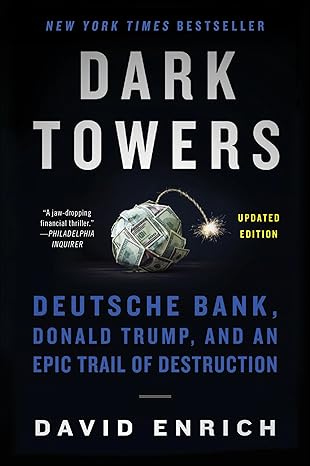
Dark Towers
By David Enrich
Deutsche Bank, Donald Trump, and an Epic Trail of Destruction
Introduction
Dark Towers tells a story that feels almost too strange, too reckless, and too dangerous to be real. Yet it is real, and that is what gives the book its charge. At the center stands Deutsche Bank, a huge institution that once wanted to prove it could sit beside the proudest names on Wall Street and in the City of London. It chased growth, glamour, and power with such force that caution often became an obstacle to be pushed aside. What follows is not just a tale about one bank making bad choices. It is a story about a culture that rewarded aggression, sidelined doubt, and treated rules as things to work around if they got in the way of profits. David Enrich builds this story like a thriller, but the heart of it is deeply human. Traders, executives, risk managers, lawyers, and regulators move through these pages, each bringing ambition, fear, pride, and self preservation. Some people try to stop the worst behavior and pay a price for it. Others rise by embracing the system exactly as it is. And through it all, the bank keeps finding itself attached to scandals that seem, at first glance, unrelated. Russian money laundering. Toxic mortgage securities. manipulation of benchmark interest rates. ties to Donald Trump when most big banks would not touch him. financing linked to Jared Kushner. surveillance of critics and investigators. one episode after another, and yet together they form a pattern. That pattern is the real subject of the book. The scandals are the surface. Underneath them is a set of habits and beliefs. Winning mattered more than almost anything else. Revenue gave people protection. Internal controls existed, but often as paperwork, not as a true brake. People who raised concerns could be ignored, overruled, or pushed out. Time and again, the institution seemed to learn the wrong lesson from disaster. Instead of asking what had gone rotten, it looked for ways to survive the headline, pay the fine, and move on. The title captures the mood perfectly. These are towers of money, status, and secrecy, but they are dark because so much inside them is hidden from ordinary view. They cast shadows far beyond the trading floor. Homeowners, investors, democratic institutions, and public trust all get pulled into the damage. The book asks a question that lingers long after the final page. How can a bank become so large, so connected, and so accustomed to escaping real accountability that misconduct starts to feel normal? What makes this account so gripping is that it never stays abstract. It keeps returning to people and choices. A risky deal gets approved. A warning is brushed aside. A client no one else wants becomes worth the trouble because the fees are rich enough. A whistleblower decides whether to speak. That is how the story unfolds, step by step, until you can see how a modern financial giant can become both indispensable and deeply dangerous.
Sign up to continue reading
Get access to full book summaries, audio of the summaries, and many more.
Similar Books
Books with a similar vibe—explore more like this.
The Bitcoin Standard
Saifedean Ammous
The Decentralized Alternative to Central Banking
4.6 (291)34 mins
Fooled by Randomness
Nassim Nicholas Taleb
The Hidden Role of Chance in Life and the Markets
4.6 (937)31 mins
Let My People Go Surfing
Yvon Chouinard
The Education of a Reluctant Businessman
4.6 (892)26 mins
Digital Gold
Nathaniel Popper
The Untold Story of Bitcoin
4.5 (240)21 mins

The Value of Debt in Building Wealth
Thomas J. Anderson
Creating Your Glide Path to a Healthy Financial L.I.F.E.
4.5 (262)19 mins
Thinking in Systems
Donella H. Meadows
A Primer
4.5 (1784)36 mins
The Big Short
Michael Lewis
Inside the Doomsday Machine
4.5 (1357)36 mins
Money: Master the Game
Tony Robbins
7 Simple Steps to Financial Freedom
4.5 (1785)30 mins
Utopia for Realists
Rutger Bregman
And How We Can Get There
4.5 (839)31 mins
Blockchain Revolution
Don Tapscott & Alex Tapscott
How the Technology Behind Bitcoin Is Changing Money, Business and the World
4.5 (483)26 mins