
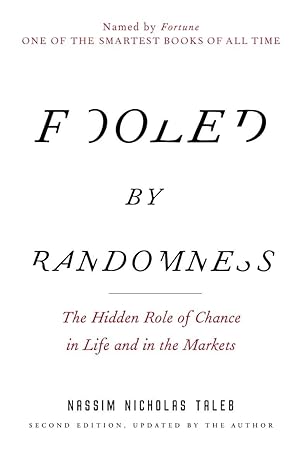
Fooled by Randomness Summary
By Nassim Nicholas Taleb
The Hidden Role of Chance in Life and the Markets
Summary preview
Life likes to play tricks on us. It hands out rewards in ways that look meaningful, then laughs quietly while we invent noble explanations for what was often little more than luck. That is the pulse of Fooled by Randomness. The book is not really about finance, though markets appear everywhere. It is not just about probability, though chance is the hidden ruler of nearly every page. It is about the human weakness of seeing patterns where none exist, of mistaking survival for skill, and of building our self respect on stories that collapse the moment luck changes direction. Nassim Nicholas Taleb writes like a trader who has read philosophers, distrusted economists, and spent too many years watching blowhards get rich for reasons they do not understand. He speaks with irritation, wit, vanity, vulnerability, and a sharp sense that modern life rewards the wrong sort of confidence. The result is a book that feels less like a classroom lecture and more like a brisk walk with someone who keeps pointing at things everyone else ignores. He wants you to notice the silent cemetery behind every visible winner. He wants you to understand that success can come from favorable odds without any real merit. He wants you to feel, almost physically, how dangerous it is to confuse a good outcome with a good decision. At the center of the book sits a simple but brutal insight. Randomness does not merely create noise around our plans. It often writes the script and then lets us pretend we were the authors. A trader makes money for years and believes he is a genius. A fund manager survives a bull market and is called prudent. A bestselling guru predicts one event correctly and is treated like a prophet. Meanwhile the countless people who made the same bet and failed are gone from view. We see the winners and construct theories around them. We almost never see the graveyard. The book moves from trading floors to philosophy, from personal humiliation to ancient skepticism, from mathematics to psychology. Along the way it examines luck, survivorship bias, skewed outcomes, narrative fallacy, emotional asymmetry, and the difference between what is visible and what is true. It also carries a moral mood. It is a defense of intellectual humility. It is a warning against the seduction of neat explanations. And it is an invitation to live in a way that is less fragile before the unexpected. If you stay with it, you begin to see that the biggest problem is not that chance exists. It is that we are built to deny its power. We crave causes, heroes, forecasts, and tidy lessons. This book keeps taking those toys away. It does so not to make you helpless, but to make you harder to fool.
Sign up to continue reading
Get access to full book summaries, audio of the summaries, and many more.
Similar Books
Books with a similar vibe—explore more like this.
Think Like a Freak
Steven D. Levitt and Stephen J. Dubner
Find the unconvential yet brilliant ideas hidden in data
4.4 (69) mins
The Winner's Curse
Richard H. Thaler, Alex O. Imas
Behavioral Economics Anomalies Then and Now
4.3 (11) mins
An Economist Walks into a Brothel
Allison Schrager
And Other Unexpected Places to Understand Risk
4.2 (275)22 mins
A Field Guide to Lies
Daniel J. Levitin
Critical Thinking with Statistics and the Scientific Method
4.2 (20)22 mins

Trading in the Zone
Mark Douglas
Master the Market with Confidence, Discipline, and a Winning Attitude
4.2 (118) mins
Everybody Lies
Seth Stephens-Davidowitz
Big Data, New Data and What the Internet Can Tell Us About Who We Really Are
4.0 (593)26 mins

Command and Control
Eric Schlosser
Nuclear Weapons, the Damascus Accident, and the Illusion of Safety
4.9 (14) mins
This Is How They Tell Me the World Ends
Nicole Perlroth
The Cyberweapons Arms Race
4.8 (64)33 mins

Widen the Window
Elizabeth A. Stanley
Training Your Brain and Body to Thrive During Stress and Recover from Trauma
4.8 (158) mins
The Screwtape Letters
C.S. Lewis
Letters from a Senior to a Junior Devil
4.8 (47) mins