Full Book Summary of Doughnut Economics by Kate Raworth
By Kate Raworth
Seven Ways to Think Like a 21st-Century Economist
Preview
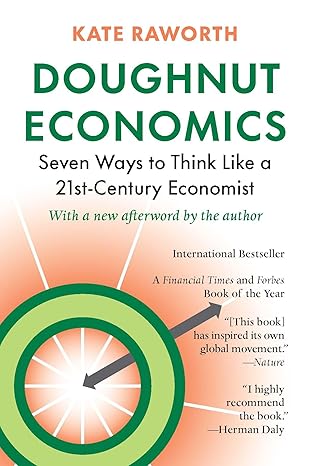
Economics shapes the way we live, but for many people it has come to feel like a strange language spoken by experts behind closed doors. We are told that growth must rise, markets know best, and human well being will somehow follow if the numbers are right. Yet all around us we can see a different story. Inequality deepens. Climate breakdown accelerates. Millions still lack food, housing, healthcare, political voice, and security, even in countries praised for their economic success. At the same time, the living world is pushed beyond its limits. The promise that standard economics would deliver shared prosperity without wrecking the planet has not been kept. That is the starting point of this book. It asks a beautifully simple question. What if the economy were designed not to grow forever, but to help humanity thrive in balance with the Earth. From that question comes the image that gives the book its name, the doughnut. Picture two circles. The inner circle marks the social foundation every person should be able to stand on, including food, water, health, education, income, peace, justice, energy, housing, gender equality, and political voice. Fall below that inner ring and people are left in deprivation. The outer circle marks the ecological ceiling we must not overshoot, including climate change, biodiversity loss, land conversion, chemical pollution, and ocean acidification. Go beyond that outer ring and we damage the living systems that support life. Between those two rings lies the safe and just space for humanity. The book is a challenge, a provocation, and a redesign manual all at once. It does not simply criticize old ideas. It shows how deeply they have shaped public debate, policy, education, and our own imagination. It asks us to look again at the diagrams, metaphors, and assumptions that have...