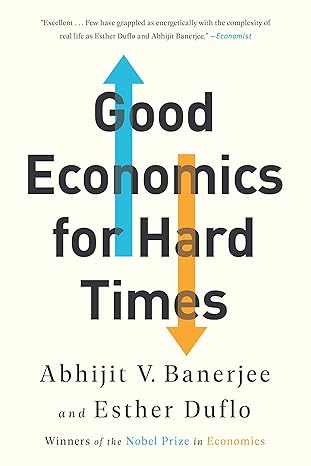
Full Book Summary of Good Economics for Hard Times by Abhijit Banerjee & Esther Duflo
By Abhijit Banerjee & Esther Duflo
Better Answers to Our Biggest Problems
Preview
Hard times make people want simple answers. When jobs feel shaky, when inequality grows, when migration becomes a political storm, when trade seems to help some and hurt others, it is comforting to hear someone say they know exactly what is wrong and exactly how to fix it. This book begins by pushing back against that temptation. The world economy is not a machine with one broken part. It is a tangled web of people, rules, fears, hopes, mistakes, and institutions. If we want better answers, we need patience, evidence, and a willingness to distrust grand slogans. That is the spirit running through Good Economics for Hard Times by Abhijit Banerjee & Esther Duflo. The book takes on the biggest economic arguments of our age, not with cold certainty, but with curiosity and discipline. It asks what really happens when immigrants arrive, when trade opens up, when growth slows, when technology replaces workers, when climate change threatens livelihoods, and when governments try to help the poor. Again and again, the argument is the same. The easy story is usually wrong, or at least dangerously incomplete. Human beings do not behave like neat equations. They carry identities, attachments, fears of loss, and limited information. Policies that ignore this reality often fail, even when the theory looks elegant. The book also has a moral aim. It is not content to measure national income and move on. It asks who gains, who loses, and why the losses are often brushed aside. A society can get richer and still leave millions feeling betrayed. A policy can make sense on average and still wreck the life of a particular town, worker, or family. That gap between what looks efficient and what feels just is one of the book's deepest concerns. Yet this is not a...