Full Book Summary of The Only Game In Town by Mohamed A. El-Erian
By Mohamed A. El-Erian
Central Banks, Instability, And Avoiding The Next Collapse
Preview
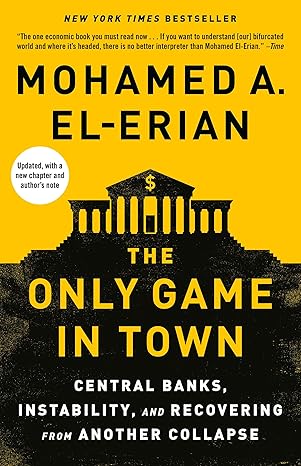
For years after the global financial crisis, many of us lived inside an economic experiment that felt both extraordinary and strangely normal. Growth was weak, wages disappointed, inequality widened, politics turned bitter, and yet financial markets often floated higher. If that sounds like a contradiction, that is exactly the puzzle at the heart of this book. The world kept looking to central banks to rescue economies that were struggling with much deeper problems. Interest rates were pushed down to near zero, then below zero in some places. Massive bond buying became routine. Financial markets learned to hang on every word from a handful of policy makers. What began as emergency medicine slowly turned into a way of life. That is the landscape Mohamed A. El-Erian wants you to see clearly. His argument is simple, but it has enormous consequences. Central banks became "the only game in town" not because they were all powerful, but because other policy makers stepped back. Governments failed to deliver the structural reforms, smart fiscal measures, better education, stronger infrastructure, and fairer opportunity that healthy economies need. So central banks were asked to do more and more with tools that were never designed to solve all these problems. They helped prevent collapse, and that matters greatly. But over time, relying on them too heavily created distortions, fed financial risk taking, encouraged political complacency, and deepened the gap between Wall Street and Main Street. The book moves through this story with the voice of someone who has sat close to the center of events and who understands both the machinery of policy and the human consequences of getting it wrong. It is not a narrow technical discussion. It is a broad account of how economics, markets, politics, and society became tangled together in the years after the...