
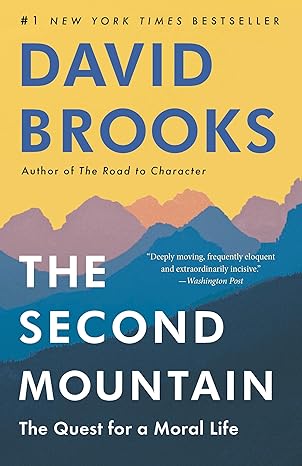
The Second Mountain Summary
By David Brooks
The Quest for a Moral Life
Summary preview
Most of us begin life by climbing what could be called the first mountain. We chase success, build a career, try to become impressive in the eyes of others, and gather the prizes our culture tells us to want. We work hard for freedom, comfort, status, and personal fulfillment. Sometimes that climb feels exciting. Sometimes it feels noble. It gives shape to our days and a scorecard for our efforts. But often, after all that striving, a quiet sadness appears. The life that looked so full from the outside can feel thin from the inside. You may find yourself asking whether happiness, achievement, and self expression are enough to hold a whole life together. That is the territory this book enters. David Brooks explores the moment when people discover there is another way to live. Usually that discovery comes after some kind of valley. A failure, a disappointment, a divorce, a death, a spiritual emptiness, a moral collapse, or simply the dull ache of a life organized around the self. In the valley, your old language stops working. Your old ambitions lose their shine. You begin to see that the self centered life, however polished, cannot answer the deepest human hunger. It cannot satisfy the longing to belong, to give, to love, and to be bound to something larger than your own desires. The second mountain is the mountain of commitment. It is the life you enter when you stop asking, What can life give me, and begin asking, What is life asking of me. It is built not on individual freedom alone, but on vows. Vows to another person in marriage. Vows to children and family. Vows to a community. Vows to a calling. Vows to faith and moral purpose. These commitments limit you, yes, but they also free you. They anchor you. They give you identity. They rescue you from the loneliness of living only for yourself. What makes this book memorable is that it is not only an argument. It is also a confession, a social diagnosis, and a guide. It moves from personal story to moral philosophy, from cultural criticism to portraits of people who have built thick, generous lives. It asks why modern society has become lonely, fragmented, and mistrustful. It asks what kind of character can heal that damage. And it suggests that joy is found less in self construction than in self donation. The pages ahead trace that movement carefully. They begin with the false promise of the first mountain and the hard lessons of the valley. Then they explore the four great commitments that can build a meaningful life. Along the way, they show that the strongest people are often the most bound people, and that the fullest lives are woven from responsibility, love, and service.
Sign up to continue reading
Get access to full book summaries, audio of the summaries, and many more.
Similar Books
Books with a similar vibe—explore more like this.
The Four Agreements
Don Miguel Ruiz & Janet Mills
A Practical Guide to Personal Freedom
4.3 (913)21 mins
The Yoga Sutras of Patanjali
Translated and commentated on by Sri Swami Satchidananda
Timeless Teachings for Mind, Body, and Emotional Harmony
4.8 (320)32 mins
Sovereign Self
Acharya Shunya
Claim Your Inner Joy and Freedom with the Empowering Wisdom of the Vedas, Upanishads, and Bhagavad Gita
4.8 (114) mins
The Art of Simple Living
Shunmyo Masuno
100 Daily Practices from a Japanese Zen Monk for a Lifetime of Calm and Joy
4.7 (1002)26 mins
The Midnight Library
Matt Haig
A Fantasy Novel About the Choices That Lead to a Life Well-Lived
4.7 (4782)32 mins
The Book of Five Rings
Miyamoto Musashi
A Classic Text on the Japanese Way of the Sword
4.7 (293)23 mins
Uncle Tom's Cabin
Harriet Beecher Stowe
The Problem of Slavery and Its Treatment of Human Beings
4.7 (41)25 mins
Understanding and Responding to Self-Harm
Allan House
The One Stop Guide: Practical Advice for Anybody Affected by Self-Harm
4.6 (351)21 mins
The Art of Living
Thich Nhat Hanh
Peace and Freedom in the Here and Now
4.6 (674)28 mins
The Divine Comedy
Dante Alighieri
The Inferno, The Purgatorio, and The Paradiso
4.6 (457)27 mins