
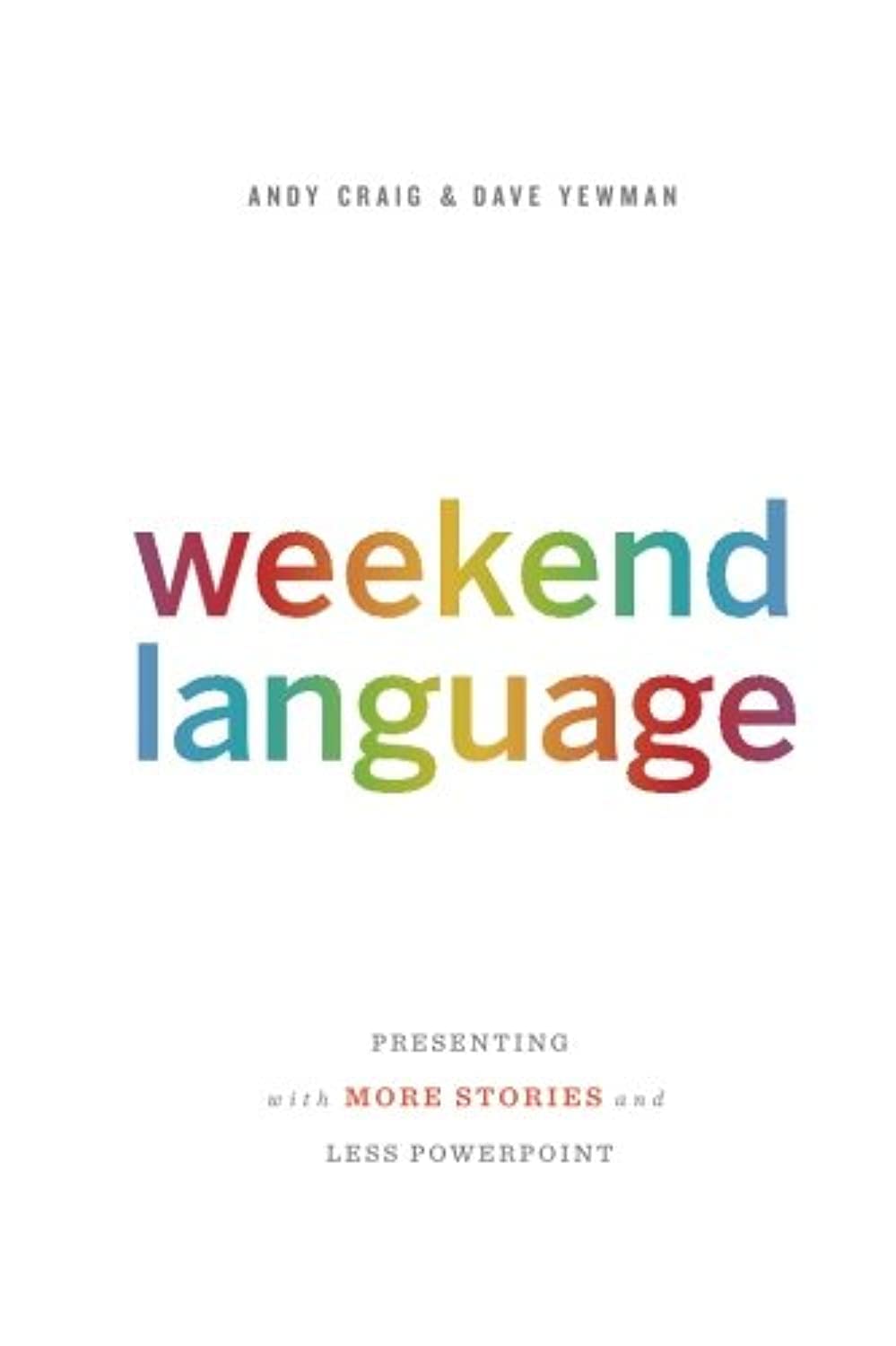
Weekend Language Summary
By Andy Craig, Dave Yewman
Presenting with More Stories and Less PowerPoint
Summary preview
Weekend Language is a smart, playful guide to one of the strangest little habits in modern life. We all do it. We say one thing Monday through Friday, then switch our tone, our words, even our whole personality when the weekend arrives. At work we are careful, polished, efficient. On Saturday afternoon we are looser, louder, more personal, and often much more honest. This book takes that split and turns it into a lens for understanding how language really works in everyday life. Andy Craig and Dave Yewman treat speech not as a fixed rulebook but as a living performance. They are interested in the gap between official language and human language. One belongs to meetings, memos, public statements, customer service scripts, and all the tidy little phrases people use when they want to sound proper. The other belongs to the backyard, the bar, the family table, the game on television, the text thread, the sudden joke, and the half serious complaint. The book asks a simple but revealing question. Why do we trust one voice more than the other? Their answer unfolds with humor and sharp observation. People are hungry for language that sounds real. They can spot puffed up words, stale slogans, and empty professional chatter almost instantly. At the same time, they know that pure casual talk is not enough for every situation. We need both kinds of language. We need order and freedom, polish and personality. The trick is knowing when language is helping us connect and when it is hiding us. That is the real heart of the book. It is not just about slang or weekend small talk. It is about authenticity, persuasion, and power. Language shapes relationships. It can make people feel included or shut out. It can calm fear or stir it up. It can make a leader sound human or make a human sound like a machine. The book keeps returning to the idea that words are never neutral. They reveal priorities, attitudes, class signals, and emotional distance. As the pages move along, the authors explore how people code switch between public and private selves, how institutions train us to speak in safe formulas, and how much gets lost when speech becomes too managed. They also show how wit, story, and everyday phrasing can cut through noise better than stiff correctness ever could. What you get is part cultural commentary, part language manual, and part invitation to listen more closely to what people really mean when they speak. By the end, you are not just hearing words. You are hearing posture, fear, desire, belonging, and the wish to be believed.
Sign up to continue reading
Get access to full book summaries, audio of the summaries, and many more.
Similar Books
Books with a similar vibe—explore more like this.
Cold Calling Sucks (And That's Why It Works)
Nick Cegelski, Armand Farrokh
A Step-by-Step Guide to Calling Strangers in Sales
4.8 (459)20 mins
B2B Customer Experience
Paul Hague & Nicholas Hague
A Practical Guide to Delivering Exceptional CX
4.7 (4)26 mins
Relationship Currency
Ravi Rajani
Five Communication Habits For Limitless Influence and Success
4.7 (34)21 mins
Sell Like A Spy
Jeremy Hurewitz
The Art of Persuasion from the World of Espionage
4.5 (312)21 mins
Getting to Yes
Roger Fisher, William Ury & Bruce Patton
Negotiating an Agreement Without Giving In
4.5 (883)36 mins
Click Here
Alex Schultz
The Art and Science of Digital Marketing and Advertising
4.4 (6)25 mins
Crucial Conversations
Kerry Patterson, Joseph Grenny, Ron McMillan, Al Switzler
Tools for Talking When Stakes Are High
4.3 (658)32 mins
Hook Point
Brendan Kane
How to Stand Out in a 3-Second World
4.3 (233)22 mins
How to Master the Art of Selling
Tom Hopkins
Boost Your Sales Skills With Proven Strategies and Techniques
4.3 (22)25 mins
Email Marketing Demystified
Matthew Paulson
A Step-By-Step Guide to Building a Massive Mailing List, Writing Copy That Converts and Generating More Sales Through Email Mark
3.5 (4)23 mins