
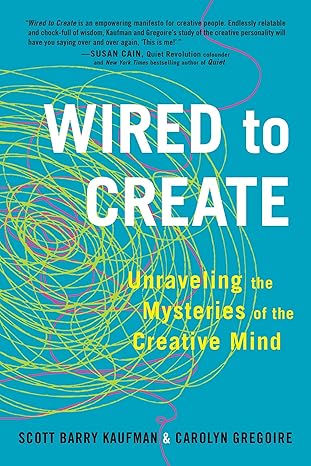
Wired to Create Summary
By Scott Barry Kaufman
Unraveling the Mysteries of the Creative Mind
Summary preview
Creativity is often treated like a rare gift, something handed out to a lucky few at birth. We tell stories about geniuses who seem touched by magic, as if they woke up one day overflowing with original ideas while the rest of us were left to admire them from a distance. But Wired to Create asks you to look again. It invites you to see creativity not as a single talent, not as a neat personality type, and not as a mysterious force that belongs only to artists, inventors, or rebels. Instead, it shows creativity as a rich way of engaging with life, a way of thinking, feeling, noticing, and connecting that is available to far more people than we usually imagine. Scott Barry Kaufman explores the minds and lives of highly creative people with a deep curiosity and a very human touch. The goal is not to flatten creativity into a formula. In fact, one of the most important messages here is that creativity resists simple formulas. Creative people are often bundles of contradictions. They can be playful and disciplined, dreamy and focused, open to experience yet stubbornly devoted to their vision. They may break rules while also mastering them. They can feel deeply vulnerable and yet boldly expressive. If you try to reduce creativity to one trait, one habit, or one brain region, it slips away. What this book does beautifully is gather together psychology, neuroscience, personality research, and vivid stories from real lives to build a more complete picture. You begin to see that creativity grows out of a certain kind of mental openness, an ability to make unusual connections, a willingness to explore the unknown, and the courage to turn inner chaos into something meaningful. You also see that the creative life is not always easy. It can involve self doubt, sensitivity, loneliness, and risk. But those same qualities can become sources of depth, originality, and transformation when they are understood and channeled. Rather than offering shallow advice about how to become a genius by next Tuesday, the book asks bigger and better questions. What personality traits support creative achievement. How do imagination and daydreaming contribute to insight. Why do some people turn pain into art. What role do play, intuition, solitude, and mindfulness have in the creative process. And how can we build lives and environments that help originality thrive. As you move through these ideas, you are encouraged to stop thinking of creativity as a distant performance by extraordinary people and start seeing it as a living process. It shows up in art, science, business, relationships, and personal growth. It can emerge in a poem, a theory, a classroom, a kitchen, or a quiet decision to live more truthfully. The heart of the book is simple and powerful. Creativity is not a luxury. It is one of the deepest expressions of being fully human.
Sign up to continue reading
Get access to full book summaries, audio of the summaries, and many more.
Similar Books
Books with a similar vibe—explore more like this.

The Song of Roland
Anonymous
Enter a World of Medieval Heroism, Where Honor Reigns Supreme
4.9 (3) mins
Othello
William Shakespeare
Love, Betrayal, and the Fall of a Hero
4.8 (14) mins
We Have Always Lived in the Castle
Shirley Jackson
Enter a Disturbing Labyrinth of Family Secrets and Dark Neurosis
4.8 (5) mins
Show Your Work!
Austin Kleon
10 Ways to Share Your Creativity and Get Discovered
4.7 (1129)26 mins
InGenius
Tina Seelig
A Crash Course on Creativity
4.7 (8) mins
Write Your Book in a Flash
Dan Janal
The Paint-by-Numbers System to Write the Book of Your Dreams—FAST!
4.7 (31) mins
Humor Me
Christopher Duffy
How Laughing More Can Make You Present, Creative, Connected, and Happy
4.7 (28) mins
The Creative Act
Rick Rubin
A Way of Being
4.6 (512)27 mins
How to Think Like Leonardo da Vinci
Michael J. Gelb
Seven Steps to Genius Every Day
4.6 (180)25 mins
Rest
Alex Soojung-Kim Pang
Why You Get More Done When You Work Less
4.6 (313)30 mins