
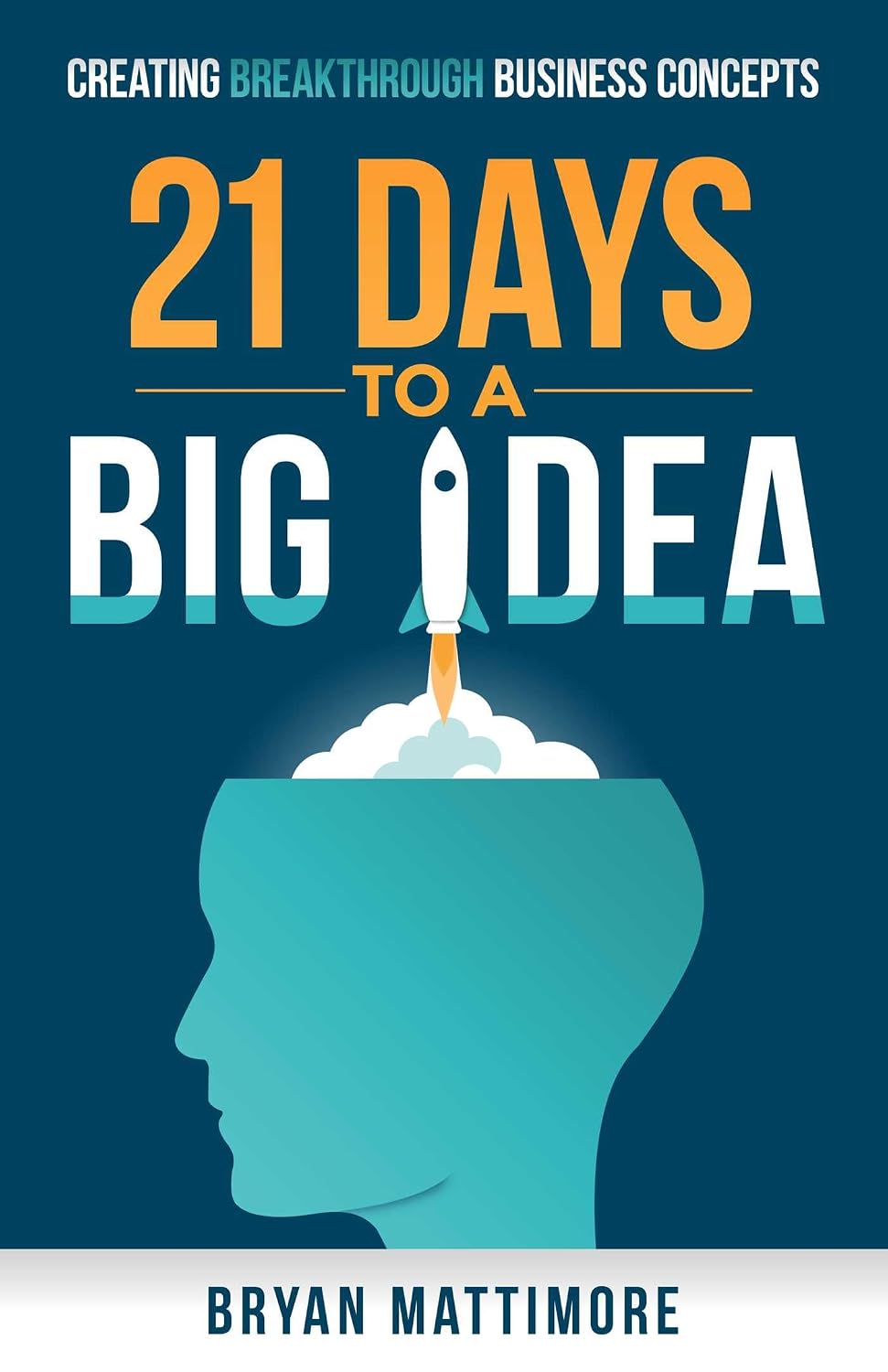
21 Days to a Big Idea Summary
By Bryan Mattimore
Creating Breakthrough Business Concepts
Summary preview
Great ideas rarely arrive because you sit at a desk and demand brilliance by noon. They show up when you prepare for them, court them, tease them out, and then give them room to breathe. That is the heart of 21 Days to a Big Idea. Bryan Mattimore takes the mystery out of creativity without draining away its magic. He treats idea generation not as a gift reserved for a few lucky geniuses, but as a process you can learn, practice, and repeat. If you have ever said, “I’m not creative,” this book is here to challenge that belief with energy, stories, and a practical system. The promise is wonderfully bold. In just twenty one days, you can dramatically improve your odds of producing a breakthrough idea for a product, a business, a marketing campaign, a personal project, or a difficult problem that needs a fresh answer. Not because the book offers a gimmick, and not because it pretends every idea will be gold, but because it understands how the mind actually works. Big ideas are usually built from small sparks. They grow from curiosity, preparation, stimulation, incubation, combination, and persistence. The book gives you a daily path for doing exactly that. What makes this approach refreshing is that it balances discipline with play. You are asked to gather information, define your challenge well, look for patterns, and use specific creative techniques. At the same time, you are invited to daydream, wander, relax, and trust the subconscious mind to keep working when your conscious mind steps aside. That mix matters. Too much structure can choke imagination. Too little structure leaves you with vague hopes and empty pages. The book aims for the sweet spot where method helps inspiration happen more often. Another strength is its optimism about ordinary people. You do not need a design lab, a huge budget, or a job title with the word innovation in it. You need commitment, openness, and a willingness to do the exercises. Again and again, the message is that quantity leads to quality. You do not begin by hunting one perfect answer. You begin by generating many possibilities, including strange ones, weak ones, and unfinished ones. Somewhere in that messy pile, something valuable starts to shine. Across the journey, you meet examples from business and invention that show creative thinking in action. These stories help ground the method in real life. By the end, the larger lesson becomes clear. A big idea is not a lightning strike you passively wait for. It is something you can actively pursue by setting up the right conditions and following a process that respects both rigor and imagination.
Sign up to continue reading
Get access to full book summaries, audio of the summaries, and many more.
Similar Books
Books with a similar vibe—explore more like this.
Girl Code
Cara Alwill Leyba
Secrets to Sanity and Success for the Female Entrepreneur
4.9 (4)21 mins
Do Design
Alan Moore
Why beauty is key to everything
4.6 (402)27 mins
Shoe Dog
Phil Knight
A Memoir by the Creator of Nike
4.6 (796)31 mins
The Hero With a Thousand Faces
Joseph Campbell
Understanding the Hero’s Journey Through Psychology and Mythology
4.6 (473)20 mins
The Design Thinking Workbook
CJ Meadows, Charvi Parikh
Essential Skills for Creativity and Business Growth
4.5 (623)13 mins

The Hobbit
J.R.R. Tolkien
A Journey Through Middle Earth A Lord of the Rings Prequel
4.5 (489)37 mins
Creativity Rules
Tina Seelig
Get Ideas Out of Your Head and into the World
4.5 (12)21 mins

Never Play It Safe
Chase Jarvis
A Practical Guide to Freedom, Creativity, and a Life You Love
4.4 (271)27 mins
The Innovator's Dilemma
Clayton Christensen
When New Technologies Cause Great Firms to Fail
4.4 (829)20 mins
Awaken Your Genius
Ozan Varol
Escape Conformity, Ignite Creativity, and Become Extraordinary
4.4 (672)22 mins