
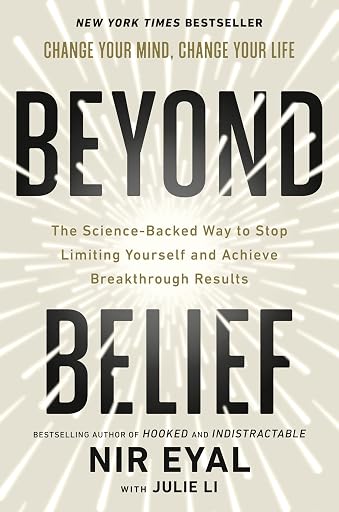
Beyond Belief Summary
By Nir Eyal
How to Stop Limiting Yourself and Achieve Breakthrough Results
Summary preview
At the heart of Beyond Belief is a simple but powerful question. Why do some products become part of people’s lives while most others are forgotten almost as soon as they are tried? Nir Eyal takes you behind the scenes of that mystery and shows that lasting customer habits are not accidents. They are built. Companies that win your attention again and again do not rely only on advertising, discounts, or one time bursts of excitement. They design experiences that gently pull you back until using the product feels natural, almost automatic. The book is really about the psychology of habit forming products. It looks at the invisible loops that connect what you feel, what you do, and what reward you expect. If you have ever wondered why you check your phone without thinking, open an app when you are bored, or return to the same service even when many alternatives exist, this book gives you a practical lens for understanding that behavior. More importantly, it offers builders, creators, and entrepreneurs a framework for creating products that people want to come back to. What makes the message land is that it does not stay in theory. You are walked through real examples from technology and business, from social networks to search engines, from photo sharing to messaging and online communities. These examples show that the products people use every day are not just useful. They often tap into deeper feelings like loneliness, uncertainty, curiosity, and the desire for connection, status, mastery, or relief. A product becomes sticky when it solves one of those recurring inner tensions quickly and reliably. The core framework in the book is the Hook Model, a cycle made up of trigger, action, variable reward, and investment. The idea is that repeated passes through this loop can turn occasional use into habit. First something prompts the behavior. Then the behavior itself must be simple enough to happen with little effort. Next comes a reward, but not a flat predictable one. The reward has some mystery, some variability, something that keeps the brain interested. Finally the user puts something into the product, whether time, data, effort, social capital, or content, which makes the next return more likely. What gives the book extra force is that it is not only a how to manual. It also wrestles with responsibility. If you learn how to shape habits, you also need to ask whether what you are building genuinely improves people’s lives. The book invites you to be honest about your motives and your impact. It gives you tools, but it also asks you to use them with care. By the time you move through its ideas, you can see products differently. You stop seeing screens and features. You start seeing loops of human behavior, emotional needs, and design choices that either fade away or become part of daily life.
Sign up to continue reading
Get access to full book summaries, audio of the summaries, and many more.
Similar Books
Books with a similar vibe—explore more like this.
The Science of Self-Discipline
Peter Hollins
Resist Temptation and Achieve Your Goals
4.7 (71)20 mins
Die Empty
Todd Henry
Unleash Your Best Work Every Day
4.6 (40)22 mins
Sovereign
Emma Seppala
Reclaim Your Freedom, Energy, and Power in a Time of Distraction, Uncertainty, and Chaos
4.6 (6)21 mins
Breaking The Habit of Being Yourself
Joe Dispenza
How to Lose Your Mind and Create a New One
4.5 (415)23 mins
Feel-Good Productivity
Ali Abdaal
How to Do More of What Matters to You
4.5 (1198)15 mins
The Art of Laziness
Library Mindset
Overcome Procrastination & Improve Your Productivity
4.5 (52)20 mins
Is Your Work Worth It?
Jennifer Tosti-Kharas & Christopher Wong Michaelson
How to Think about Meaningful Work
4.4 (3)22 mins
The Power of Habit
Charles Duhigg
Why We Do What We Do in Life and Business
4.3 (3181)30 mins
The Everyday Hero Manifesto
Robin Sharma
Activate Your Positivity, Maximize Your Productivity, Serve The World
4.3 (185)22 mins
Focal Point
Brian Tracy
Simplify Life, Double Productivity, Achieve Your Goals
4.3 (32)23 mins