
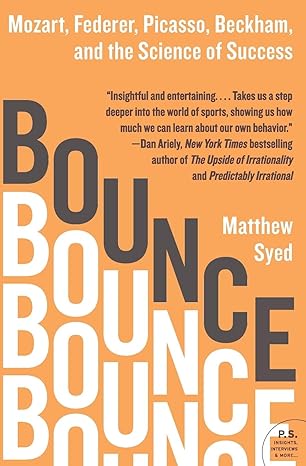
Bounce Summary
By Matthew Syed
The Myth of Talent and the Power of Practice
Summary preview
Most of us grow up with a comforting story about success. We tell ourselves that the truly great are simply born different. They arrive with a special gift, a hidden spark, a mysterious natural edge that the rest of us can admire but never quite touch. It is a neat idea, and in some ways a soothing one, because it turns excellence into magic. If genius is in the blood, then we do not have to wrestle too hard with our own limits, our own effort, or the systems that shape who gets a chance. That is the story this book sets out to challenge. The real engine of high performance, I argue, is not talent in the way we usually imagine it. It is practice, and not just any practice, but long, structured, purposeful work carried out over time. It is the kind of effort that stretches you beyond what feels comfortable, exposes your weaknesses, and keeps returning to them until they begin to change. It is also about opportunity, environment, and culture. Who gets access to coaching, who gets encouraged early, who lands in the right place at the right moment, who is allowed to fail and try again. These forces matter far more than the myth of effortless brilliance lets on. The book begins with a deeply personal thread. As a child and then as a professional table tennis player, I lived inside a world that looked from the outside like a temple of talent. People assumed the top players had simply been born with extraordinary reflexes and timing. Yet when I looked closely at my own story, and at the stories of the champions around me, I saw something else. I saw thousands of hours in practice halls. I saw repetition so intense it became a way of life. I saw tiny advantages that snowballed over years. And I saw how easily we misread the finished product, mistaking the visible performance for an invisible gift. From there, the book opens out into sport, music, chess, education, aviation, and psychology. It looks at the famous ten thousand hour rule, not as a magical number, but as a useful way to grasp the sheer quantity of meaningful practice that elite performance usually demands. It explores why some environments produce excellence again and again. It examines how pressure affects the mind, why choking happens, and how confidence can be both powerful and fragile. It also asks a larger question about fairness. If achievement depends so heavily on opportunity and sustained training, then what should schools, families, and societies do differently? By the end, the message is both unsettling and hopeful. Unsettling because it strips away easy legends. Hopeful because it suggests that human potential is far more open than we tend to think. Matthew Syed invites you to see greatness not as a miracle granted to a lucky few, but as a process. Once you understand that, the world looks different. So do your own possibilities.
Sign up to continue reading
Get access to full book summaries, audio of the summaries, and many more.
Similar Books
Books with a similar vibe—explore more like this.
Hidden Potential
Adam Grant
The Science of Achieving Greater Things
4.4 (728)23 mins
Surrender to Lead
Jessica Kriegel, Joe Terry
The Counterintuitive Approach to Driving Extraordinary Results
4.9 (7) mins

Girl Code
Cara Alwill Leyba
Secrets to Sanity and Success for the Female Entrepreneur
4.9 (4) mins
The Gift of Struggle
Bobby Herrera
Life-Changing Lessons About Leading
4.8 (22)21 mins
The Opposite of Settling
Case Kenny
Get What You Want in Love and Life, Without Losing Your Spark
4.8 (13) mins
The Score That Matters
Ryan Hawk, Brook Cupps
Growing Excellence in Yourself and Those You Lead
4.7 (368)17 mins
Friday Forward
Robert Glazer
Inspiration & Motivation to End Your Week Stronger Than It Started
4.6 (385)25 mins
Die Empty
Todd Henry
Unleash Your Best Work Every Day
4.6 (40)22 mins
Ultralearning
Scott H. Young
Accelerate Your Career, Master Hard Tasks and Outsmart the Competition
4.6 (328) mins
I Hate Job Interviews
Sam Owens
Stop Stressing. Start Performing. Get the Job You Want.
4.6 (6) mins