
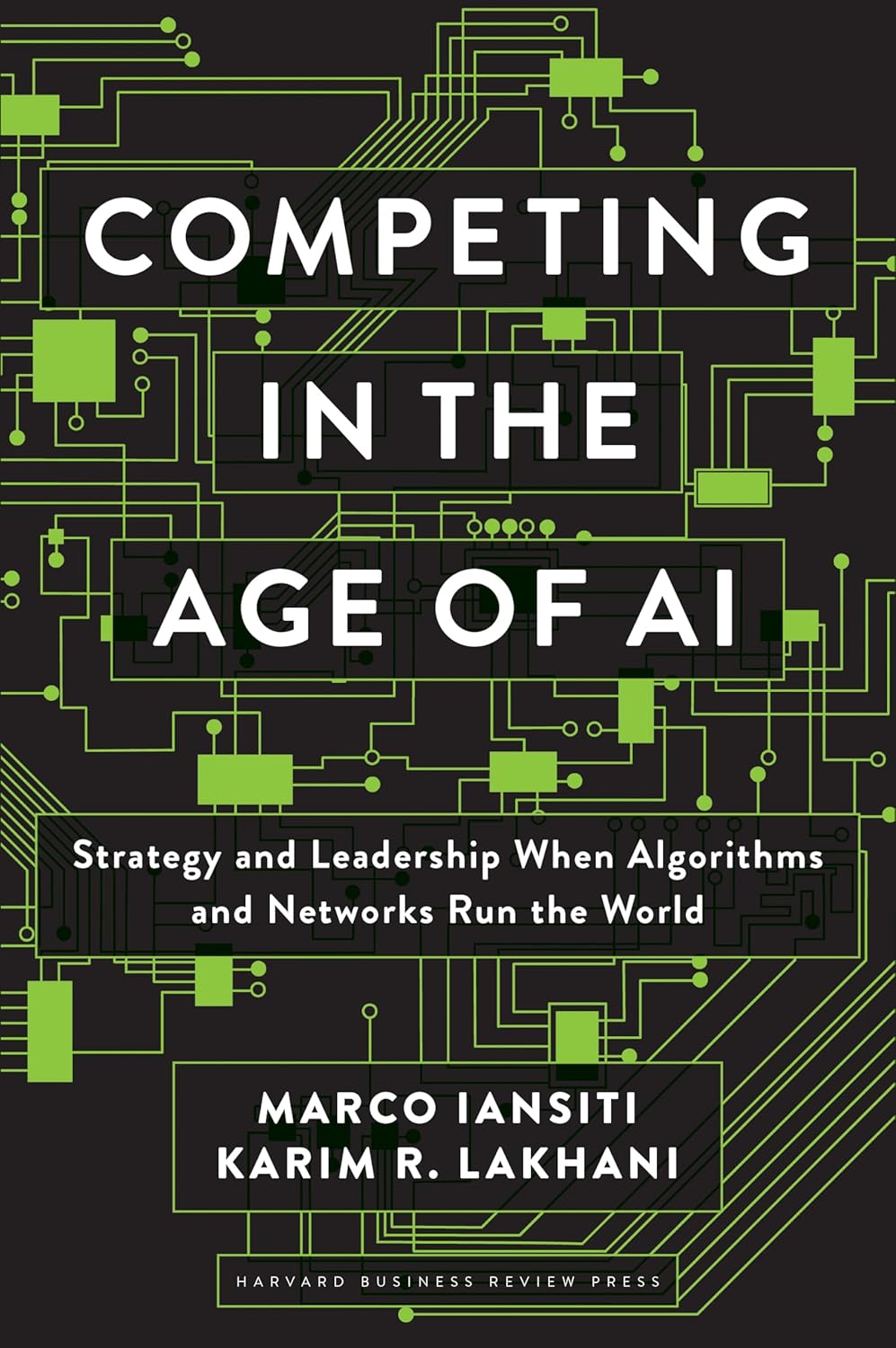
Competing in the Age of AI Summary
By Marco Iansiti & Karim R. Lakhani
Strategy and Leadership When Algorithms and Networks Run the World
Summary preview
Competing in the age of AI is not really a book about technology alone. It is a book about what happens when technology rewrites the basic logic of business. The heart of the message is simple and unsettling. Artificial intelligence is not just one more tool that makes old companies a little faster or a little cheaper. It changes the architecture of the firm itself. It changes how decisions get made, how value gets created, how customers get served, and even what it means to manage an organization. The big shift begins with data, but it does not end there. When data flows continuously from customers, operations, products, and partners, and when machine learning systems can absorb that data and improve with use, the company stops working like a traditional pipeline. It starts to behave more like a digital operating system. Processes that used to be broken into departments and handed from one manager to another can become connected, automated, and intelligent. What once required layers of coordination can happen in real time. Scale stops being only physical scale and becomes learning scale. That is why some firms pull away so dramatically from the rest. Think of companies like Amazon, Google, Facebook, Ant Financial, Alibaba, Microsoft, and Netflix. Their advantage is not only that they own good software or have smart engineers. Their advantage is that they are built around a new model. They combine data, analytics, experimentation, software, and connected ecosystems into a system that keeps getting better as more people use it. The more they learn, the better the service. The better the service, the more users they attract. The more users they attract, the more data they gather. This loop can become incredibly powerful. Marco Iansiti & Karim R. Lakhani want you to see both the opportunity and the danger. The opportunity is obvious. AI can personalize services, streamline operations, predict demand, reduce errors, and unlock entirely new products. The danger is just as real. If old organizations try to bolt AI onto outdated structures, they may gain very little. Worse, they may miss the deeper transformation happening around them. Competitors that are organized natively around digital learning systems can move faster, operate with lower friction, and reshape customer expectations before incumbents have time to react. So the book asks a practical question. If AI changes the nature of the firm, how should leaders respond. The answer is not a simple checklist. It is a new way of thinking about strategy, organization, talent, leadership, and competition. The story that follows is about how businesses are being rebuilt from the inside out, and why the future belongs not merely to those who adopt AI, but to those who redesign themselves around it.
Sign up to continue reading
Get access to full book summaries, audio of the summaries, and many more.
Similar Books
Books with a similar vibe—explore more like this.
Problem Hunting
Brian Long
The Tech Startup Textbook
4.2 (18)22 mins
The AI-First Company
Ash Fontana
How to Compete and Win with Artificial Intelligence
3.8 (7)24 mins

The Brand Benefits Playbook
Allen Weiss, Debbie J. MacInnis
Why Customers Aren't Buying What You're Selling--And What to Do About It
4.8 (803)20 mins
The Science of Scaling
Benjamin Hardy, Blake Erickson
Grow Your Business Bigger and Faster Than You Think Possible
4.8 (22)20 mins
The Heart of Transformation
Michael J. Leckie
Build the Human Capabilities That Change Organizations for Good
4.7 (64)25 mins
Process!
Mike Paton, Lisa González
How Discipline and Consistency Will Set You and Your Business Free
4.6 (5)23 mins

The Startup Lifecycle
Gregory Shepard
The Definitive Guide to Building a Startup from Idea to Exit
4.5 (346)21 mins

High Growth Handbook
Elad Gil
Scaling Startups from 10 to 10,000 People
4.5 (413)19 mins
Day Trading Attention
Gary Vaynerchuk
Build Brand and Sales in the New Social Media World
4.5 (947)21 mins
Tech Leadership
Andrew Swerdlow
How to Evolve from Individual Contributor to Tech Leader
4.5 (11)22 mins