
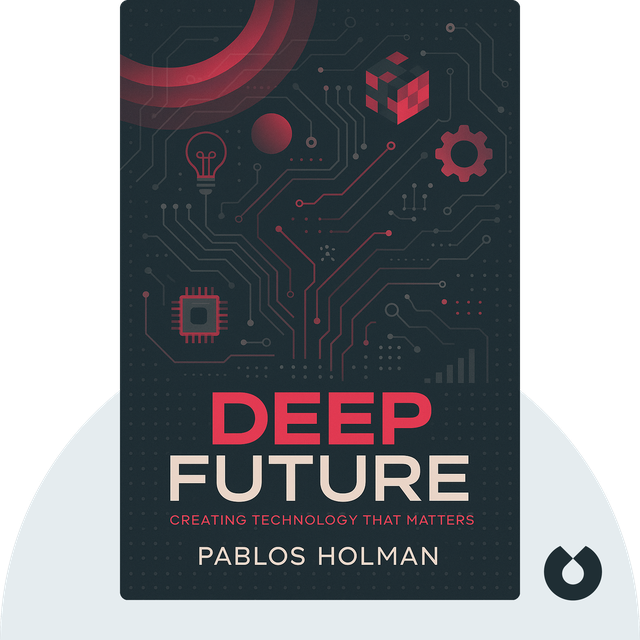
Deep Future Summary
By Pablos Holman
Creating Technology That Matters
Summary preview
Deep Future is a book about the biggest problems on Earth and the wild, practical, often surprising tools we can build to solve them. Pablos Holman does not come to these problems like a distant policy expert or a gloomy prophet. He comes like an inventor standing in a workshop, sleeves rolled up, looking at a broken machine and asking a simple question. Why are we still doing it this way? That attitude gives the whole book its pulse. It is restless, curious, impatient with excuses, and full of respect for the power of engineering. The heart of the book is this idea that humanity already knows how to make astonishing things, yet we often aim that talent at convenience, entertainment, or small improvements while the largest challenges keep growing. Hunger, disease, unsafe water, dirty energy, weak infrastructure, and the fragility of modern systems are not mysteries. They are engineering targets. They are design problems. If we decide to treat them that way, the future can look very different from the anxious, declining version we are so often told to expect. What makes this book special is that it does not settle for grand slogans. It dives into specific machines, methods, and experiments. You are taken into the world of high tech greenhouses, advanced desalination, safer nuclear systems, better ways to fight pandemics, improved tools for food production, and radically fresh approaches to computing and invention itself. The argument is not that every bold idea will work exactly as planned. The argument is that serious progress comes from trying daring things, learning from failure, and refusing to let tradition decide what is possible. There is also a deeper current running through the book. It asks you to see civilization as a stack of interconnected systems. Water affects agriculture. Energy affects everything. Disease can destabilize economies. Computing changes how fast we can discover new medicines, new materials, and new ways to organize society. Once you see those links, you start to understand why solving one foundational problem can unlock many others. The result is a book that feels both urgent and hopeful. It says the future is not something that simply arrives. We build it, poorly or brilliantly, by the choices we make about technology, risk, ambition, and responsibility. The real danger is not that the problems are too hard. The real danger is that we think too small, move too slowly, and accept needless limits. This is a guided tour through a future that could be deeper, cleaner, healthier, and more resilient if we are bold enough to invent it.
Sign up to continue reading
Get access to full book summaries, audio of the summaries, and many more.
Similar Books
Books with a similar vibe—explore more like this.
The Human Edge
Greg Orme
How Curiosity And Creativity Are Your Superpowers In The Digital Economy
4.6 (595)26 mins

L&D's Playbook for the Digital Age
Brandon Carson
Transform learning into a growth engine for the digital workplace.
3.1 (5) mins
Write Your Book in a Flash
Dan Janal
The Paint-by-Numbers System to Write the Book of Your Dreams—FAST!
4.7 (31) mins
How to Think Like Leonardo da Vinci
Michael J. Gelb
Seven Steps to Genius Every Day
4.6 (180)25 mins
Six Thinking Hats
Edward de Bono
A revolutionary approach to get the most out of working in a group
4.6 (80) mins

Future Fit
Andrea Clarke
How to Stay Relevant and Competitive in the Future of Work
4.5 (642)33 mins
Tomorrow, and Tomorrow, and Tomorrow
Gabrielle Zevin
A Novel
4.5 (4281)24 mins
The Practice
Seth Godin
Shipping Creative Work
4.5 (692)27 mins
Day Trading Attention
Gary Vaynerchuk
Build Brand and Sales in the New Social Media World
4.5 (947)21 mins
The Creativity Code
Marcus du Sautoy
How AI is learning to write, paint and think
4.5 (1038)36 mins