
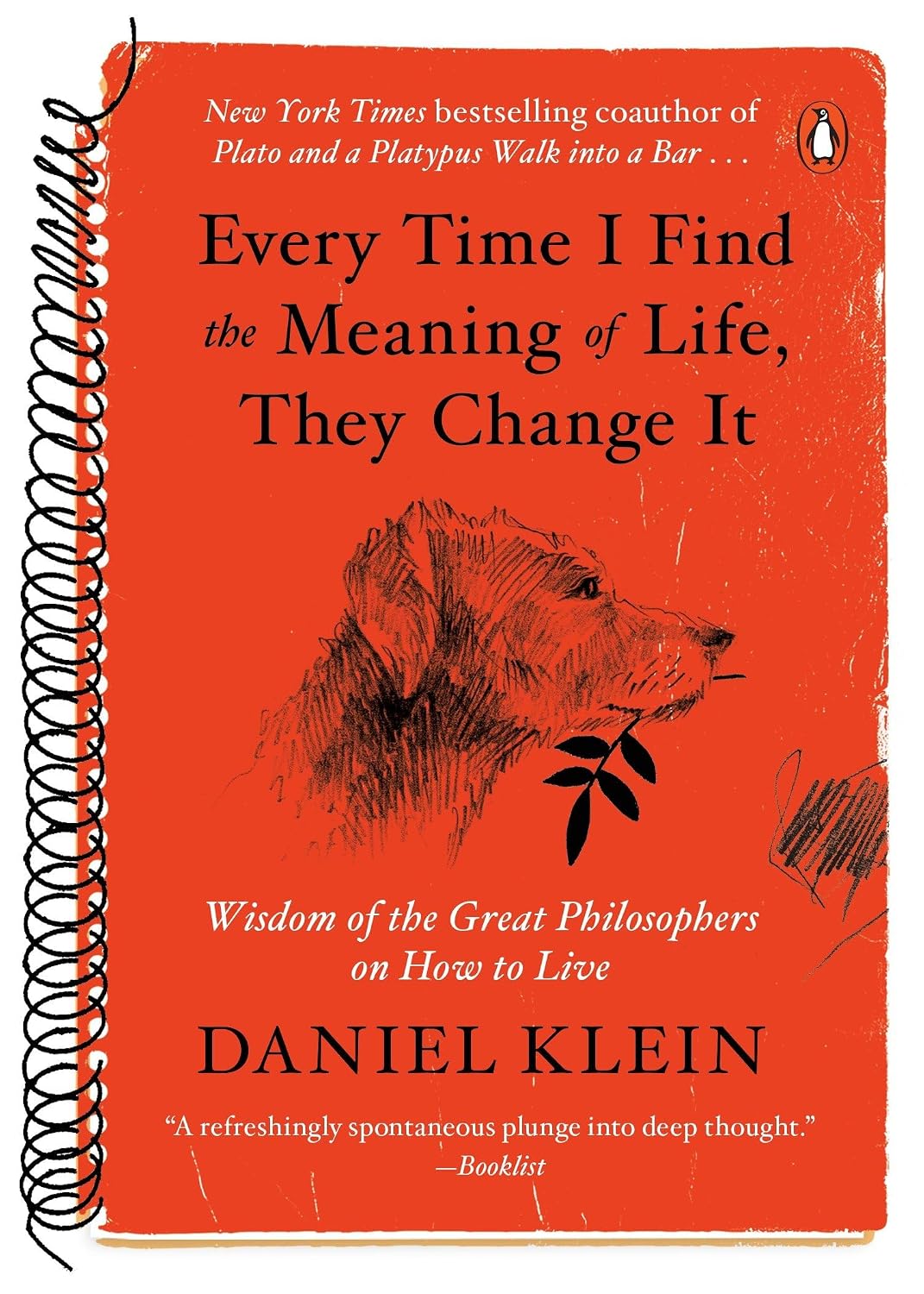
Every Time I Find the Meaning of Life, They Change It Summary
By Daniel Klein
Wisdom of the Great Philosophers on How to Live
Summary preview
Suppose you spend a lifetime chasing wisdom, only to discover that wisdom keeps moving the furniture around. You finally settle into one grand idea about love, success, God, pleasure, duty, or happiness, and just when you are ready to call it home, somebody from another century wanders in and says, not so fast. That is the comic little ache at the heart of this book. It is a cheerful, rueful, deeply human stroll through the question that nags at almost everyone sooner or later. What is the point of all this, and how are we supposed to live while we are figuring it out. Daniel Klein approaches that question the way a witty old friend might, with curiosity, self mockery, and a refusal to pretend he has solved the puzzle once and for all. He is not building a grand philosophical system. He is poking through the attic of his own life, opening dusty boxes filled with old notes, old books, old passions, and old confusions. What he finds there is both funny and moving. As a young man he fell hard for philosophy. He copied favorite lines onto index cards, carried around dazzling thoughts from great thinkers, and hoped that somewhere among Socrates, Epicurus, Nietzsche, and the rest, there might be a sentence sturdy enough to lean his life against. Years later, now older and more aware of how slippery all certainties are, he goes back to those cards. What follows is not a textbook tour of ideas. It is a memoir shaped by philosophy and a philosophy softened by memoir. The big thinkers arrive not as marble busts on pedestals but as lively companions in an ongoing inner conversation. One philosopher praises reason, another pleasure, another faith, another irony, another acceptance, and each sounds convincing for a while. The trouble, and also the delight, is that human life refuses to fit neatly inside any one answer. Youth wants revelation. Age begins to suspect that contradiction may be the most honest teacher. The book keeps circling a simple but profound recognition. We do not just think about meaning from a distance. We feel our way toward it through love, aging, ambition, sex, boredom, grief, delight, memory, and the small habits of everyday life. The question of meaning is not solved once. It is lived again and again under changing conditions. That is why the title lands with such playful force. Every time the meaning seems fixed, life changes, and the meaning changes with it. So this is a book about philosophy, yes, but even more it is about temperament. It asks whether wisdom means finding the right answer or learning how to dwell gracefully among many partial answers. It invites you into a mind that has stopped demanding final certainty and started appreciating the comic richness of not quite knowing.
Sign up to continue reading
Get access to full book summaries, audio of the summaries, and many more.
Similar Books
Books with a similar vibe—explore more like this.
How Proust Can Change Your Life
Alain de Botton
Valuable Insights Into Living Your Best Life
4.6 (74)24 mins

Ecce Homo
Friedrich Nietzsche
How One Becomes What One is
4.4 (21)25 mins
The Four Agreements
Don Miguel Ruiz & Janet Mills
A Practical Guide to Personal Freedom
4.3 (913)21 mins
The Art of Worldly Wisdom
Baltasar Gracián y Morales
A Pocket Oracle
4.3 (101)19 mins
The Art of Insubordination
Todd B. Kashdan
How to Dissent and Defy Effectively
4.1 (314)24 mins
Surrender to Lead
Jessica Kriegel, Joe Terry
The Counterintuitive Approach to Driving Extraordinary Results
4.9 (7)21 mins

Girl Code
Cara Alwill Leyba
Secrets to Sanity and Success for the Female Entrepreneur
4.9 (4)21 mins
The Gift of Struggle
Bobby Herrera
Life-Changing Lessons About Leading
4.8 (22)21 mins
The Opposite of Settling
Case Kenny
Get What You Want in Love and Life, Without Losing Your Spark
4.8 (13)25 mins
Discipline Is Destiny
Ryan Holiday
The Power of Self-Control
4.8 (891)19 mins