
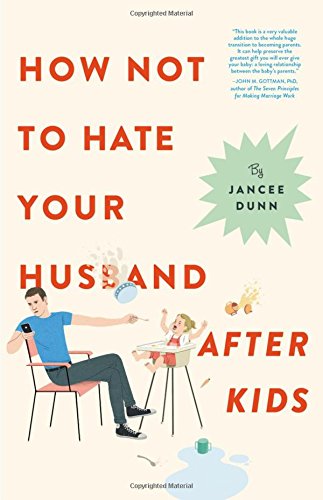
How Not to Hate Your Husband After Kids Summary
By Jancee Dunn
Strategies for Staying Together as Your Family Expands
Summary preview
Before kids, love can feel like a private little club. You and your partner have jokes, rituals, lazy mornings, and the vague belief that because you adore each other, the practical stuff will somehow sort itself out. Then a baby arrives, and suddenly your relationship is not just about romance or companionship. It becomes a round the clock logistics company with spit up on its shirt. The dishes multiply. Sleep disappears. Resentment slips in wearing yoga pants and carrying a mental checklist a mile long. That is the mess this book walks into with honesty, wit, and the kind of relief that comes from hearing someone say the thing you were secretly scared to admit. Jancee Dunn starts with a confession that will feel familiar to a lot of people. She loves her husband. She also finds herself wanting to throttle him over who is noticing, remembering, anticipating, and doing the endless invisible work of family life. What looks from the outside like small household friction turns out to be something much bigger. It is about fairness, identity, emotional labor, and what happens when two people who mean well drift into a lopsided system they never consciously chose. The book is part memoir, part reporting, and part practical guide. It follows one couple trying to climb out of the stale, bitter pattern where one parent becomes the default manager of everything and the other becomes a sort of helpful assistant who can still claim he is doing plenty. Instead of settling for vague advice about communication, the story goes searching for specifics. It talks to therapists, researchers, marriage experts, military teams, conflict mediators, and ordinary couples who have figured out ways to share work and lower the emotional temperature at home. What makes the journey so inviting is its tone. It never pretends marriage after kids can be made perfect. It does not ask anyone to become a saint. It understands that tired people snap, that fairness is emotional as much as mathematical, and that tiny repeated moments can either corrode a relationship or slowly repair it. The goal is not to create some glittering ideal family. The goal is much more useful. It is to stop the daily habits that turn partners into enemies and start building systems that make kindness easier. So what unfolds is not a lecture about being nicer. It is a sharp, funny, deeply humane look at how domestic life really works when children enter the picture. It asks why women so often carry more than their share, why men can miss the mental load even when they care, and how couples can redesign the ordinary machinery of their lives. By the end, the message is reassuring and bracing at the same time. Love is not enough on its own. But love, backed by skill, awareness, and a fair division of labor, can survive the chaos.
Sign up to continue reading
Get access to full book summaries, audio of the summaries, and many more.
Similar Books
Books with a similar vibe—explore more like this.
Who's the Favorite?
Catherine Carr
The Loving, Messy Realities of Sibling Relationships
4.6 (9) mins
The Opposite of Settling
Case Kenny
Get What You Want in Love and Life, Without Losing Your Spark
4.8 (13) mins

Set Boundaries, Find Peace
Nedra Glover Tawwab
A Guide to Reclaiming Yourself
4.7 (819)27 mins
What Your Childhood Memories Say About You
Kevin Leman
And What You Can Do about It
4.7 (17) mins
Til Stress Do Us Part
Elizabeth Earnshaw
How to Heal the #1 Issue in Our Relationships
4.6 (139)20 mins
The Parenting Map
Dr. Shefali
Step by Step Solutions to Consciously Create the Ultimate Parent-Child Relationship
4.6 (917)16 mins
How to be Love(d)
Humble the Poet
Simple Truths for Going Easier on Yourself, Embracing Imperfection & Loving Your Way to a Better Life
4.6 (45) mins

Closer to Love
Vex King
How to Attract the Right Relationships and Deepen Your Connections
4.6 (74) mins
Raising Securely Attached Kids
Eli Harwood
Using Connection-Focused Parenting to Create Confidence, Empathy, and Resilience
4.5 (726)25 mins
Atlas of the Heart
Brené Brown
Mapping Meaningful Connection and the Language of Human Experience
4.5 (1028)31 mins