
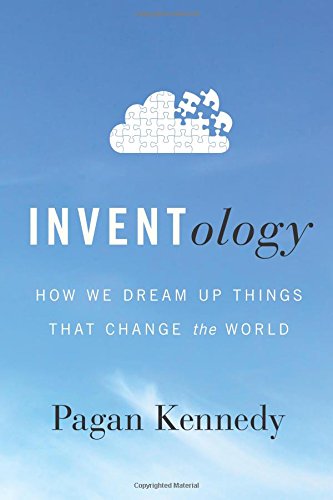
Inventology Summary
By Pagan Kennedy
How We Dream Up Things That Change the World
Summary preview
Inventology is a book about a question that sounds simple and turns out to be wonderfully slippery. Where do good ideas come from, and why do some people seem able to keep producing them again and again? Rather than treating invention as a lightning strike from nowhere, this book goes looking for patterns in the lives of people who built things, tested wild notions, failed in public, and kept going. The result is not a neat formula. It is something better. It is a guided tour through the habits, tricks, environments, and states of mind that help ideas take shape. Pagan Kennedy approaches inventors not as marble statues of genius but as working people with messy desks, odd routines, and strong curiosities. Some are famous, some nearly forgotten, and some are still alive and tinkering. What links them is not perfection or even brilliance in the usual sense. It is a particular style of attention. They notice gaps. They borrow freely. They return to half solved puzzles. They talk to the right strangers. They build rough versions of things before they understand everything. Again and again, the book shows that invention is less like divine inspiration and more like a craft, one that can be observed up close. The journey moves across centuries and across very different kinds of creators. We meet practical mechanics, amateur dreamers, researchers, artists of utility, and people who seem to live between fields. We see that new ideas often emerge from collision. One discipline rubs against another. One problem echoes an old one. A person trained to look one way suddenly sees a new use in a familiar object. Sometimes the inventor succeeds because of deep expertise. Sometimes success comes from ignorance, because not knowing the rules makes it easier to break them. What gives the book its energy is the way it treats invention as a lived experience. We are not just told that persistence matters. We see people pursuing weird hunches for years. We are not just told that collaboration helps. We watch ideas move through conversations, workshops, and chance encounters. The book also delights in the strange side roads of innovation, the false starts, lucky accidents, and social blind spots that can hide a solution in plain sight. By the time the story unfolds, a larger point becomes clear. The mind that invents is not a rare machine available only to a chosen few. It is a human capacity that can be nurtured. If you want to understand creativity in a hands on, worldly, and deeply curious way, this book invites you to look past myths of genius and into the everyday practices that make novelty possible.
Sign up to continue reading
Get access to full book summaries, audio of the summaries, and many more.
Similar Books
Books with a similar vibe—explore more like this.

Girl Code
Cara Alwill Leyba
Secrets to Sanity and Success for the Female Entrepreneur
4.9 (4)21 mins
Shoe Dog
Phil Knight
A Memoir by the Creator of Nike
4.6 (796)31 mins
The Cult of We
Eliot Brown & Maureen Farrell
WeWork, Adam Neumann, and the Great Startup Delusion
4.4 (592)25 mins
21 Days to a Big Idea
Bryan Mattimore
Creating Breakthrough Business Concepts
4.3 (62)26 mins
The Common Path to Uncommon Success
John Lee Dumas
A Roadmap to Financial Freedom and Fulfillment
4.3 (43)27 mins

Never Enough
Andrew Wilkinson
From Barista to Billionaire
4.2 (658)33 mins
The Power of Starting Something Stupid
Richie Norton
How to Crush Fear, Make Dreams Happen, and Live Without Regret
4.2 (22)23 mins
Arise, Awake
Rashmi Bansal
The Inspiring Stories of Young Entrepreneurs Who Graduated from College into a Business of Their Own
4.0 (16)23 mins
Smartcuts
Shane Snow
How Hackers, Innovators, and Icons Accelerate Success
3.9 (17)33 mins
Nine-Figure Mindset
Brandon Dawson
How to Go from Zero to Over $100 Million in Net Worth
3.8 (27)24 mins