
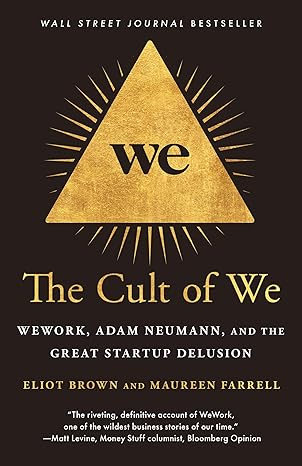
The Cult of We Summary
By Eliot Brown & Maureen Farrell
WeWork, Adam Neumann, and the Great Startup Delusion
Summary preview
There are business stories that feel like balance sheets with dialogue, and then there are stories that feel like modern fables about money, ego, belief, and the strange power of charisma. The Cult of We belongs to that second kind. It tells the rise and fall of WeWork, but really it is about something bigger. It is about what happens when a company stops acting like a business and starts acting like a movement, when investors stop asking basic questions because they are afraid of missing out, and when a founder learns how to turn confidence into a kind of spell. At the center of it all is Adam Neumann, a leader who could make almost any room feel charged with destiny. He sold not just office space, but a dream of community, purpose, and human elevation. His company wrapped old fashioned commercial real estate in the language of spiritual awakening and world changing innovation. Desks became a mission. Leasing became a revolution. Growth became proof of genius. Around him, employees, investors, and admirers were pulled into a story so intoxicating that many stopped noticing how shaky the foundation really was. The book follows that arc with sharp reporting and a strong feel for the absurd details that made the whole saga unforgettable. Eliot Brown & Maureen Farrell show how WeWork managed to convince some of the smartest people in finance that it was not just another office rental business. They trace how a simple startup idea was inflated into a global phenomenon worth tens of billions, even while losses ballooned, governance collapsed, and basic discipline disappeared. The result is part corporate thriller, part cautionary tale, and part portrait of an era when private markets were flooded with cash and ambition often counted for more than evidence. What makes the story gripping is not only the scale of the collapse, but the way it happened in plain sight. The warning signs were there. Lavish spending, messy accounting, self dealing, reckless expansion, and a leadership culture built around devotion rather than challenge all appeared long before the public unraveling. Yet each red flag was either excused, ignored, or turned into a sign of visionary boldness. That is the strange logic of a bubble. The more unbelievable the story becomes, the more some people want to believe it. As you move through this summary, you will see how the company was built, how the myth was sold, how the money poured in, and how the entire structure cracked when exposed to real scrutiny. What emerges is not just a portrait of one founder or one failed company, but a look at a system that often rewards storytelling more than substance. It is lively, bizarre, funny at times, and deeply revealing about the culture of modern capitalism.
Sign up to continue reading
Get access to full book summaries, audio of the summaries, and many more.
Similar Books
Books with a similar vibe—explore more like this.

Girl Code
Cara Alwill Leyba
Secrets to Sanity and Success for the Female Entrepreneur
4.9 (4)21 mins

Shoe Dog
Phil Knight
A Memoir by the Creator of Nike
4.6 (796)31 mins

21 Days to a Big Idea
Bryan Mattimore
Creating Breakthrough Business Concepts
4.3 (62)26 mins
The Common Path to Uncommon Success
John Lee Dumas
A Roadmap to Financial Freedom and Fulfillment
4.3 (43)27 mins

Never Enough
Andrew Wilkinson
From Barista to Billionaire
4.2 (658)33 mins

The Power of Starting Something Stupid
Richie Norton
How to Crush Fear, Make Dreams Happen, and Live Without Regret
4.2 (22)23 mins

Arise, Awake
Rashmi Bansal
The Inspiring Stories of Young Entrepreneurs Who Graduated from College into a Business of Their Own
4.0 (16)23 mins

Inventology
Pagan Kennedy
How We Dream Up Things That Change the World
4.0 (7)26 mins

Smartcuts
Shane Snow
How Hackers, Innovators, and Icons Accelerate Success
3.9 (17)33 mins
Nine-Figure Mindset
Brandon Dawson
How to Go from Zero to Over $100 Million in Net Worth
3.8 (27)24 mins