
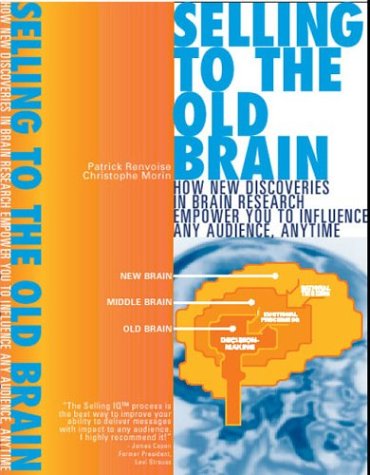
Selling to the Old Brain Summary
By Patrick Renvoisé, Christophe Morin
How Neuroscience holds the Key to Influencing Your Audience
Summary preview
Most selling advice starts in the wrong place. It starts with what you want to say, what your product can do, or how smart your audience is supposed to be. This book asks you to flip that around. If you really want to persuade, you need to begin with the organ that makes the final decision. Not the neat, rational part people like to praise. Not the emotional language people use afterward to explain themselves. You need to speak to the oldest, deepest, most instinctive part of the brain. That is the true buyer. Patrick Renvoisé and Christophe Morin build their whole message on a simple but powerful claim. Human beings do not buy first with logic and then with emotion. They buy when the old brain feels safe, rewarded, relieved, or strongly compelled. The new brain can process words and numbers. The middle brain can feel. But the old brain, the primitive brain, is the one that decides. If your message never reaches it, your brilliant presentation may be admired and still fail. That idea changes everything about communication. It changes the way you design a sales pitch, tell a story, shape a website, lead a meeting, write a brochure, and even answer objections. Instead of overwhelming people with features, you learn to focus on survival level concerns. Instead of trying to be complete, you try to be clear. Instead of giving more information, you give the right information in the right order. The book keeps bringing you back to one practical question. How do you package your message so the old brain notices it, cares about it, remembers it, and acts on it? The answer is not vague motivation. It is a method. The authors translate neuroscience into concrete tools you can use. They explain how the brain has three parts working together but not equally. They show why the primitive brain loves contrast, simplicity, beginnings and endings, visual input, and anything centered on pain and gain. Then they turn those insights into a selling process called NeuroMAP, a step by step way to identify the buyer’s pain, sharpen claims, prove them, and deliver them with impact. What makes the book work is that it never stays trapped in theory. Again and again, it uses examples from business pitches, marketing campaigns, and everyday communication to show why some messages break through and others die in the room. The writing keeps nudging you toward a hard truth. Your customer does not care about your offer the way you do. Your customer cares about their own problem, their own risk, their own future. When you respect that reality, selling becomes less about pressure and more about alignment. So the journey ahead is straightforward and demanding at the same time. Learn how the brain really decides. Stop talking to the wrong listener. Build messages that connect with instinct, emotion, and proof. Then deliver them so clearly that action feels natural. That is the promise of this book, and it is far...
Sign up to continue reading
Get access to full book summaries, audio of the summaries, and many more.
Similar Books
Books with a similar vibe—explore more like this.
Influence
Robert B. Cialdini
The Psychology of Persuasion
4.4 (927)32 mins
Crucial Conversations
Kerry Patterson, Joseph Grenny, Ron McMillan, Al Switzler
Tools for Talking When Stakes Are High
4.3 (658)32 mins
Cold Calling Sucks (And That's Why It Works)
Nick Cegelski, Armand Farrokh
A Step-by-Step Guide to Calling Strangers in Sales
4.8 (459)20 mins

The Science of Selling
David Hoffeld
Proven Strategies to Make Your Pitch, Influence Decisions, and Close the Deal
4.7 (188)25 mins

Once Upon a Stranger
Gillian Sandstrom
The Science of How Small Talk Can Add Up to a Big Life
4.7 (21)22 mins

B2B Customer Experience
Paul Hague & Nicholas Hague
A Practical Guide to Delivering Exceptional CX
4.7 (4)26 mins
Presentation Advantage
Kory Kogon, Breck England and Julie Schmidt
How to Inform and Persuade Any Audience
4.7 (72)19 mins

The New Emotional Intelligence
Travis Bradberry
Master your emotional skills for lasting success
4.7 (48)22 mins
Relationship Currency
Ravi Rajani
Five Communication Habits For Limitless Influence and Success
4.7 (34)21 mins

The Hero With a Thousand Faces
Joseph Campbell
Understanding the Hero’s Journey Through Psychology and Mythology
4.6 (473)20 mins