
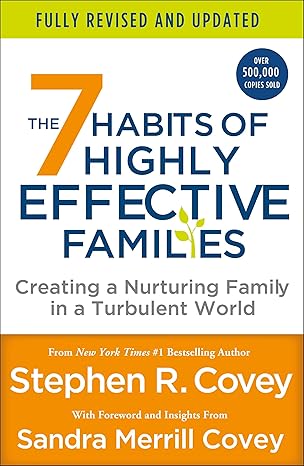
The 7 Habits of Highly Effective Families Summary
By Stephen Covey
Creating Powerful & Positive Relationships Within the Family
Summary preview
Family life can be full of love and still feel messy, rushed, and strangely fragile. We care deeply about the people under our own roof, yet those are often the very people we neglect, control, disappoint, or take for granted. The heart of this book is a simple but demanding idea. Strong families do not happen by accident. They are built on purpose, one habit at a time, from the inside out. Stephen Covey begins with a concern many parents, spouses, and children recognize at once. The world is pulling families apart. Schedules are packed. Media is loud. Pressure comes from school, work, money, and endless distractions. It is easy to drift into survival mode, where everyone lives near each other but not really with each other. In that kind of climate, techniques are not enough. Quick fixes do not heal mistrust. Rules alone do not create closeness. What is needed is a return to timeless principles. That is why this book takes the seven habits that helped individuals become more effective and brings them into the home. The focus is not perfection. It is progress. It is learning how to create a family culture where trust grows, where people are heard, where promises mean something, and where home becomes the place you recharge instead of the place you escape from. The message is hopeful because it does not depend on having ideal children, ideal parents, or ideal circumstances. It depends on choices, character, and steady effort. The book asks you to think of your family not just as a collection of people sharing space, but as your most important team, your deepest stewardship, and your richest opportunity to serve. It pushes you to look first at yourself. If you want more love, become more loving. If you want peace, become more peaceful. If you want respect, show more respect. Influence begins with example. Leadership in a family is moral leadership. As the journey unfolds, you are invited to build a clear family mission, put first things first, create cooperation instead of rivalry, really listen, honor differences, and keep renewing the emotional and spiritual life of the home. Along the way, Stephen Covey uses stories from his own family and from many others to show what these habits look like in real life. The result is not a stiff program. It feels more like a practical invitation to create a home where each person matters and where love is made visible in daily actions. What follows is a path toward that kind of home. It begins with responsibility and ends with renewal, but every step is connected. Each habit strengthens the others. Together they form a way of living that can help a family become not just more organized or more successful, but more united, more joyful, and more deeply human.
Sign up to continue reading
Get access to full book summaries, audio of the summaries, and many more.
Similar Books
Books with a similar vibe—explore more like this.

Who's the Favorite?
Catherine Carr
The Loving, Messy Realities of Sibling Relationships
4.6 (9) mins
Excellent Advice for Living
Kevin Kelly
Wisdom I Wish I'd Known Earlier
4.2 (140) mins
How Not to Hate Your Husband After Kids
Jancee Dunn
Strategies for Staying Together as Your Family Expands
4.1 (5)23 mins
Sexploitation
Cindy Pierce
Helping Kids Develop Healthy Sexuality in a Porn-Driven World
3.9 (7) mins
Smitten
Tom Bellamy
Romantic Obsession, the Neuroscience of Limerence, and How to Make Love Last
5.0 (4) mins

The Little Prince
Antoine de Saint-Exupéry
A Tale About the Human Condition and the Search for Happiness
4.9 (36) mins
Us
Terrence Real
Getting Past You and Me to Build a More Loving Relationship
4.8 (140) mins
The Opposite of Settling
Case Kenny
Get What You Want in Love and Life, Without Losing Your Spark
4.8 (13) mins

Romeo and Juliet
William Shakespeare
The Tragic Story of Two Star-Crossed Lovers From Feuding Families
4.8 (20) mins

Set Boundaries, Find Peace
Nedra Glover Tawwab
A Guide to Reclaiming Yourself
4.7 (819)27 mins