
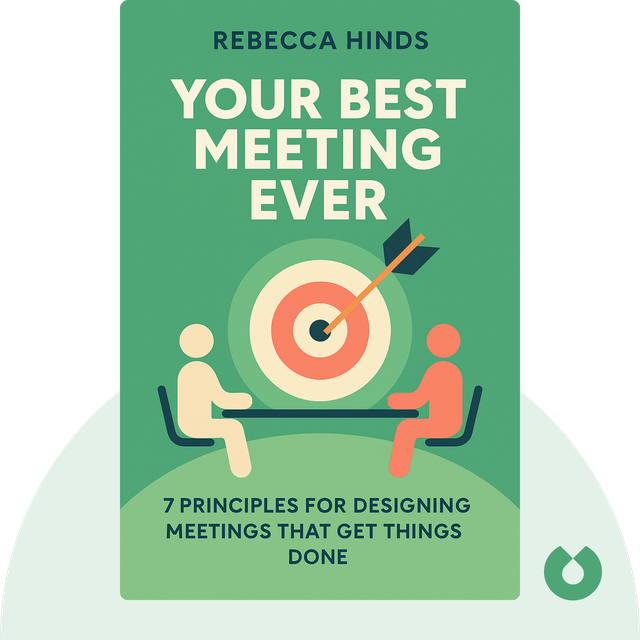
Your Best Meeting Ever Summary
By Rebecca Hinds
7 Principles for Designing Meetings That Get Things Done
Summary preview
Meetings are where modern work really happens. They are the place where decisions get made, ideas are tested, relationships are built, and teams figure out how to move forward together. Yet for many people, meetings feel like a drain. They eat up time, wander off course, leave people confused, and often create more work than clarity. That gap between what meetings could do and what they usually do is the problem at the heart of Your Best Meeting Ever. Rebecca Hinds asks you to stop treating bad meetings as normal. She makes a simple but powerful case. Meetings are not hopeless. They are not naturally painful. They become frustrating because people walk into them with fuzzy goals, poor habits, mixed expectations, and little awareness of how human attention and group dynamics actually work. Once you understand those patterns, you can redesign meetings so they become shorter, sharper, more inclusive, and much more useful. The book is practical from the start. It does not just complain about overloaded calendars or distracted teammates. It shows you how to think about a meeting as a tool. Like any tool, it works only when you choose it for the right job and use it with care. Some work needs a meeting. Some work absolutely does not. One of the most refreshing ideas in the book is that the best meeting is often the one you never hold. Before gathering people, you should know why you are doing it, what kind of outcome you need, and whether real time conversation is the best path. From there, the book moves through the full life of a meeting. It begins before anyone joins the call or enters the room. It looks at the choices that shape success ahead of time, such as who needs to be there, what preparation matters, how long the meeting should last, and what rules help people focus. Then it turns to the live experience itself. You see how to open well, guide discussion, encourage every voice, manage conflict, keep energy up, and reach decisions people actually understand. Finally, it follows the meeting after it ends, because a good conversation means very little if no one knows what happens next. What makes the book especially useful is its human lens. It is not only about efficiency. It is about trust, fairness, psychological safety, inclusion, and respect. Meetings can make people feel heard or invisible. They can create belonging or reinforce hierarchy. They can unlock great thinking or silence it. The message running through the book is clear. If you improve your meetings, you improve the way your team works together. And if you improve the way your team works together, you improve the quality of the work itself.
Sign up to continue reading
Get access to full book summaries, audio of the summaries, and many more.
Similar Books
Books with a similar vibe—explore more like this.

Team
David Allen, Edward Lamont
Getting Things Done with Others
4.4 (525)21 mins

Virtual Leadership
Penny Pullan
Strategies for Getting the Best Out of Virtual Work and Teams
4.3 (6)23 mins
Next Play
Alan Stein Jr.
Improve Team Performance, Productivity, and Fulfillment
4.9 (34)26 mins
B2B Customer Experience
Paul Hague & Nicholas Hague
A Practical Guide to Delivering Exceptional CX
4.7 (4)26 mins
Influence is Your Superpower
Zoe Chance
The Science of Winning Hearts, Sparking Change, and Making Good Things Happen
4.7 (149)23 mins
Distancing
L. David Marquet, Michael A. Gillespie
How Great Leaders Reframe to Make Better Decisions
4.7 (22)24 mins
Relationship Currency
Ravi Rajani
Five Communication Habits For Limitless Influence and Success
4.7 (34)21 mins
Coaching for Performance
Sir John Whitmore
The Principles and Practice of Coaching and Leadership
4.6 (219)24 mins
How to Be a Star at Work
Robert E. Kelley
9 Breakthrough Strategies You Need to Succeed
4.6 (34)28 mins
Compassionate Leadership
Paul Axtell
16 Simple Ways to Engage and Inspire Your Team at Work
4.6 (11)28 mins