
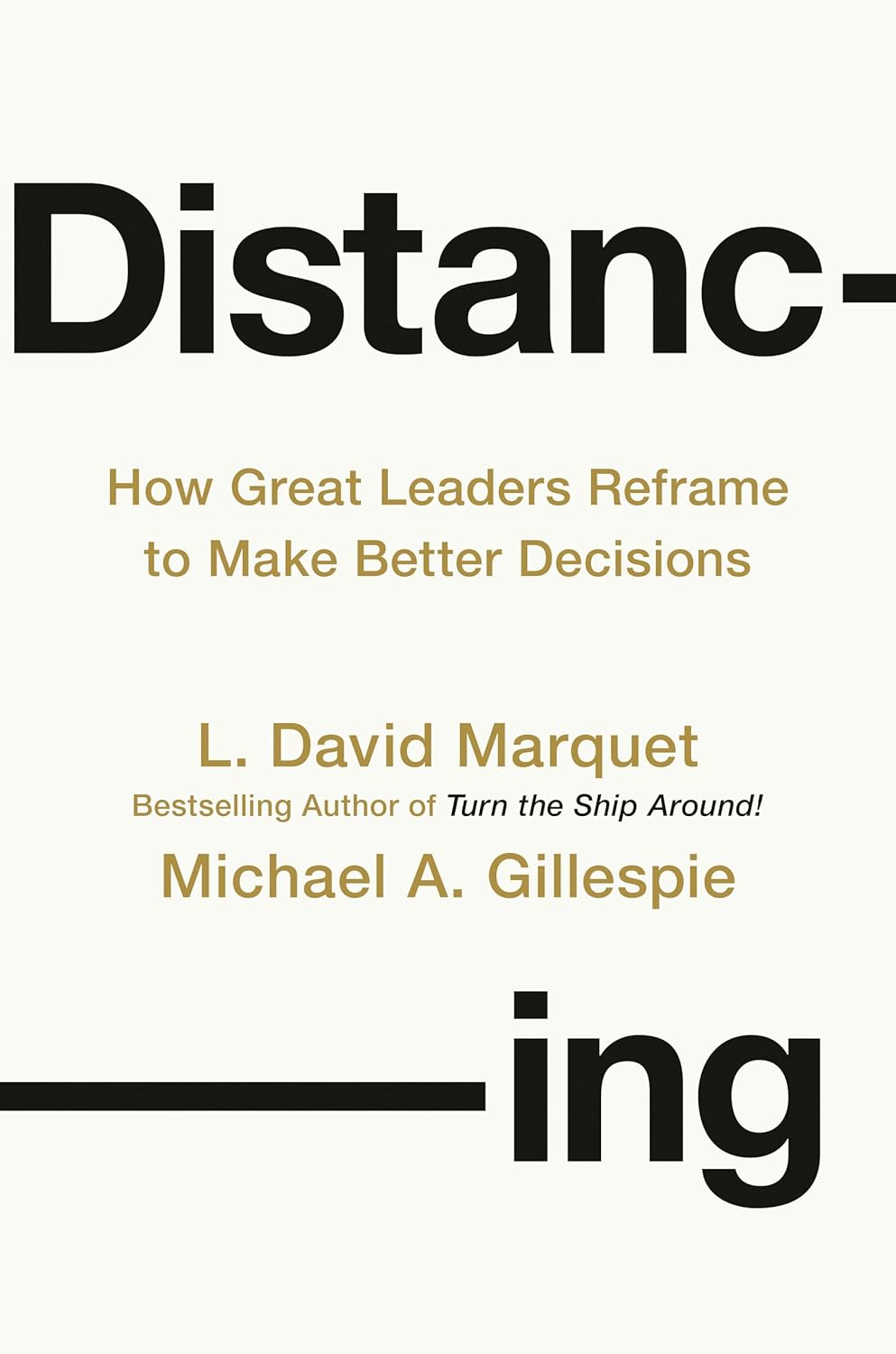
Distancing Summary
By L. David Marquet, Michael A. Gillespie
How Great Leaders Reframe to Make Better Decisions
Summary preview
Some problems in life ask you to lean in, get closer, and study the details. Others ask for the opposite. They ask you to step back. To pause. To create space between yourself and the thing that is pressing on you so hard that it starts to distort your thinking. That is the heart of Distancing, a practical and deeply human book by L. David Marquet and Michael A. Gillespie. It is about a skill we rarely name even though we need it almost every day. The skill is learning how to detach just enough from our emotions, assumptions, habits, and social pressure so we can see more clearly and act more wisely. The book is built on a simple but powerful insight. When you are too close to a problem, your field of vision shrinks. You react instead of reflect. You grab the first explanation, the loudest voice, the strongest feeling, or the most familiar habit. But when you create distance, even a little, something changes. You notice patterns. You become less captive to fear, ego, and urgency. You can think in longer time frames. You can imagine other perspectives. You can make better choices. This is not a book that treats distancing as cold withdrawal or indifference. It is not telling you to stop caring. It is telling you that caring works better when it is paired with perspective. The authors show that distance can be emotional, social, temporal, physical, or conceptual. You can distance from a heated feeling, from the authority of a group, from the pressure of the present moment, from a narrow identity, or from the assumption that your first thought must be the right one. In each case, distance gives you room to think. What makes the book especially compelling is that it does not leave the idea floating in abstraction. It grounds the argument in stories, psychology, history, leadership, and ordinary life. You see distancing at work in moments of crisis and in moments so small they might otherwise pass unnoticed. A leader reframes a tense situation. A person interrupts a spiral of self talk. A team escapes groupthink by changing how it speaks and decides. A small shift in language or position opens up a much larger shift in understanding. As the book unfolds, the message becomes richer. Distancing is not a trick. It is a discipline. It can be practiced. It can be designed into relationships, teams, and institutions. And it matters not only for high stakes leadership, but for arguments at home, setbacks at work, personal disappointment, anxiety about the future, and the constant pull of immediate reaction. The book invites you to become less trapped by closeness and more capable of wise action. What follows is a journey through the many ways distance helps us see, choose, and live better.
Sign up to continue reading
Get access to full book summaries, audio of the summaries, and many more.
Similar Books
Books with a similar vibe—explore more like this.
Say What They Can't Unhear
Tamsen Webster
The 9 Principles of Lasting Change
4.5 (212)32 mins
Negotiation Made Simple
John Lowry
A Practical Guide for Solving Problems, Building Relationships, and Delivering the Deal
4.5 (517)20 mins
Becoming a Person of Influence
John C. Maxwell, Jim Dornan
How to Positively Impact the Lives of Others
4.5 (365)18 mins
How to Become a People Magnet
Marc Reklau
62 Simple Strategies to Build Powerful Relationships and Positively Impact the Lives of Everyone You Get in Touch with
4.5 (494)26 mins

From Conflict to Courage
Marlene Chism
How to Stop Avoiding and Start Leading
4.5 (3)22 mins
The Art of Persuasion
Bob Burg
Winning Without Intimidation
4.4 (186)26 mins
Working with Emotional Intelligence
Daniel Goleman
The Crucial Role of emotional Intelligence in the Workplace
4.4 (556)23 mins
Conversational Intelligence
Judith E. Glaser
How Great Leaders Build Trust and Get Extraordinary Results
4.4 (14)21 mins
Trust Yourself
Melody Wilding
Stop Overthinking and Channel Your Emotions for Success at Work
4.4 (25)24 mins
Collaborating with the Enemy
Adam Kahane
How to Work with People You Don't Agree with or Like or Trust
4.4 (14)22 mins