
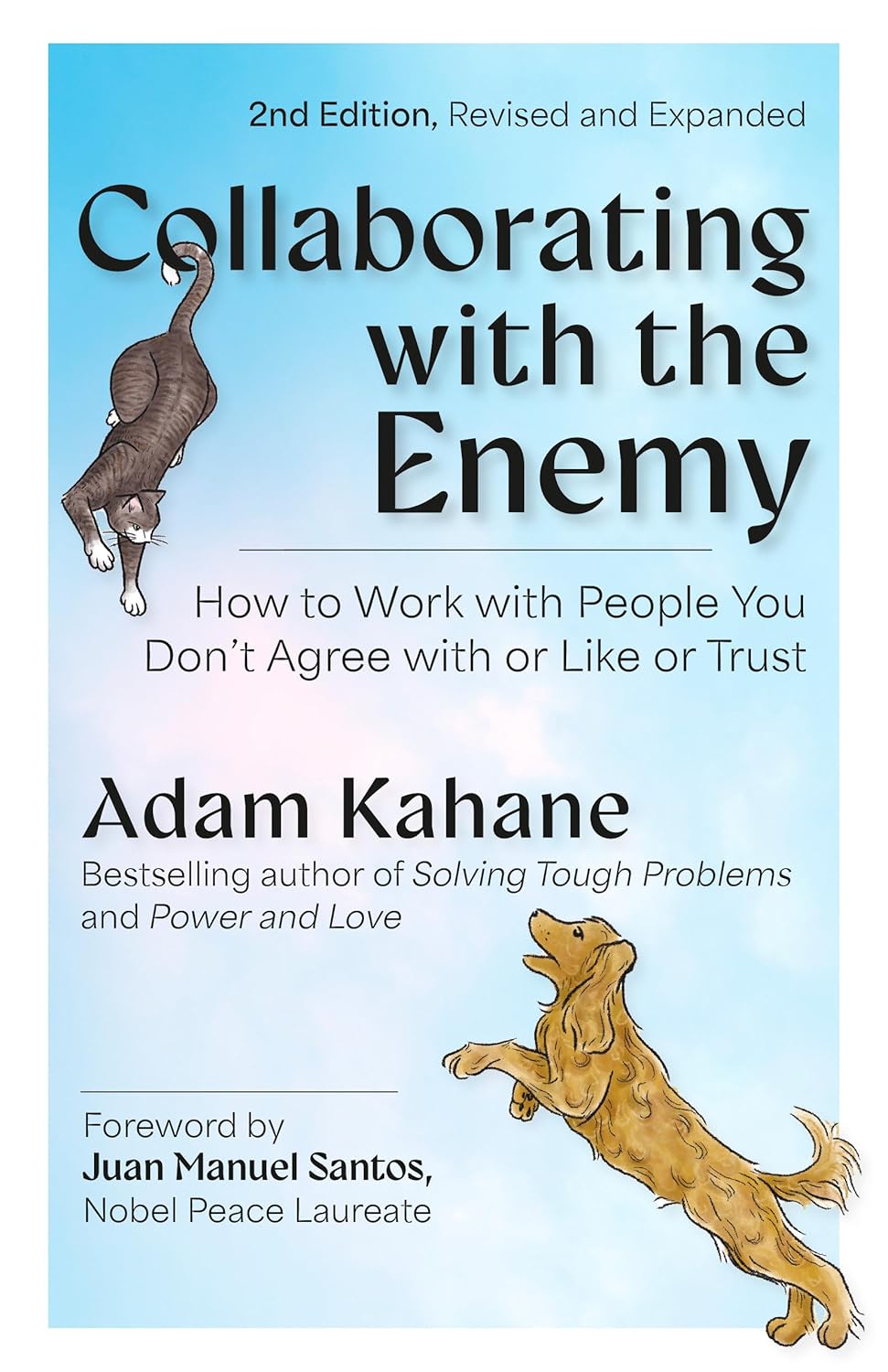
Collaborating with the Enemy Summary
By Adam Kahane
How to Work with People You Don't Agree with or Like or Trust
Summary preview
Most of us grow up with a comforting picture of collaboration. We imagine people sitting around a table, listening well, finding common ground, and then moving forward together toward a shared goal. That picture is neat, hopeful, and often wrong. The world we actually live in is messier than that. We are asked to work with people we do not trust, people we dislike, people who want different things from us, and sometimes people whose actions have harmed us. The hard truth at the heart of this book is simple. If we only know how to collaborate with friends, allies, and people who agree with us, then we do not really know how to collaborate at all. That is the challenge Adam Kahane takes up. He writes from decades of work in some of the toughest situations imaginable, from South Africa during the end of apartheid to Colombia, Guatemala, the Middle East, and organizations torn by conflict. Again and again, he has been invited into rooms where there is no trust, no agreement, and no possibility of control. The people in those rooms are not there because they want harmony. They are there because they are stuck together in a problem they cannot solve alone. The book begins by shaking loose the old model of collaboration, what he calls conventional collaboration. That model depends on three comforting assumptions. First, that we can collaborate only if we all share the same goal. Second, that we can collaborate only if we agree on the problem and the solution. Third, that we can collaborate only if there is safety, trust, and a willingness to move together. In many real conflicts, none of this exists. And yet action is still required. That is where a different kind of practice becomes necessary. The book calls this stretch collaboration. It is stretch because it asks us to move beyond what feels natural and safe. It asks us to work with people we do not control, toward outcomes we cannot predict, in systems that are constantly changing. It is not about getting everyone on the same page. It is not about removing conflict. It is about stepping into conflict in a way that can generate movement. What unfolds is not a tidy method with guarantees. It is a deeper shift in stance. We are invited to stop trying to impose solutions, stop waiting for perfect agreement, and stop standing outside the system as if we are the wise fixer. Instead we enter as participants, as co creators, and as people willing to change ourselves as part of changing the situation. That is why this book feels both practical and personal. It speaks to politics, organizations, communities, and families, but it also speaks to the way you and I meet tension in everyday life. Its purpose is not to promise peace. Its purpose is to help us learn how to move forward when peace is not available yet.
Sign up to continue reading
Get access to full book summaries, audio of the summaries, and many more.
Similar Books
Books with a similar vibe—explore more like this.
Distancing
L. David Marquet, Michael A. Gillespie
How Great Leaders Reframe to Make Better Decisions
4.7 (22)24 mins
Say What They Can't Unhear
Tamsen Webster
The 9 Principles of Lasting Change
4.5 (212)32 mins
Negotiation Made Simple
John Lowry
A Practical Guide for Solving Problems, Building Relationships, and Delivering the Deal
4.5 (517)20 mins
Becoming a Person of Influence
John C. Maxwell, Jim Dornan
How to Positively Impact the Lives of Others
4.5 (365)18 mins
How to Become a People Magnet
Marc Reklau
62 Simple Strategies to Build Powerful Relationships and Positively Impact the Lives of Everyone You Get in Touch with
4.5 (494)26 mins
From Conflict to Courage
Marlene Chism
How to Stop Avoiding and Start Leading
4.5 (3)22 mins
The Art of Persuasion
Bob Burg
Winning Without Intimidation
4.4 (186)26 mins
Working with Emotional Intelligence
Daniel Goleman
The Crucial Role of emotional Intelligence in the Workplace
4.4 (556)23 mins
Conversational Intelligence
Judith E. Glaser
How Great Leaders Build Trust and Get Extraordinary Results
4.4 (14)21 mins
Trust Yourself
Melody Wilding
Stop Overthinking and Channel Your Emotions for Success at Work
4.4 (25)24 mins