
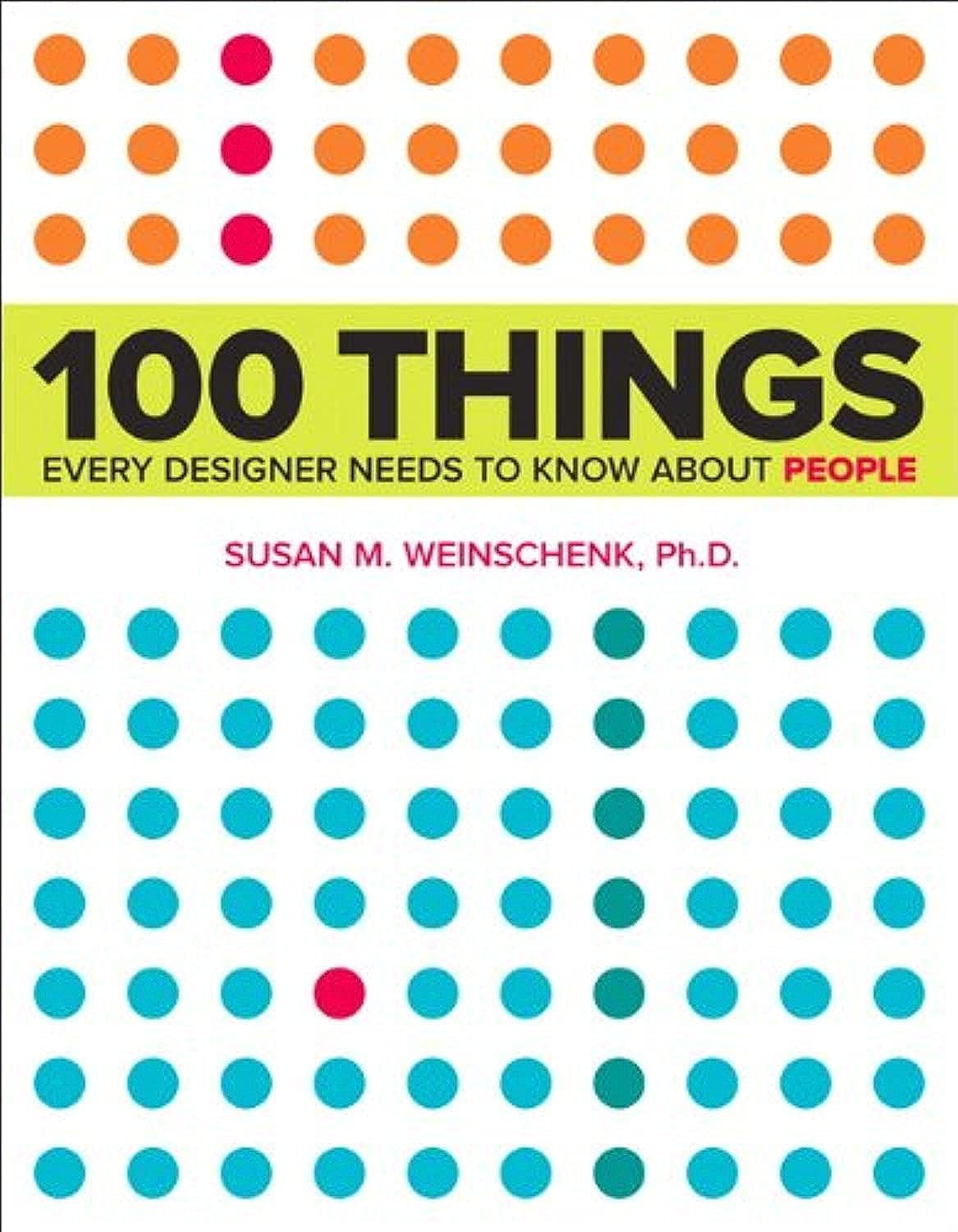
100 Things Every Designer Needs to Know About People Summary
By Susan M. Weinschenk
The essential guide for every designer from a behavioral psychologist
Summary preview
Design is not really about decorating a screen, picking a font, or making something look modern. It is about people. It is about what they notice, what they ignore, what they remember, what they forget, what makes them trust, what makes them hesitate, and what gets them to act. That is the heart of this book. It takes a huge body of research from psychology, neuroscience, vision, memory, motivation, and behavior, and turns it into plain language you can actually use when you design websites, software, products, presentations, forms, signs, instructions, or anything else people must see and use. The promise is simple and powerful. If you understand how people really work, then you can design in a way that feels natural instead of confusing. You stop guessing. You stop relying on personal taste alone. You stop assuming that users will read every word, weigh every option, and behave logically. They will not. People scan before they read. They are influenced by stories, faces, habits, expectations, and social signals. Their memory is limited. Their attention is fragile. Their decisions are often emotional first and rational second. Once you accept that, design becomes less mysterious and much more effective. Susan M. Weinschenk gathers one hundred short lessons around that idea. Each one answers a practical question. What catches the eye first. How much can people hold in short term memory. Why do they miss things that seem obvious. What makes them trust a site. Why do they make mistakes. What pushes them to keep going. Why are they sometimes lazy, sometimes curious, and sometimes stubbornly resistant to change. The book is not trying to turn you into a laboratory scientist. It is trying to give you a working map of human nature. What makes the book especially useful is its rhythm. Each idea is brief, direct, and grounded in research, but it always bends back toward action. You are shown not just what is true about people, but why it matters for buttons, layouts, menus, instructions, error messages, dashboards, navigation, video, audio, and persuasion. For example, when people can recognize something instead of recall it from memory, they do better. When choices pile up, they freeze or choose badly. When the design matches mental models people already have, they move faster and feel smarter. So the book becomes a kind of field guide to the human mind. It reminds you that people are wonderfully capable, but also full of limits and shortcuts. Great design works with those limits instead of fighting them. That is the invitation here. Learn how people see, think, remember, feel, and decide, and you can create things that are clearer, kinder, and much more likely to succeed.
Sign up to continue reading
Get access to full book summaries, audio of the summaries, and many more.
Similar Books
Books with a similar vibe—explore more like this.

Othello
William Shakespeare
Love, Betrayal, and the Fall of a Hero
4.8 (14) mins
We Have Always Lived in the Castle
Shirley Jackson
Enter a Disturbing Labyrinth of Family Secrets and Dark Neurosis
4.8 (5)14 mins

The Hero With a Thousand Faces
Joseph Campbell
Understanding the Hero’s Journey Through Psychology and Mythology
4.6 (473)20 mins
Six Thinking Hats
Edward de Bono
A revolutionary approach to get the most out of working in a group
4.6 (80) mins
A Whole New Mind
Daniel H. Pink
Why Right-Brainers Will Rule the Future
4.5 (279)32 mins
How to Think More Effectively
The School of Life
A guide to greater productivity, insight and creativity
4.5 (909)23 mins
Lateral Thinking
Edward de Bono
Creativity Step by Step
4.4 (254)22 mins

The Trial
Franz Kafka
Explore a Labyrinth of Absurdity in This Timeless Legal Odyssey
4.4 (593)23 mins
Think Like a Freak
Steven D. Levitt and Stephen J. Dubner
Find the unconvential yet brilliant ideas hidden in data
4.4 (69)35 mins
Deviate
Beau Lotto
The Science of Seeing Differently
4.3 (490)26 mins