
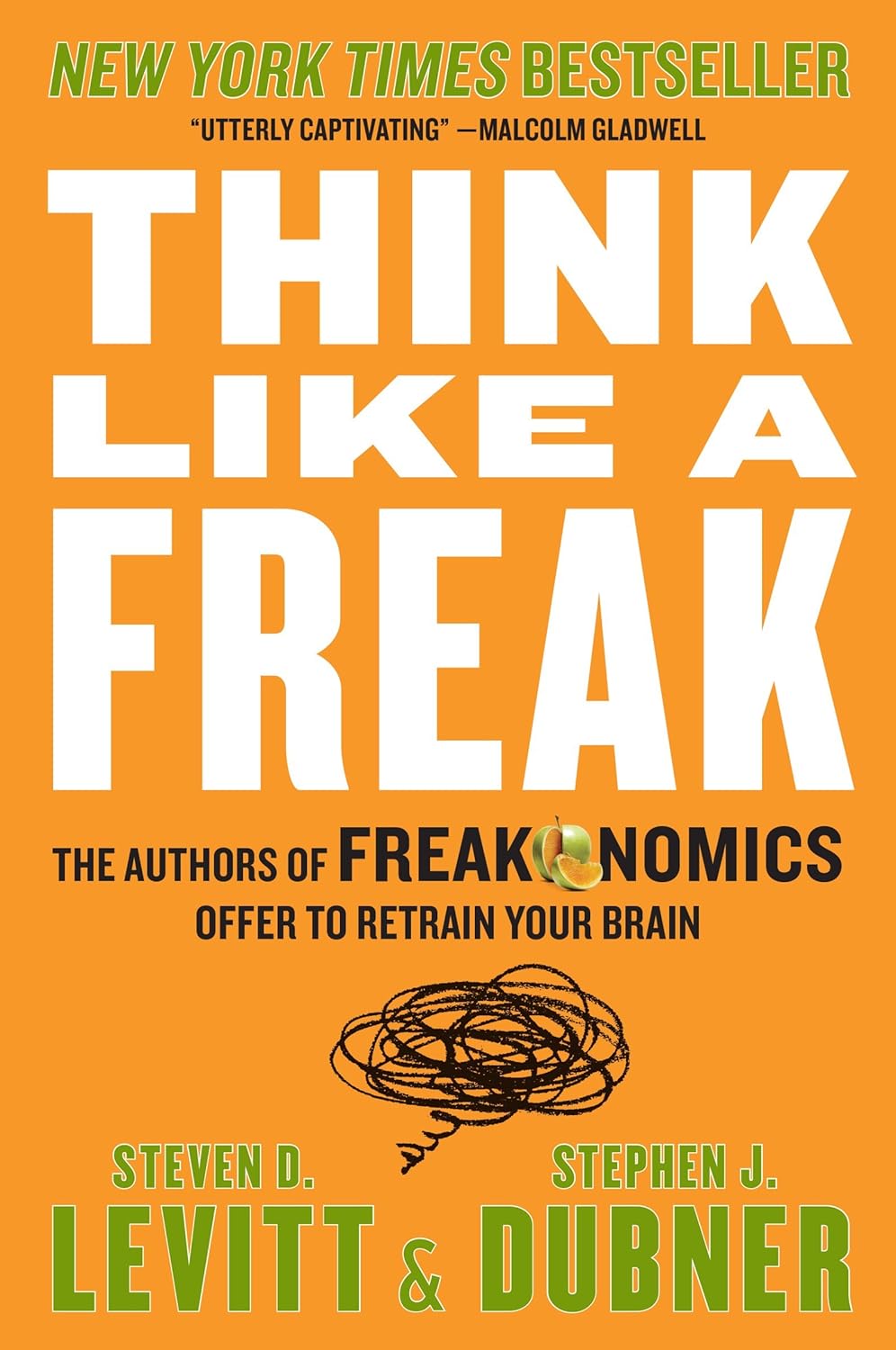
Think Like a Freak Summary
By Steven D. Levitt and Stephen J. Dubner
Find the unconvential yet brilliant ideas hidden in data
Summary preview
Most of us like to think we are pretty smart. We have opinions, instincts, beliefs, and a nice little collection of explanations for why the world works the way it does. But what if many of those explanations are lazy, inherited, emotional, or just plain wrong? That is the challenge at the heart of this book. It is not really about becoming a genius. It is about learning to see better. It is about getting past the obvious answer, past the answer that makes you feel good, and getting a little closer to the truth. The big idea is simple. Thinking like a freak means thinking differently from the crowd, but not differently just for the fun of being weird. It means staying curious when others are satisfied. It means asking small questions before giant ones. It means caring more about what is true than about what is popular, moral sounding, or comforting. It means looking at incentives, data, and human behavior with a fresh eye. It also means admitting when you do not know something, which turns out to be a lot more useful than pretending you do. This way of thinking can help you tackle all kinds of problems, from serious global issues to the annoying little puzzles in your own life. Why do people keep making bad choices? Why do experts often fail? Why do campaigns that seem noble backfire? Why is quitting sometimes the smartest move? Why do people learn more from stories than from statistics? These are the kinds of questions the book loves. It takes topics that seem unrelated and finds the hidden links between them. It also has a habit of taking big respectable ideas and poking at them until they wobble. Steven D. Levitt and Stephen J. Dubner are not interested in giving you a rigid system with ten guaranteed rules for success. They are after something looser and more alive. They want to show you habits of mind. They want you to notice what everyone else overlooks. They want you to strip a problem down to its actual mechanics. They want you to be willing to say, as the book does more than once in spirit, that the first question is often not the right question. What follows is a tour through that style of thinking. You will meet surprising examples, oddball experiments, and stories that sound playful but carry a sharp lesson underneath. The book keeps returning to one message. If you can get your ego out of the way, if you can ask better questions, if you can understand what really motivates people, and if you can tell the truth in a way others can hear, then you can solve more problems than you think. Maybe not all of them. But certainly more than the ordinary way of thinking ever will.
Sign up to continue reading
Get access to full book summaries, audio of the summaries, and many more.
Similar Books
Books with a similar vibe—explore more like this.

Othello
William Shakespeare
Love, Betrayal, and the Fall of a Hero
4.8 (14)22 mins

We Have Always Lived in the Castle
Shirley Jackson
Enter a Disturbing Labyrinth of Family Secrets and Dark Neurosis
4.8 (5)14 mins
Fooled by Randomness
Nassim Nicholas Taleb
The Hidden Role of Chance in Life and the Markets
4.6 (937)31 mins
The Hero With a Thousand Faces
Joseph Campbell
Understanding the Hero’s Journey Through Psychology and Mythology
4.6 (473)20 mins
Six Thinking Hats
Edward de Bono
A revolutionary approach to get the most out of working in a group
4.6 (80)34 mins
A Whole New Mind
Daniel H. Pink
Why Right-Brainers Will Rule the Future
4.5 (279)32 mins
How to Think More Effectively
The School of Life
A guide to greater productivity, insight and creativity
4.5 (909)23 mins
Lateral Thinking
Edward de Bono
Creativity Step by Step
4.4 (254)22 mins
The $12 Million Stuffed Shark
Don Thompson
The Curious Economics of Contemporary Art
4.4 (573)24 mins

The Trial
Franz Kafka
Explore a Labyrinth of Absurdity in This Timeless Legal Odyssey
4.4 (593)23 mins