
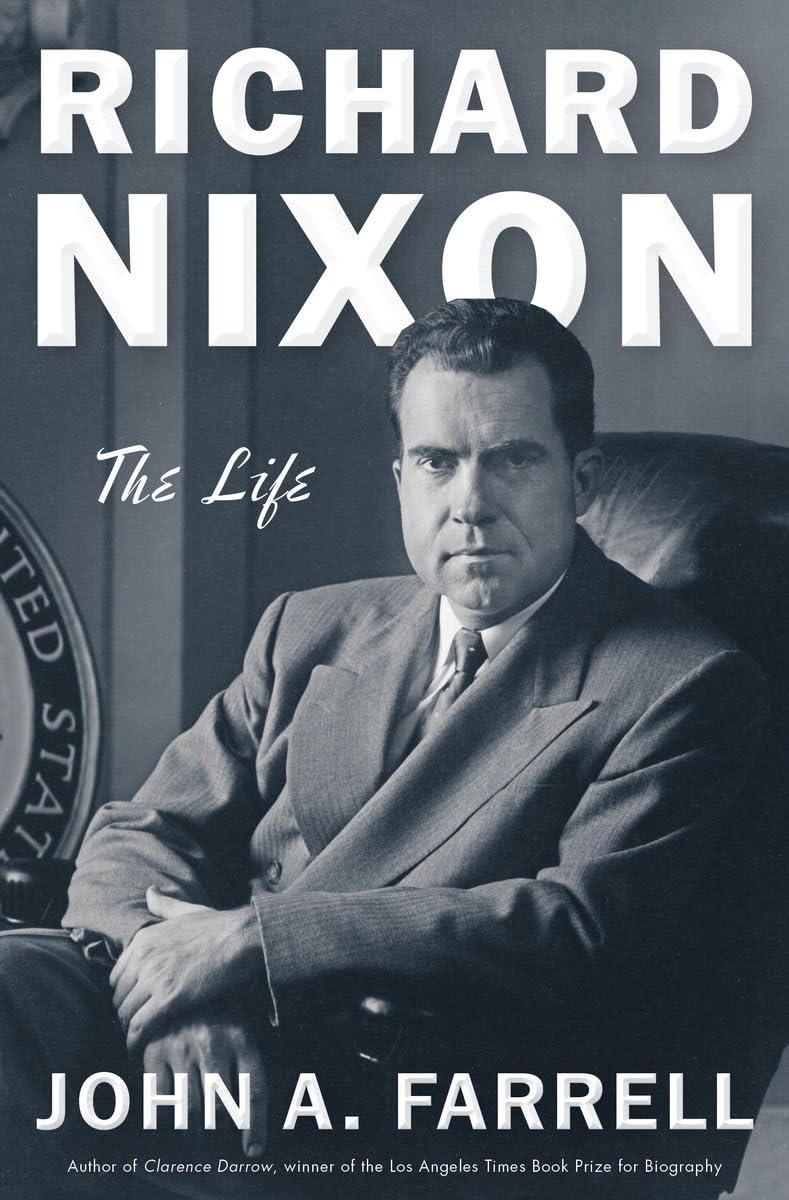
Richard Nixon Summary
By John A. Farrell
The Life
Summary preview
Richard Nixon has always seemed to live in two worlds at once. In one world, he is the scrappy boy from a hard luck family in Southern California, the son of a stern Quaker father and an ambitious mother, a young man who studies relentlessly, outworks richer rivals, and rises by force of discipline and nerve. In the other world, he is the dark, suspicious operator who sees enemies everywhere, stores up grudges like ammunition, and finally destroys himself in the greatest political scandal in American history. What makes this life so compelling is that both worlds are real. They are not masks that cancel each other out. They are the two faces of the same man. That is the heart of John A. Farrell’s portrait. He does not give us a cartoon villain or a secret hero waiting to be rescued from his reputation. He gives us a whole human being, gifted and damaged, brave and petty, visionary and vindictive. Nixon was capable of great acts of statecraft. He opened relations with China, pursued arms control with the Soviet Union, and understood, often better than his peers, the anxieties and resentments of ordinary Americans who felt ignored by elites. At the same time, he nurtured a private politics of resentment and fear. He believed deeply in loyalty, yet he inspired distrust. He wanted greatness, yet he kept reaching for small and shabby advantages. The book follows this contradiction from the beginning. It starts in the lemon groves and grocery stores of Yorba Linda and Whittier, where family struggle and personal loss left their mark. It moves through his early hunger for advancement, his rise as an anti Communist congressman and senator, his years beside Dwight Eisenhower, his bitter defeats, and his astonishing comeback. Then it enters the White House years, where his largest achievements and his fatal compulsions sit side by side. You watch him handle war, diplomacy, protest, race, the press, and political enemies with a mix of shrewdness and insecurity that never stops shaping events. What emerges is not just the story of one presidency but of postwar America itself. The country Nixon spoke to was divided by class, race, culture, and the Vietnam War. He sensed those fractures early and exploited them brilliantly. He also reflected them. His language of the “silent majority” gave millions a voice, but his methods widened the corrosion of public trust. For instance, the same president who could think on a grand geopolitical scale could also obsess over leaks, enemies lists, and acts of political sabotage. This is a life told with sympathy but without softness. It asks you to see how injury can become ambition, how ambition can become power, and how power, in the hands of a man unable to master his own suspicions, can turn inward and rot. By the end, Nixon stands not as a simple warning or a simple triumph, but as a tragic American figure who reached the summit and then, unable to escape himself,...
Sign up to continue reading
Get access to full book summaries, audio of the summaries, and many more.
Similar Books
Books with a similar vibe—explore more like this.
Guantánamo Diary
Mohamedou Ould Slahi, edited by Larry Siems
Guantanamo from the Inside
4.7 (3)27 mins

For the Record
David Cameron
An honest account from a prime minister who truly altered his country's course
4.5 (14)30 mins
On the House
John Boehner
A Washington Memoir
4.4 (3)27 mins

The First Muslim
Lesley Hazleton
The Story of Muhammad
4.2 (27)35 mins

Unbroken Bonds of Battle
Johnny Joey Jones
A Book of Heroism, Patriotism, and Friendship
4.0 (18)21 mins
After the Fall
Ben Rhodes
Being American in the World We've Made
3.9 (47)25 mins

Undaunted
John O. Brennan
My Fight Against America's Enemies, At Home and Abroad
3.8 (5)38 mins

A Very Stable Genius
Philip Rucker and Carol Leonnig
Donald J. Trump's Testing of America
3.6 (40)27 mins

Speaking for Myself
Sarah Huckabee Sanders
Faith, Freedom, and the Fight of Our Lives Inside the Trump White House
3.3 (18)24 mins
Bedtime Biography: Yes I Can
Sammy Davis, Jr. and Jane and Burt Boyar
The Story of Sammy Davis Jr.
4.9 (7)26 mins