
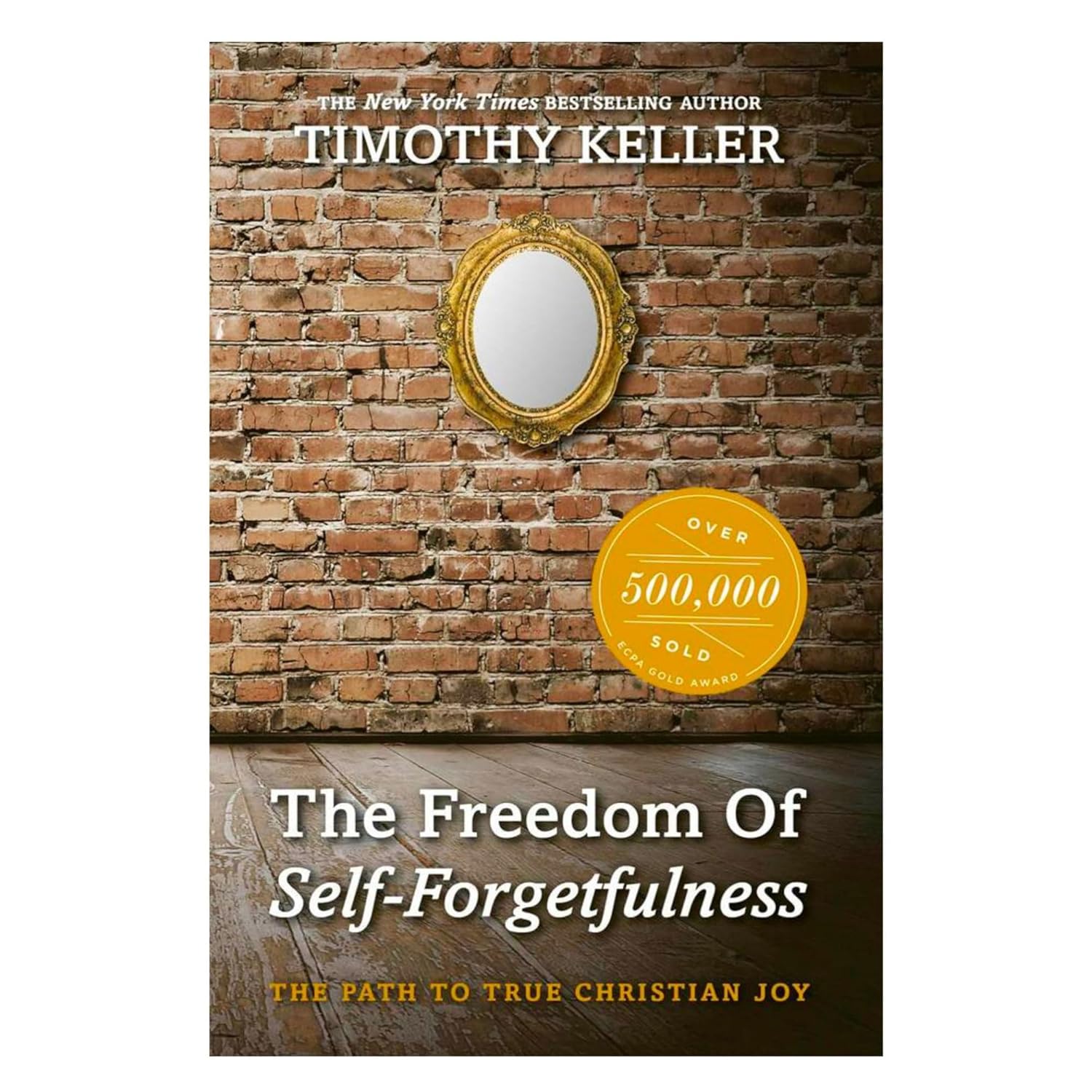
The Freedom of Self-Forgetfulness Summary
By Timothy Keller
The Path to True Christian Joy
Summary preview
Most of us spend an enormous part of life thinking about ourselves. We worry about how we appear, how we compare, whether we are winning or losing, whether other people respect us, and whether we can respect ourselves. Even when we are trying to be humble, we are often still circling around the self. We are bruised by criticism, inflated by praise, and quietly exhausted by the endless work of managing an identity. That is the human problem this little book takes up with striking clarity. Timothy Keller takes a short passage from Paul’s first letter to the Corinthians and opens up a vision of freedom that is surprising, deeply Christian, and very practical. The issue is not simply low self esteem, nor is it high self esteem. The modern world often tells us that the answer to insecurity is to think better of ourselves, to admire ourselves more, to build a stronger sense of worth from within. But that does not really solve the problem. If you make your identity depend on your achievements, your morality, your gifts, your appearance, or even your spiritual record, you are still trapped inside a courtroom where the verdict on your life always seems unfinished. You keep returning to the bench, trying to prove yourself one more time. The book’s central claim is wonderfully simple. Real freedom comes not from loving yourself more, and not from hating yourself less, but from forgetting yourself. The healthy person is not a person who constantly says, I am important. The healthy person is one who is simply not thinking about the self very much at all. That sounds strange at first, because we have been trained to believe that peace lies in a more secure self image. Yet the book argues that the more you stare at yourself, whether proudly or anxiously, the less free you become. To make this clear, the argument moves in a steady sequence. It begins by showing what a fragile ego looks like and why ordinary methods of feeding it never work for long. Then it explores what Paul means when he says he cares very little about the opinions of others, and even about his own opinion of himself. Finally, it turns to the gospel, where the deepest reason for self forgetfulness is found. The Christian message says that the verdict we crave has already been given in Christ. Because of that, the frantic need to perform can begin to die. This is a brief book, but it reaches into ordinary life with unusual force. It speaks to ambition, relationships, criticism, pride, shame, and the ache to matter. It invites you into a life that is lighter, steadier, and more joyful because the self is no longer sitting at the center of everything.
Sign up to continue reading
Get access to full book summaries, audio of the summaries, and many more.
Similar Books
Books with a similar vibe—explore more like this.

The Seven Circles
Chelsey Luger & Thosh Collins
Indigenous Teachings for Living Well
4.7 (13) mins

The Inner Work
Mathew Micheletti & Ashley Cottrell
An Invitation to True Freedom and Lasting Happiness
4.6 (76)22 mins
The Road Less Traveled
M. Scott Peck
A New Psychology of Love, Traditional Values and Spiritual Growth
4.4 (1249)22 mins
Letting Go
David R. Hawkins
The Pathway of Surrender
4.4 (1029)21 mins
Codependent No More
Melody Beattie
How to Stop Controlling Others and Start Caring for Yourself
4.4 (928)24 mins
Hope
Pope Francis, Jorge Mario Bergoglio
The Autobiography
4.4 (29)23 mins
Didn't See It Coming
Carey Nieuwhof
Overcoming the Seven Greatest Challenges That No One Expects and Everyone Experiences
4.3 (304)25 mins

The Four Agreements
Don Miguel Ruiz & Janet Mills
A Practical Guide to Personal Freedom
4.3 (913)21 mins
Choose Yourself
James Altucher
Be Happy, Make Millions, Live the Dream
4.3 (723)31 mins
Be Here Now
Ram Dass
Find Peace in the Now
4.3 (583)20 mins