
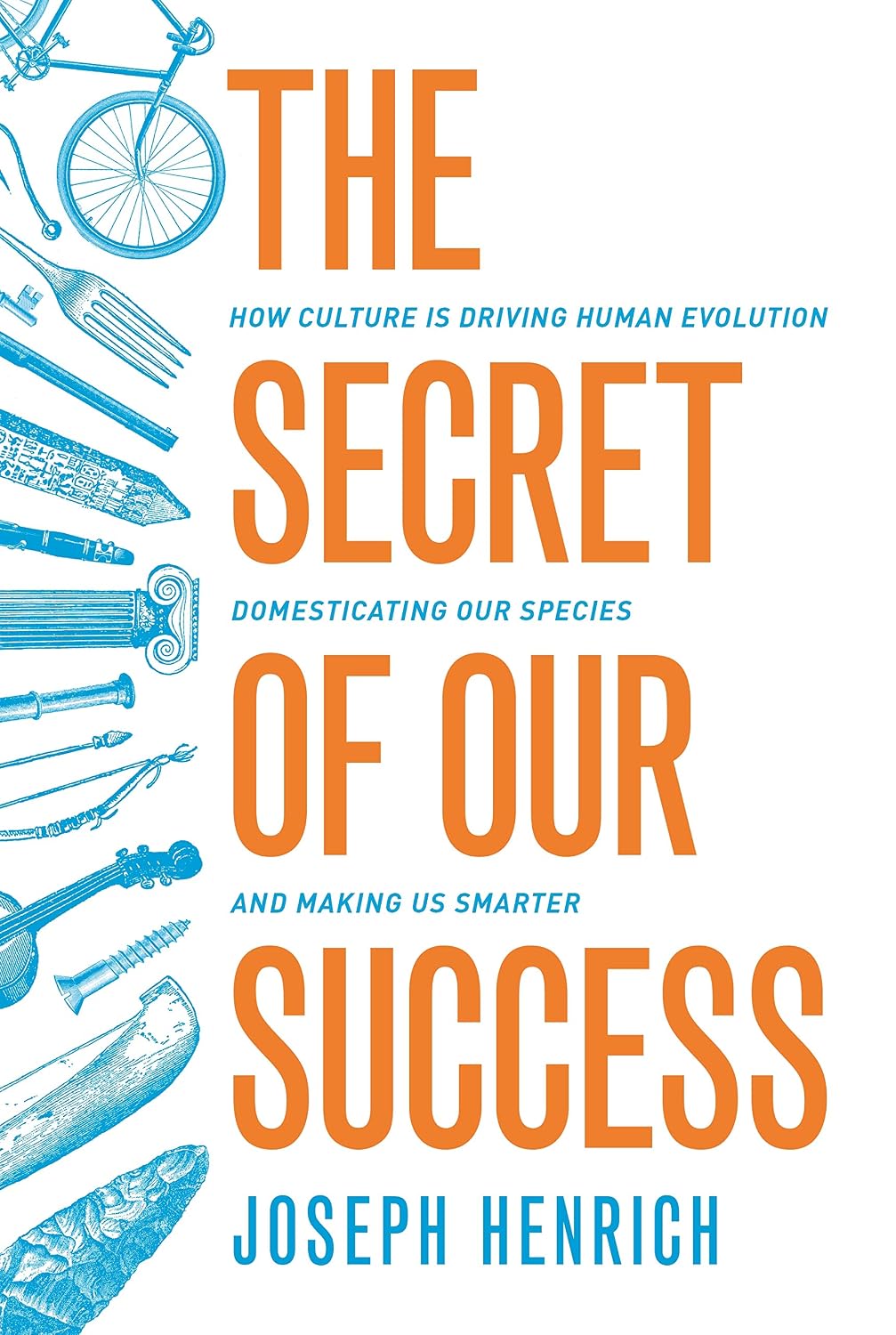
The Secret of Our Success Summary
By Joseph Henrich
How Culture Is Driving Human Evolution and More
Summary preview
Why are humans so successful? That is the puzzle at the heart of this book, and it turns out the answer is not what most of us were taught to believe. We like to imagine that our species rose to power because we are individually smarter, better at reasoning, or uniquely inventive. We tell ourselves a flattering story in which big brains and sharp logic carried us out of the Stone Age and into cities, science, and space travel. But the deeper you look, the less that story works. A lone human dropped into the wild is fragile, ignorant, and often helpless. We do not naturally know how to make a bow, track game, detoxify plants, navigate oceans, or survive Arctic winters. Yet groups of humans do these things all over the world, often with astonishing skill. The real secret, as Joseph Henrich argues, is that our species is adapted not just for thinking, but for learning from one another. We survive because we inherit vast bodies of know how from earlier generations. Much of this know how is not understood in any explicit, scientific sense by the people who use it. It is carried in habits, rituals, tools, norms, stories, and traditions. We copy successful people. We conform to what our community does. We trust elders, imitate experts, and absorb local practices long before we can explain them. Over many generations, this social learning allows useful ideas and techniques to accumulate, combine, and improve. That process, more than raw intelligence alone, built human success. Once you see this, many things begin to look different. Our large brains, our language, our long childhoods, our unusual family structures, and even our moral emotions start to make sense as parts of a cultural learning machine. Human evolution did not produce isolated geniuses who reinvent the world from scratch. It produced creatures able to tap into collective intelligence. Culture became a second inheritance system, working alongside genes and often reshaping the environments that genes then had to adapt to. From there the argument widens. The same forces that helped hunter gatherers survive in deserts, forests, and ice fields also help explain why some societies develop complex technologies, broad cooperation, powerful institutions, and thriving economies. Our psychology has been tuned by life in cultural groups, and those groups vary in ways that matter. This means that to understand religion, marriage, markets, punishment, prestige, innovation, and even intelligence itself, you have to understand cultural evolution. What follows is a sweeping tour through that idea. It moves from survival stories and laboratory findings to demography, history, economics, and human evolution. The result is a picture of our species that is at once humbling and exhilarating. We are not the smartest creatures because each of us knows so much. We are the smartest because together, across generations, we know vastly more than any one mind could ever hold.
Sign up to continue reading
Get access to full book summaries, audio of the summaries, and many more.
Similar Books
Books with a similar vibe—explore more like this.

Hope for Cynics
Jamil Zaki
The Surprising Science of Human Goodness
4.4 (574)20 mins

The Anxious Generation
Jonathan Haidt
How the Great Rewiring of Childhood Is Causing an Epidemic of Mental Illness
4.2 (325)20 mins

Brown Girl Dreaming
Jacqueline Woodson
Unravel a Moving Tale of Childhood Dreams, Race, and Empowerment
3.0 (5) mins

The Song of Roland
Anonymous
Enter a World of Medieval Heroism, Where Honor Reigns Supreme
4.9 (3)20 mins

Utilitarianism
John Stuart Mill
Explore a Timeless Ethics Classic
4.8 (46)24 mins

Othello
William Shakespeare
Love, Betrayal, and the Fall of a Hero
4.8 (14)22 mins
We Have Always Lived in the Castle
Shirley Jackson
Enter a Disturbing Labyrinth of Family Secrets and Dark Neurosis
4.8 (5)14 mins
The Extended Mind
Annie Murphy Paul
The Power of Thinking Outside the Brain
4.7 (971)30 mins
The Neuroscience of You
Chantel Prat
How every brain is different and how to understand yours
4.7 (679)20 mins
The Gift of Not Belonging
Rami Kaminski
How Outsiders Thrive in a World of Joiners
4.7 (89) mins