
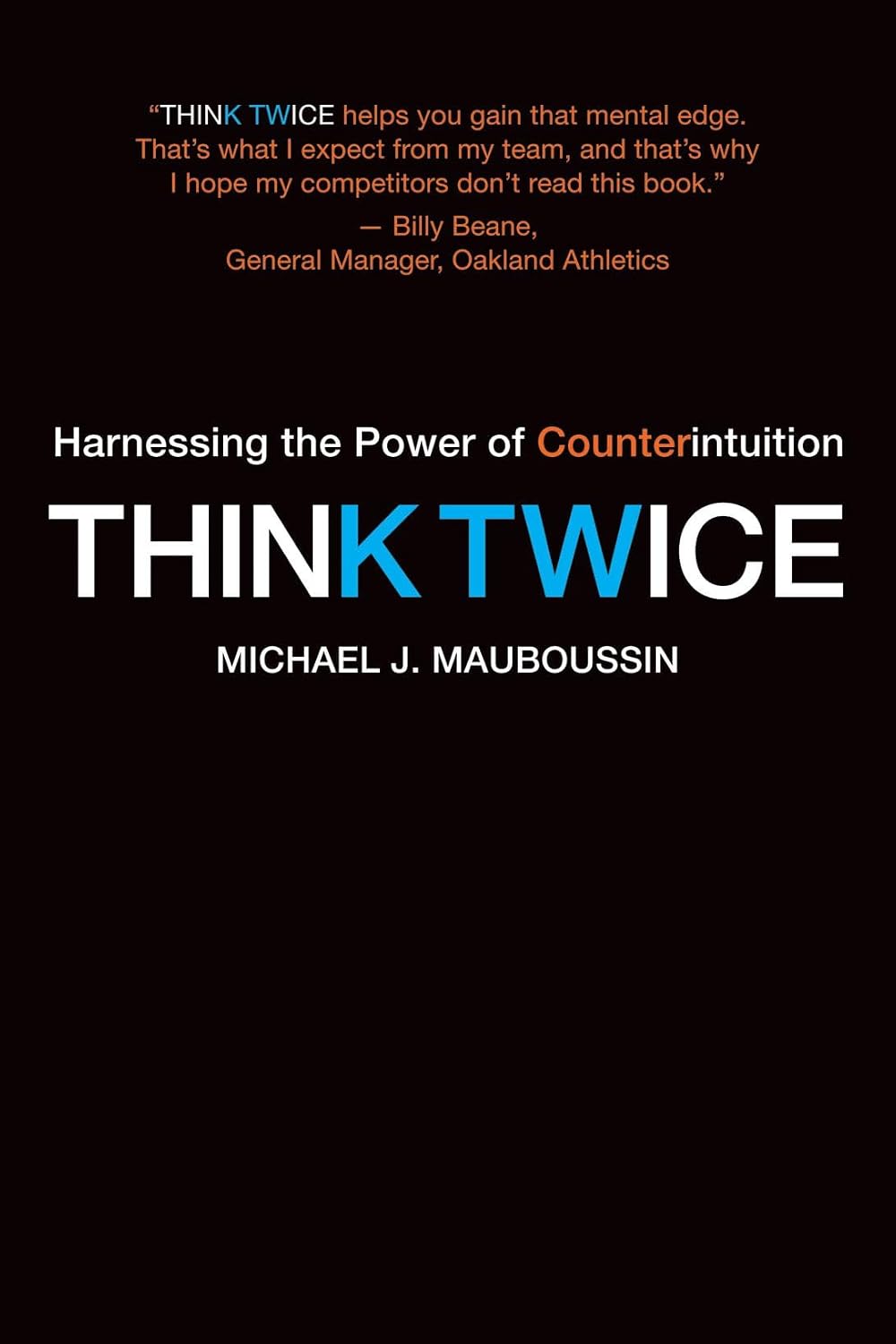
Think Twice Summary
By Michael J. Mauboussin
Harnessing the Power of Counterintuition
Summary preview
Think Twice is a book about one of the most practical skills any of us can build, which is the ability to make better decisions when the world is noisy, uncertain, and full of traps for the mind. Michael J. Mauboussin invites you to slow down just enough to see that many bad outcomes do not come from a lack of intelligence, effort, or information. They come from the way we naturally think. We jump to conclusions. We search for facts that support what we already believe. We confuse luck with skill. We tell neat stories about events that were actually messy and unpredictable. Then we act with confidence, even when confidence is the very thing that should worry us. The heart of the book is simple. If you want better results, you need a better process for thinking. That does not mean becoming cold or mechanical. It means recognizing that the brain has habits, and some of those habits are useful while others quietly lead us off course. The book works like a field guide to those habits. It points out the mental shortcuts that help us get through the day, and then shows how the same shortcuts can mislead us when stakes are high. Investing is one setting where these mistakes are especially visible, but the lessons reach much further. They apply to business, sports, medicine, leadership, and everyday life. What makes the book especially engaging is that it does not just list biases and leave you there. It moves from diagnosis to discipline. It shows why the mind works as it does, how social pressure and emotions intensify our errors, and what practical habits can help us think more clearly. You are encouraged to ask better questions, to look at base rates, to separate process from outcome, and to challenge your own certainty. The message is not that you can eliminate error. You cannot. The message is that you can become more aware of the conditions that produce error and build routines that reduce the damage. Along the way, the argument is grounded in vivid examples from psychology, finance, and organizational life. For example, a money manager may appear brilliant during a lucky streak, only to look ordinary when the environment changes. A company may celebrate a bold decision because it worked, even if the reasoning behind it was poor. A team may ignore outside evidence because its own story feels more convincing. These are not rare exceptions. They are common patterns. By the time the book opens up, you can feel its real ambition. It wants to change the way you think about thinking. It asks you to pause before acting, to question what feels obvious, and to build a mindset that is both humble and sharp. Think twice, the title suggests, not because thought should be slow for its own sake, but because a second look often reveals what the first glance missed.
Sign up to continue reading
Get access to full book summaries, audio of the summaries, and many more.