
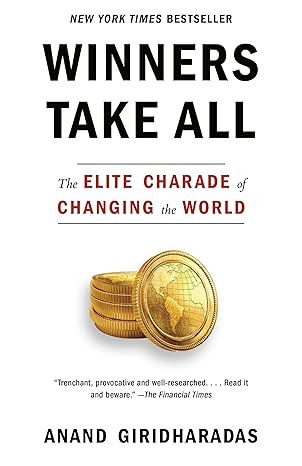
Winners Take All
By Anand Giridharadas
The Elite Charade of Changing the World
Introduction
There is a story powerful people like to tell about themselves. It is a flattering story, a hopeful story, a story that lets them keep everything they have while feeling noble about the wreckage around them. It says that the same winners who benefit most from our age of inequality are also the ones best equipped to solve it. It says private genius can fix public failure. It says the market can repair the harms the market helped create. And if you listen closely, it says something even more comforting to those at the top. It says they need not be challenged, constrained, taxed much, or made to share power. They need only be admired, invited, and given a stage. That is the illusion this book sets out to puncture. Anand Giridharadas walks into the worlds of elite philanthropy, social entrepreneurship, high minded conferences, and billionaire reformism not as an outsider who has never seen them, but as someone who once believed in much of what they promise. He attends the gatherings where rich and influential people speak of changing the world. He listens to the language of innovation, disruption, impact, and doing well by doing good. He notices how often these phrases sparkle just enough to hide a harder truth. The people with the greatest influence are often trying to solve problems in ways that leave untouched the systems that made them winners in the first place. The book is not an attack on generosity itself. It is not sneering at people who care, or saying every donor, investor, or reformer is a fraud. The deeper argument is more unsettling than that. Good intentions, when trapped inside a rigged system, can become part of the rigging. Charity can ease pain while preserving the conditions that cause it. Market based fixes can turn every human need into a business opportunity. Elite compassion can make injustice more bearable without making it less real. What unfolds is a guided tour through the moral logic of our gilded age. We meet billionaire philanthropists who want to give back without giving up. We meet social entrepreneurs who treat citizenship like a startup pitch. We meet institutions that celebrate change so long as it does not threaten concentrated wealth. Again and again, the same pattern appears. The winners are allowed to define both the problem and the acceptable solution. They fund what feels innovative. They avoid what feels political. They praise collaboration while resisting redistribution. They want to improve the world, but on terms that leave their own dominance secure. The question running through these pages is simple and explosive. Can the people who profit from an unjust order be trusted to remake it? Or are they, despite all their brilliance and benevolence, too invested in the very rules that need changing? This book asks you to look past the glow of elite virtue and ask what justice would require if the point were not to feel good about change, but to actually make it...
Sign up to continue reading
Get access to full book summaries, audio of the summaries, and many more.
Similar Books
Books with a similar vibe—explore more like this.
The Big Short
Michael Lewis
Inside the Doomsday Machine
4.5 (1357)36 mins
Utopia for Realists
Rutger Bregman
And How We Can Get There
4.5 (839)31 mins
The $12 Million Stuffed Shark
Don Thompson
The Curious Economics of Contemporary Art
4.4 (573)24 mins
Americana
Bhu Srinivasan
A 400-Year History of American Capitalism
4.3 (123)31 mins
Capital
Karl Marx
A Critique of Political Economy
4.3 (794)24 mins
Capitalism Socialism and Democracy
Joseph Schumpeter
Essential analysis on where the world economy is headed
4.3 (728)26 mins
The Sum of Us
Heather McGhee
What Racism Costs Everyone and How We Can Prosper Together
4.3 (628)25 mins
How Economics Explains the World
Andrew Leigh
A Short History of Humanity
4.2 (117)25 mins
Power and Progress
Daron Acemoglu & Simon Johnson
Our Thousand-Year Struggle Over Technology and Prosperity
4.0 (389)24 mins
The Technology Trap
Carl Benedikt Frey
Capital, Labor, and Power in the Age of Automation
3.9 (734)18 mins