
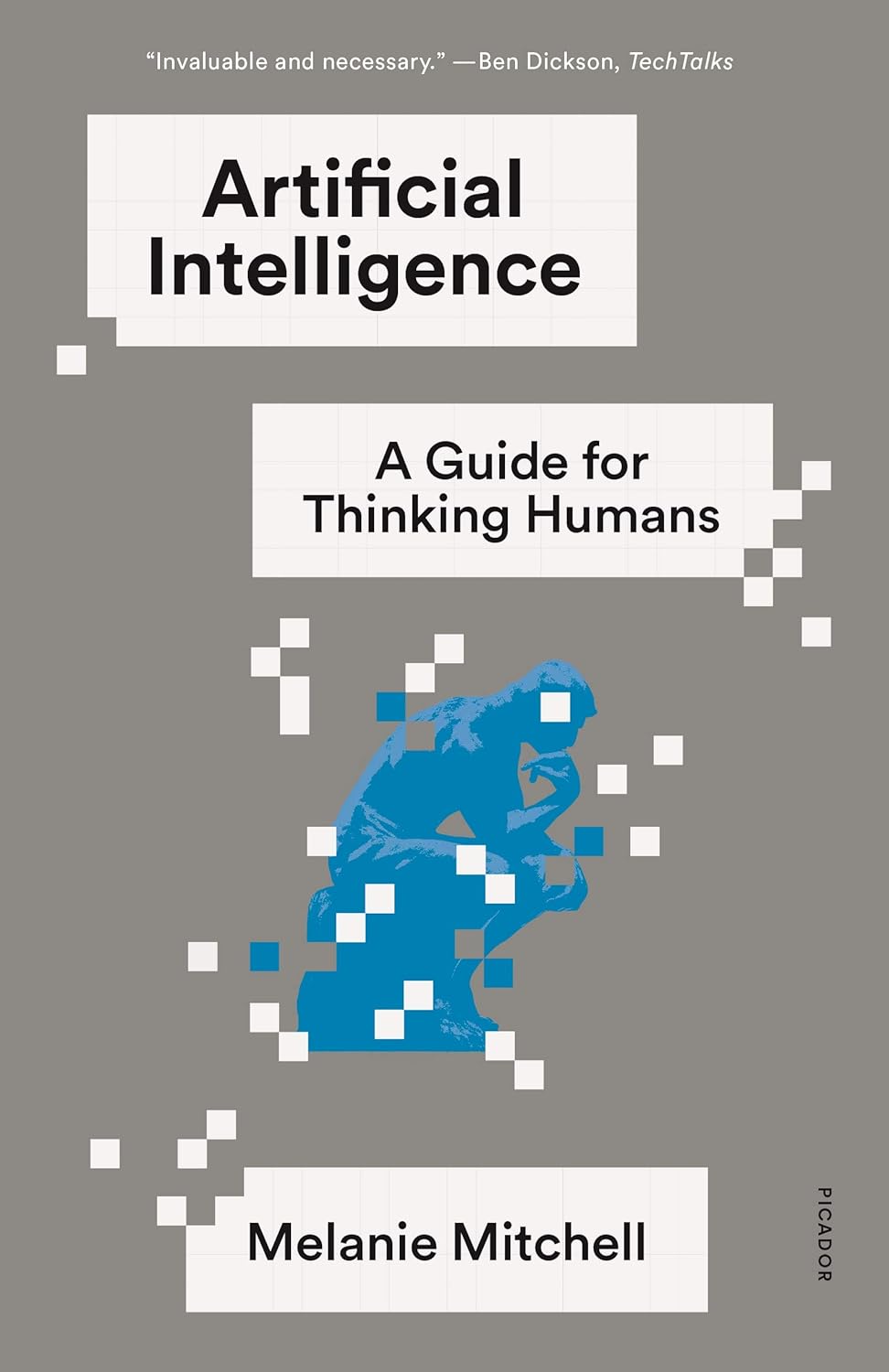
Artificial Intelligence Summary
By Melanie Mitchell
A Guide for Thinking Humans
Summary preview
Artificial intelligence has always carried two kinds of power at once. One is practical. We build machines to recognize speech, recommend songs, drive cars, translate languages, diagnose disease, and sort through oceans of data. The other is imaginative. We picture minds made of circuits, helpers and rivals, tools and beings, and we ask a deep question that sits underneath all the noise. What does it really mean for a machine to be intelligent? That question is the beating heart of this book. Melanie Mitchell guides you through the long, strange, exciting story of AI, not as a clean march of progress but as a field full of bold dreams, surprising successes, stubborn failures, and repeated lessons that people often forget. The book is not simply a celebration of clever technology. It is a reality check, a history lesson, and an invitation to think more clearly. You are shown why AI systems can seem dazzling one moment and deeply confused the next, why headline grabbing breakthroughs do not automatically add up to humanlike understanding, and why intelligence is much broader and messier than solving narrow tasks. The journey begins with the old ambitions of AI. Researchers wanted machines that could reason, use language, form concepts, and make sense of the world the way people do. Over time, different approaches rose and fell. Some researchers tried to encode knowledge and logic directly. Others turned to learning from data, especially through neural networks. Again and again, success on specific benchmarks created optimism that general intelligence might be near. Again and again, the world pushed back. Systems that performed beautifully in limited settings broke down when faced with ambiguity, novelty, context, or common sense. What makes this account especially vivid is that it never treats intelligence as just a technical puzzle. It connects AI to psychology, biology, philosophy, and daily life. Human minds learn from surprisingly little data, move easily across situations, and rely on rich background knowledge of the physical and social world. Machines often need enormous amounts of examples and still lack the flexible understanding that children display without effort. That gap matters. It shapes what current AI can do, what it cannot do, and what kinds of research might actually move us forward. By the time you move through the book, you are not being asked to choose between hype and cynicism. You are being asked to look carefully. Some systems are astonishing. Some claims are inflated. Some problems are technical. Others are conceptual. And all of it leads back to the same central challenge. If we want machines with something closer to genuine intelligence, we need more than speed, more than data, and more than bigger benchmarks. We need a deeper grasp of what intelligence itself is.
Sign up to continue reading
Get access to full book summaries, audio of the summaries, and many more.
Similar Books
Books with a similar vibe—explore more like this.

Liftoff
Eric Berger
Elon Musk and the Desperate Early Days That Launched SpaceX
4.6 (638)26 mins
Humility Is The New Smart
Edward D. Hess and Katherine Ludwig
Rethinking Human Excellence In the Smart Machine Age
4.6 (49)21 mins

Power Play
Tim Higgins
Tesla, Elon Musk, and the Bet of the Century
4.4 (682)22 mins
Human Edge in the AI Age
Nitin Seth
Eight Timeless Mantras For Success
4.3 (28)25 mins

Bedtime Biography: Yes I Can
Sammy Davis, Jr. and Jane and Burt Boyar
The Story of Sammy Davis Jr.
4.9 (7)26 mins

The Little Prince
Antoine de Saint-Exupéry
A Tale About the Human Condition and the Search for Happiness
4.9 (36)22 mins
Surrender to Lead
Jessica Kriegel, Joe Terry
The Counterintuitive Approach to Driving Extraordinary Results
4.9 (7)21 mins

Girl Code
Cara Alwill Leyba
Secrets to Sanity and Success for the Female Entrepreneur
4.9 (4)21 mins
Nineteen Eighty-Four (1984)
George Orwell
A Dystopian Classic on the Dangers of Totalitarianism
4.9 (697)17 mins

American Lion
Jon Meacham
Andrew Jackson in the White House
4.9 (16)35 mins