
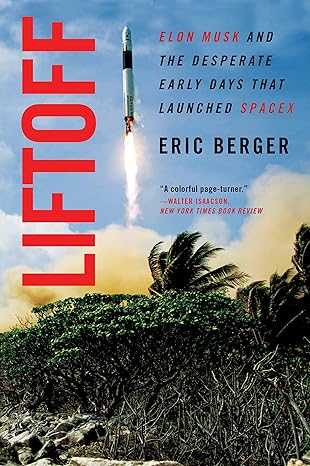
Liftoff Summary
By Eric Berger
Elon Musk and the Desperate Early Days That Launched SpaceX
Summary preview
Liftoff tells the story of how a small, bruised, stubborn company did something most experts thought was nearly impossible. It follows SpaceX through its earliest years, when the dream of reaching orbit was not a polished business plan or a glossy legend, but a messy, high risk bet held together by ambition, improvisation, and a startling tolerance for failure. At the center of it all is Elon Musk, not yet the mythic figure he would become, but a relentless founder spending his own fortune on a rocket company that many people in aerospace quietly assumed would flame out. The book is really about the creation of Falcon 1, the first rocket SpaceX tried to build and fly. That sounds simple when said quickly. It was anything but simple. The company had to hire the right people, build engines from scratch, invent manufacturing systems, set up operations in remote places, survive technical disasters, and keep going after one failure after another. The story moves from cramped offices and rough factory floors to a tiny launch island in the Pacific, where pressure, heat, corrosion, and isolation made every task harder. What emerges is not a clean victory march, but a true startup tale, full of chaos, personality clashes, impossible deadlines, and moments where success looked one decision away from disappearing. What gives the book its energy is the way it stays close to the people doing the work. You see young engineers sleeping little, learning fast, and carrying responsibilities far beyond what large traditional aerospace firms would ever give them. You see a company culture that prized speed, directness, and action over bureaucracy. You also see the cost of that culture. People burned out. Mistakes happened. Tempers flared. The company often lived right on the edge, financially and emotionally. At the same time, the story captures a larger shift in the space industry. Falcon 1 was not only a vehicle. It was a proof of concept for a new way of building rockets. The goal was to make spaceflight cheaper, faster, and more iterative, more like software or consumer technology than the old government led model. That meant accepting failure as part of learning, while still knowing that one more failure could end the entire company. Eric Berger presents this as both a human drama and an industrial turning point. By the time you reach the end, you understand that the first successful launch of Falcon 1 mattered far beyond one rocket. It helped open the door to reusable launch systems, commercial crew flights, and a transformed space economy. But before any of that could happen, a handful of people had to drag a fragile machine to a remote island and make it fly.
Sign up to continue reading
Get access to full book summaries, audio of the summaries, and many more.
Similar Books
Books with a similar vibe—explore more like this.

Humility Is The New Smart
Edward D. Hess and Katherine Ludwig
Rethinking Human Excellence In the Smart Machine Age
4.6 (49) mins

Power Play
Tim Higgins
Tesla, Elon Musk, and the Bet of the Century
4.4 (682)22 mins

Human Edge in the AI Age
Nitin Seth
Eight Timeless Mantras For Success
4.3 (28)25 mins

Artificial Intelligence
Melanie Mitchell
A Guide for Thinking Humans
4.0 (31) mins

Bedtime Biography: Yes I Can
Sammy Davis, Jr. and Jane and Burt Boyar
The Story of Sammy Davis Jr.
4.9 (7) mins

The Little Prince
Antoine de Saint-Exupéry
A Tale About the Human Condition and the Search for Happiness
4.9 (36) mins

Surrender to Lead
Jessica Kriegel, Joe Terry
The Counterintuitive Approach to Driving Extraordinary Results
4.9 (7) mins

Girl Code
Cara Alwill Leyba
Secrets to Sanity and Success for the Female Entrepreneur
4.9 (4) mins

Nineteen Eighty-Four (1984)
George Orwell
A Dystopian Classic on the Dangers of Totalitarianism
4.9 (697) mins

American Lion
Jon Meacham
Andrew Jackson in the White House
4.9 (16)35 mins