
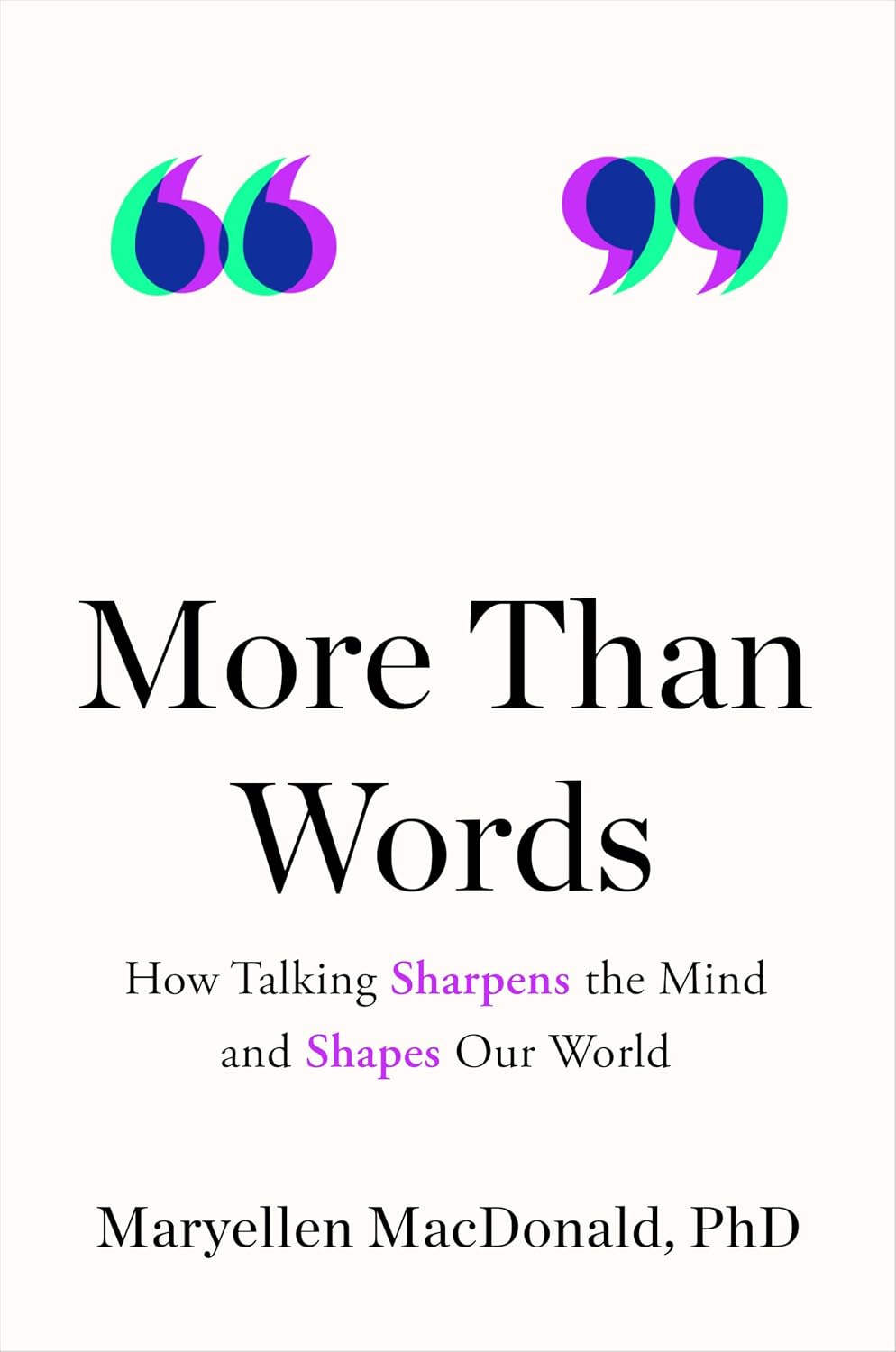
More Than Words Summary
By Maryellen MacDonald
How Talking Sharpens the Mind and Shapes Our World
Summary preview
Language feels easy when it works. We open our mouths and ideas come out. We listen and somehow turn waves of sound into meaning, emotion, memory, and action. Yet that smooth surface hides a remarkable mental achievement. In More Than Words, Maryellen MacDonald invites you behind the curtain to see how speaking, listening, reading, and understanding really happen. Her big message is simple and powerful. Language is not a neat little box in the mind, separate from the rest of human life. It is built from the same mental systems we use for moving, remembering, paying attention, learning patterns, and living with other people. That shift matters. Many of us grow up with the idea that language is special in a narrow sense, almost like a self contained machine with its own rules and its own mental organ. This book pushes back on that picture. It asks you to look at language as something the brain does with all its tools at once. Words are shaped by memory limits, by habits of attention, by the body, by the structure of action, by what speakers expect listeners to know, and by the long history of repeated experience that tunes the mind. Once you see that, many puzzles begin to make sense. Why do some sentence patterns feel harder than others. Why do speakers make slips. Why are some words easy to find and others frustratingly out of reach. Why do frequent expressions come so smoothly. Why does conversation demand such fast coordination. The book moves through these questions with a lively mix of cognitive science, psycholinguistics, everyday examples, and stories from research. You are shown not only what people say, but how scientists figure out what is happening underneath. Experiments on reading times, speech errors, memory, eye movements, and sentence processing become windows into the hidden labor of comprehension and production. For example, a simple hesitation, a garden path sentence, or a familiar phrase can reveal how much prediction and planning the brain is doing every second. What makes the book especially engaging is its way of connecting lab findings to ordinary life. It never lets language become abstract. Instead, it keeps bringing you back to human behavior as it is actually lived. You speak under pressure. You listen with distractions. You rely on routines. You adjust to your partner in conversation. You make use of what you have practiced most. Language, in this view, is more than words because meaning emerges from a whole person in a whole world. As the journey unfolds, you come to see language not as an isolated miracle but as a deeply integrated skill. That does not make it less amazing. It makes it more so. The wonder lies in how many systems work together so quickly and so well, and in how experience shapes them over time into the rich, flexible communicative life we usually take for granted.
Sign up to continue reading
Get access to full book summaries, audio of the summaries, and many more.
Similar Books
Books with a similar vibe—explore more like this.
The Courage to Teach
Parker J. Palmer
Exploring the Inner Landscape of a Teacher's Life
4.2 (5)23 mins
Once Upon a Stranger
Gillian Sandstrom
The Science of How Small Talk Can Add Up to a Big Life
4.7 (21) mins
The New Emotional Intelligence
Travis Bradberry
Master your emotional skills for lasting success
4.7 (48) mins

Fawning
Ingrid Clayton
Finding Your Way Back from the Need to Please
4.6 (15) mins
Not Nice
Aziz Gazipura
Stop People Pleasing, Staying Silent, & Feeling Guilt and Start Speaking Up, Saying No, Asking Boldly, and Unapologetically Being Yourself
4.5 (414)29 mins
Productive Failure
Manu Kapur
Unlocking Deeper Learning Through the Science of Failing
4.5 (211)22 mins
Atlas of the Heart
Brené Brown
Mapping Meaningful Connection and the Language of Human Experience
4.5 (1028)31 mins
The Narcissist's Playbook
Dana Morningstar
How to Identify, Disarm, and Protect Yourself from Narcissists, Sociopaths, Psychopaths, and Other Types of Manipulative and Abusive People
4.5 (15) mins
The Narcissist in Your Life
Julie L. Hall
Recognizing the Patterns and Learning to Break Free
4.5 (33) mins
Playful
Cas Holman
How Play Shifts Our Thinking and Sparks Creativity
4.5 (13) mins