
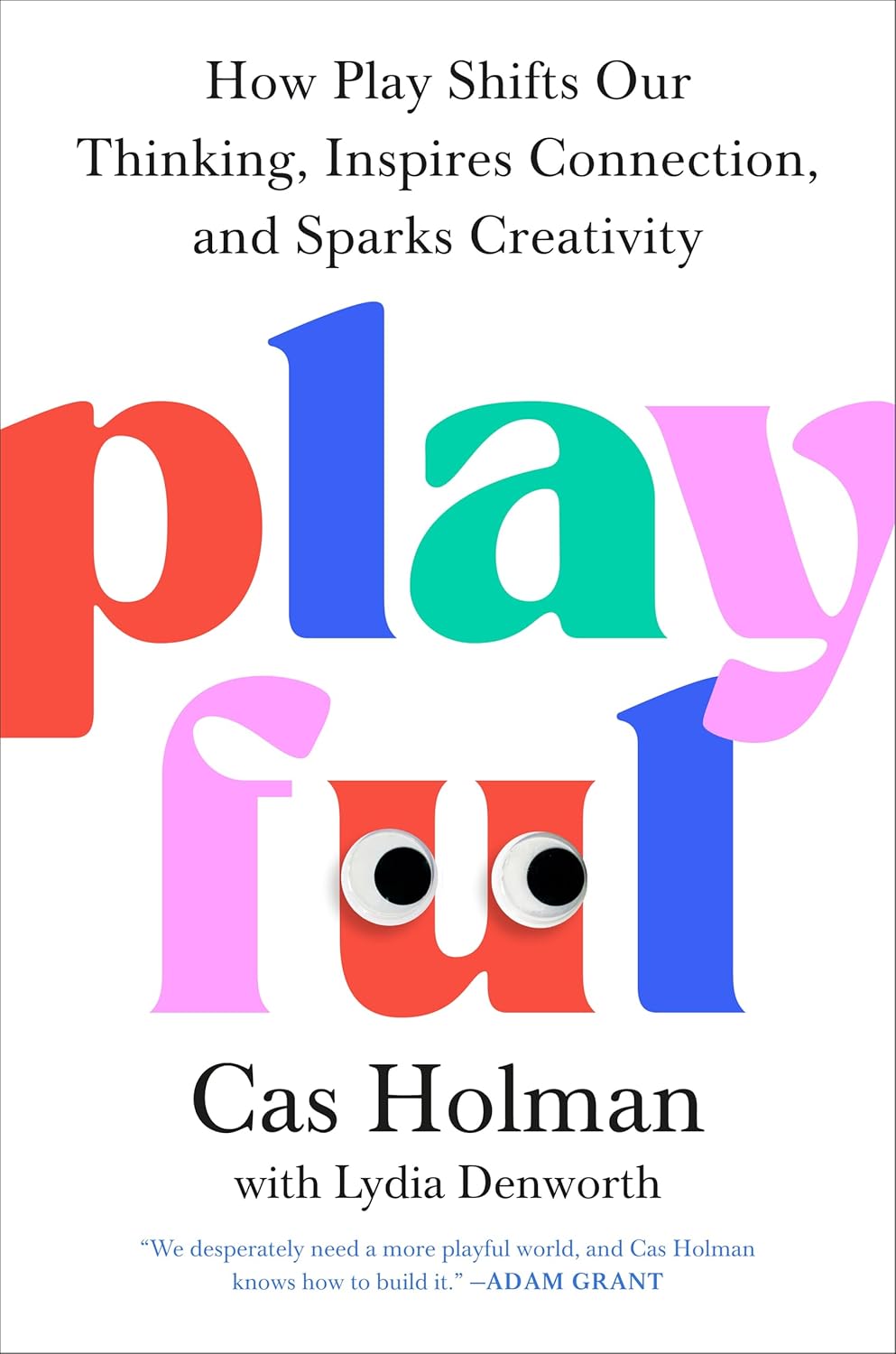
Playful Summary
By Cas Holman
How Play Shifts Our Thinking and Sparks Creativity
Summary preview
Play is not a break from life. It is one of the clearest ways we come alive inside it. That is the heart of Playful. Cas Holman invites you to see play not as a reward after work, not as a childish extra, and not as something useful only when it teaches a lesson. Play matters because it lets people explore who they are, what the world can do, and what becomes possible when rules loosen and curiosity leads. The book grows out of years spent making toys, watching children, building public play spaces, and learning from the wild intelligence of open ended activity. It argues for a simple but powerful shift. Instead of asking what children should make, know, or achieve, ask what kinds of conditions let them experiment, invent, negotiate, fail safely, and try again. Instead of controlling every outcome, make room for surprise. Instead of treating mess, ambiguity, and repetition as problems, recognize them as signs that something real is happening. The voice of the book is practical and philosophical at the same time. It stays close to the ground, to bodies moving through space, hands touching materials, groups figuring things out together. But it also keeps opening into bigger questions about freedom, trust, risk, learning, and the social world we are quietly training people to accept. When adults over design every object and every environment, they do more than organize play. They narrow imagination. They teach children that the world arrives finished and that their role is to follow instructions. A more playful world says something very different. It says your ideas matter. It says you can test reality. It says the built world is not fixed. Again and again, the book returns to open ended materials and spaces that do not dictate one correct use. A loose part can become a costume, a machine, a home, or a joke. A playground can become a site of cooperation, conflict, invention, and social rehearsal. A toy can be less like a script and more like an invitation. That difference changes everything. What unfolds across the book is both a defense of play and a way of practicing it. You are asked to notice children more carefully, to intervene less quickly, to tolerate uncertainty, and to remember your own capacity for improvisation. The point is not to romanticize childhood. It is to remember that play is a lifelong human language. Through it, people build resilience, empathy, agency, and delight. Playful makes the case that if we want freer minds and more responsive communities, we need spaces, objects, and relationships that welcome exploration rather than control.
Sign up to continue reading
Get access to full book summaries, audio of the summaries, and many more.
Similar Books
Books with a similar vibe—explore more like this.
Humor Me
Christopher Duffy
How Laughing More Can Make You Present, Creative, Connected, and Happy
4.7 (28)23 mins
More Than Words
Maryellen MacDonald
How Talking Sharpens the Mind and Shapes Our World
4.4 (16)20 mins
Non-Obvious Thinking
Rohit Bhargava, Ben DuPont
How to See What Others Miss
4.3 (768)18 mins
Says Who?
Anne Curzan
A Kinder, Funner Usage Guide for Everyone Who Cares About Words
4.2 (11)26 mins
The Courage to Teach
Parker J. Palmer
Exploring the Inner Landscape of a Teacher's Life
4.2 (5)23 mins
The Creative Brain
Anna Abraham
Myths and Truths
4.1 (190)23 mins
The Art of Talking with Children
Rebecca Rolland
Nurturing Kindness, Creativity, and Confidence in Kids
4.1 (7)24 mins
How to Write One Song
Jeff Tweedy
Loving the Things We Create and How They Love Us Back
4.0 (139)22 mins
The Great Mental Models, Volume 4
Shane Parrish, Rhiannon Beaubien
Economics and Art
4.0 (26)23 mins

The Song of Roland
Anonymous
Enter a World of Medieval Heroism, Where Honor Reigns Supreme
4.9 (3)20 mins