
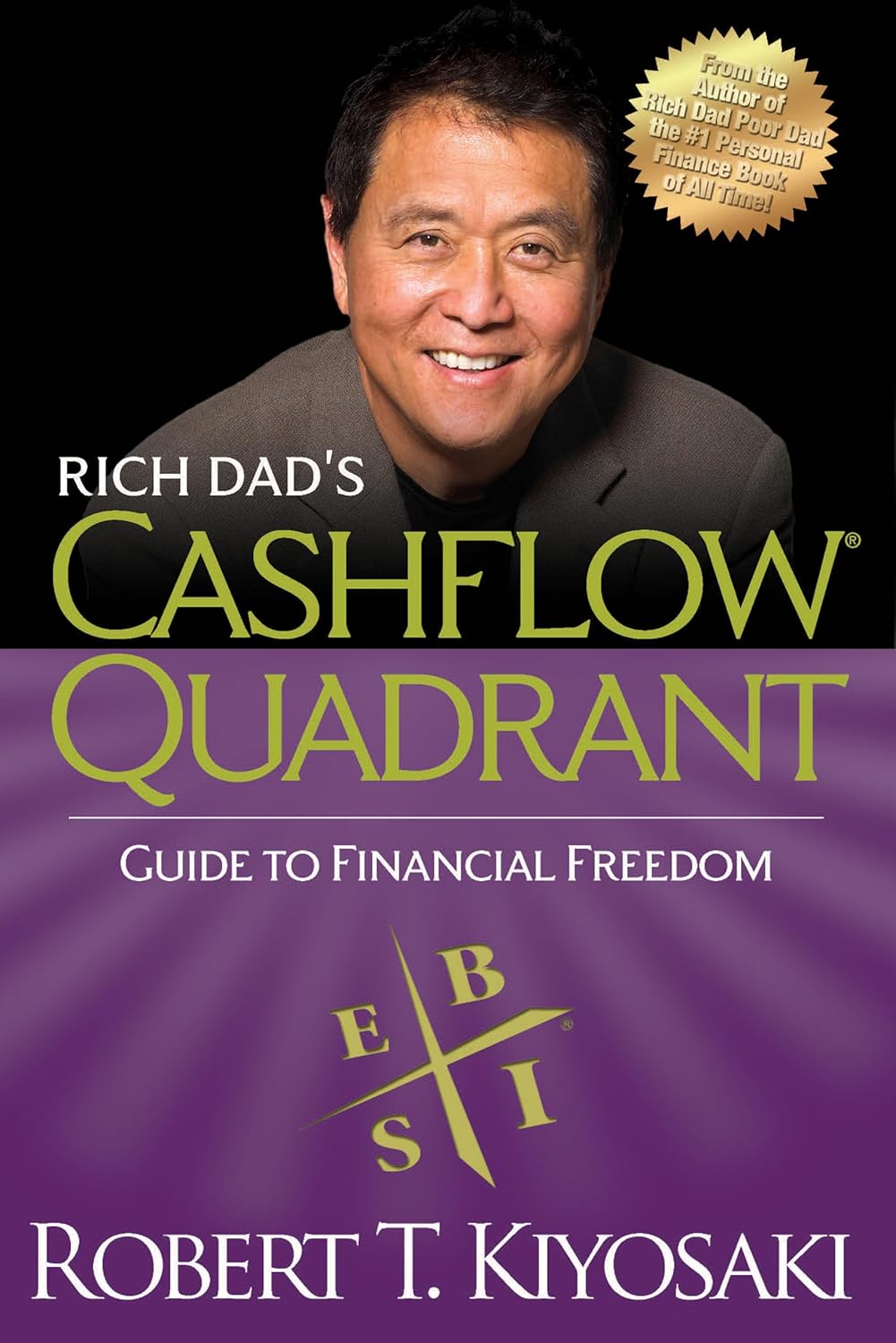
Rich Dad's Cashflow Quadrant Summary
By Robert T. Kiyosaki with Sharon L. Lechter
Guide to Financial Freedom
Summary preview
Most people grow up hearing one basic message about money. Go to school, get good grades, find a safe job, work hard, save money, stay out of debt, and maybe one day you will be secure. It sounds sensible. It sounds responsible. It is also the path that keeps many hardworking people trapped in stress, taxes, and the constant fear of losing what they worked so hard to build. That is where this book begins. It asks a simple but life changing question. Why do some people work less, make more, pay lower taxes, and become freer with time, while others work harder and harder yet never really get ahead? The answer is not just about how much money you make. It is about where your money comes from, how you think, and which side of a powerful diagram you live on. Robert T. Kiyosaki with Sharon L. Lechter uses the idea of the Cashflow Quadrant to explain that there are four main kinds of people in the world of income. On the left side are Employees and Self employed people. On the right side are Business owners and Investors. Each group has different values, different strengths, different fears, and different ways of creating money. The heart of the book is this. If you want financial freedom, you usually need to move from the left side to the right side. This is not just a book about money techniques. It is a book about identity. It is about the inner change required to stop depending on a paycheck and start building assets that generate cash flow. It is about learning to handle risk instead of hiding from it. It is about understanding taxes, debt, systems, and investments well enough to make them work for you instead of against you. It is also about why so many smart, educated, talented people struggle financially. School trains many people to be employees, but freedom often requires a different education. The voice throughout is personal and direct. You are not being lectured from a distance. You are being challenged. You are being asked to look honestly at your habits, your excuses, your fears, and your goals. Stories about rich dad and poor dad help show the difference between conventional wisdom and financial wisdom. For example, one father values job security and professional status, while the other values ownership, financial intelligence, and freedom. That contrast gives the whole book its energy. What follows is a roadmap for making one of the biggest shifts a person can make. Not just earning money, but changing the source of money. Not just working for income, but building assets that produce income with or without your daily labor. If you have ever felt that working harder is not the same as getting freer, this book was written for you.
Sign up to continue reading
Get access to full book summaries, audio of the summaries, and many more.
Similar Books
Books with a similar vibe—explore more like this.
The Fixer
Bradley Tusk
Saving Startups from Death by Politics
4.8 (5)32 mins
The Curse of Bigness
Tim Wu
Antitrust in the New Gilded Age
4.7 (820)39 mins
The Snowball
Alice Schroeder
Warren Buffett and the Business of Life
4.7 (106)33 mins
The Bitcoin Standard
Saifedean Ammous
The Decentralized Alternative to Central Banking
4.6 (291)34 mins
New to Big
David Kidder, Christina Wallace
How Companies Can Create Like Entrepreneurs, Invest Like VCs, and Install a Permanent Operating System for Growth
4.6 (683)31 mins
The Little Book of Common Sense Investing
John C. Bogle
The Only Way to Guarantee Your Fair Share of Stock Market Returns
4.6 (2674)23 mins
Big Mistakes
Michael Batnick
The Best Investors and Their Worst Investments
4.6 (17)27 mins
The NFT Handbook
Matt Fortnow and QuHarrison Terry
How to Create, Sell and Buy Non-Fungible Tokens
4.6 (137)26 mins
Financial Literacy for Managers
Richard A. Lambert
Finance and Accounting for Better Decision-Making
4.6 (22)22 mins
Rich Dad, Poor Dad
Robert T. Kiyosaki
What the Rich Teach Their Kids about Money – That the Poor and the Middle Class Do Not!
4.5 (6209)31 mins