
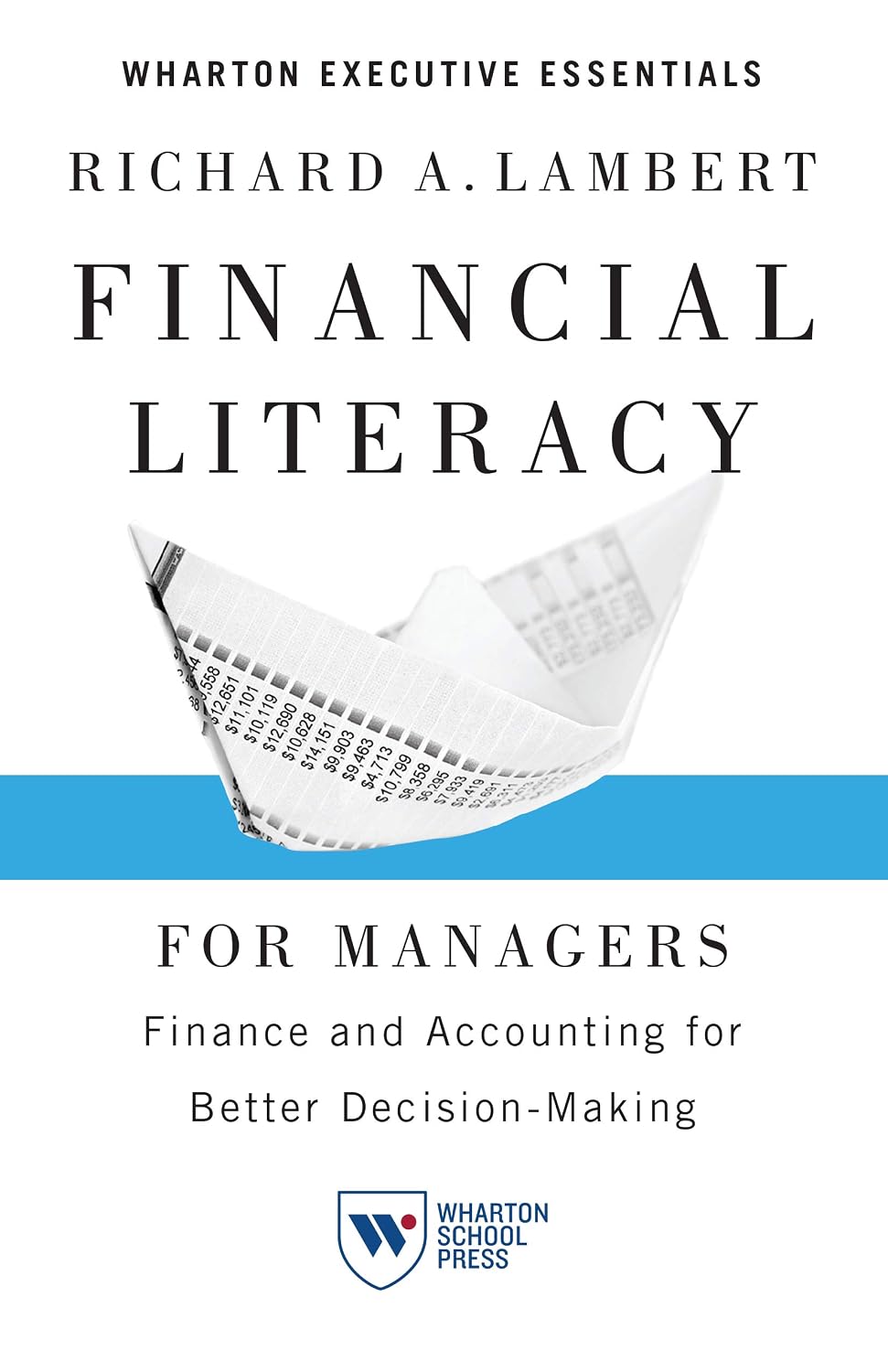
Financial Literacy for Managers Summary
By Richard A. Lambert
Finance and Accounting for Better Decision-Making
Summary preview
Most managers spend their days making choices that shape cost, quality, speed, growth, and risk. They hire people, approve projects, negotiate with suppliers, push for sales, and respond to pressure from above. Yet many do all this while feeling uneasy around the language of finance. They hear terms like return on investment, working capital, gross margin, and cash flow, and they know those ideas matter, but the numbers can still feel like a foreign country. That is the gap this book tries to close. Richard A. Lambert writes for managers who are smart, capable, and experienced, but who want to become far more confident when the conversation turns to financial results. The central promise is simple. You do not need to become an accountant to think financially. You do not need to memorize every rule or master every technical detail. What you do need is a practical understanding of how business activities show up in the numbers, how those numbers connect to one another, and how they can help you make better decisions. The book treats financial literacy not as a specialist skill for people in the finance department, but as a core management tool. If you manage people, products, operations, customers, budgets, or strategy, then finance belongs to your job. The tone is reassuring from the start. The message is that financial statements are not mysterious documents created to intimidate outsiders. They are simply organized ways of telling the story of a business. The income statement tells you whether value was created over a period of time. The balance sheet shows what the business owns, what it owes, and what is left for owners. The cash flow statement reveals where cash came from and where it went. Once you can read those stories clearly, you begin to see your own role differently. You stop seeing finance as a report card handed to you after the fact and start seeing it as a map for action. As the book unfolds, it keeps bringing the discussion back to a manager’s real world. Pricing decisions, cost control, investment choices, inventory levels, credit terms, staffing plans, and performance targets all carry financial consequences. A manager who understands those consequences can ask sharper questions and avoid common traps. A rise in sales may not mean a healthier business. A profitable division can still create cash strain. A cost cut can damage long term value if it hurts customers or weakens capability. Good management means seeing beyond the surface. At heart, this is a book about judgment. Numbers matter, but they matter because they help you think. They help you connect everyday choices to larger outcomes. They help you understand what creates value and what quietly destroys it. And they help managers speak with more authority across departments, especially with senior leaders and finance teams. The book invites you into that conversation with clarity, calm, and a steady belief that financial understanding is not only learnable, but essential.
Sign up to continue reading
Get access to full book summaries, audio of the summaries, and many more.
Similar Books
Books with a similar vibe—explore more like this.
A Beginner's Guide to the Stock Market
Matthew R. Kratter
Everything You Need to Start Making Money Today
4.5 (937)30 mins
The Leadership Pipeline
Ram Charan, Stephen Drotter, James L. Noel, Kent Jonasen
Developing Leaders in the Digital Age
4.5 (3)24 mins
The Trusted Learning Advisor
Keith Keating
The Tools, Techniques and Skills You Need to Make L&d a Business Priority
4.5 (3)24 mins

Smart Startups
Catalina Daniels, James H. Sherman
Tried and True Advice from 18 Harvard Business School Founders
4.2 (8)22 mins

The Modern Learning Ecosystem
JD Dillon
A New L&D Mindset for the Ever-Changing Workplace
4.2 (5)21 mins
The 12-Week MBA
Nathan Kracklauer & Bjorn Billhardt
Learn the Skills You Need to Lead in Business Today
4.2 (32)23 mins

The Employee Advantage
Stephan Meier
How Putting Workers First Helps Business Thrive
4.1 (139)27 mins
A Passion for Leadership
Robert M. Gates
Lessons on Change and Reform from Fifty Years of Public Service
4.0 (10)22 mins
Accounting for Non-Accountants
Wayne A. Label
The Fast and Easy Way to Learn the Basics
4.0 (10)24 mins

Learn or Die
Edward D. Hess
Using Science to Build a Leading-Edge Learning Organization
4.0 (22)25 mins