
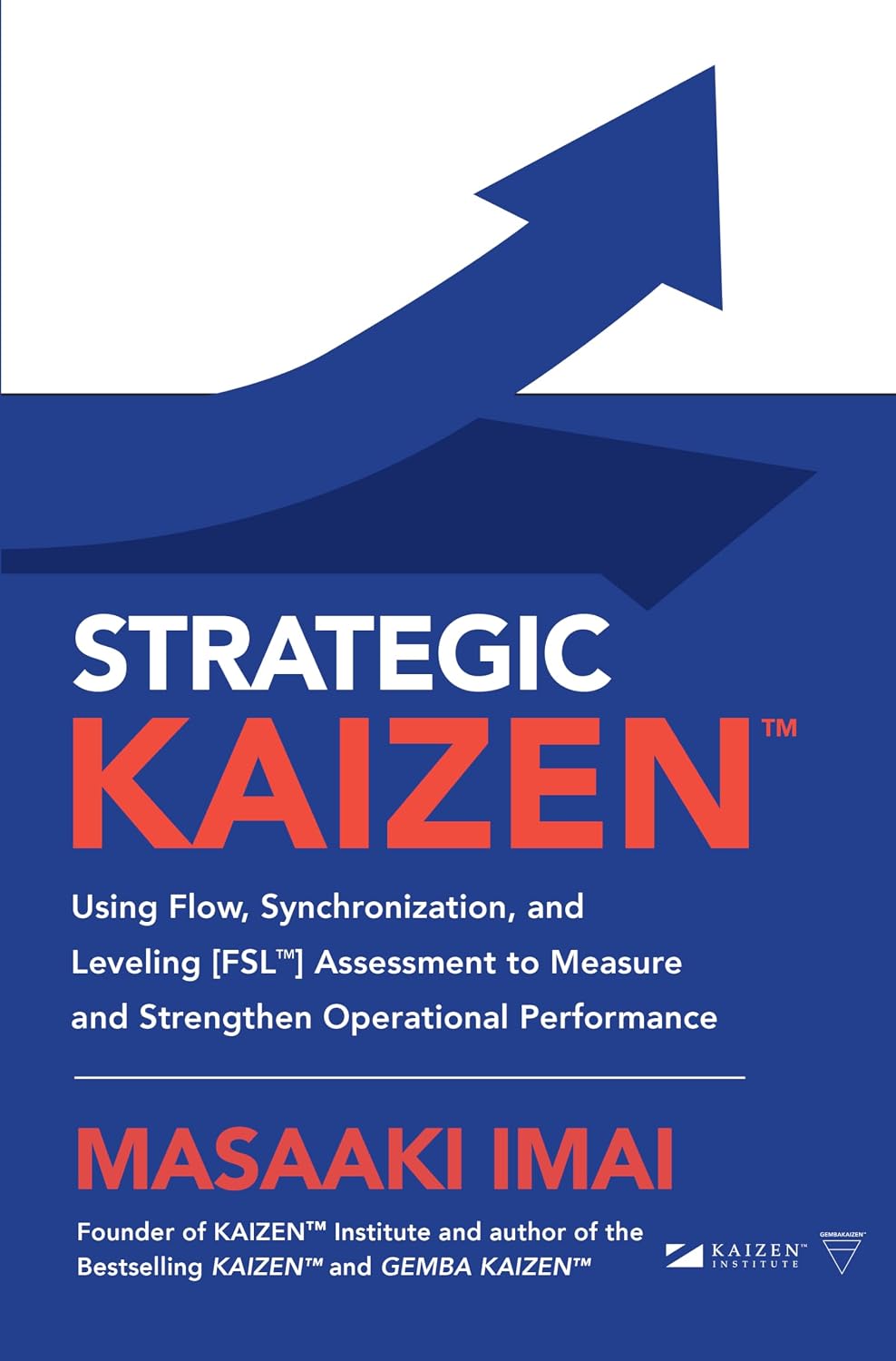
Strategic Kaizen™ Summary
By Masaaki Imai
Using Flow, Synchronization, and Leveling Assessment to Measure and Strengthen Operational Performance
Summary preview
When people hear the word strategy, they often imagine grand plans made in a boardroom far away from the place where work actually happens. When they hear kaizen, they may picture small daily improvements on the shop floor, useful but modest, practical but limited. This book brings those two worlds together and shows that they were never meant to live apart. Strategic kaizen is the discipline of linking everyday improvement to the long direction of the company, so that vision does not stay as a slogan and improvement does not become a pile of disconnected activities. The heart of the message is simple. A company cannot win through brilliant plans alone. It cannot win through isolated efficiency drives either. It must build a system where top management sets a clear challenge, middle management translates that challenge into concrete processes, and frontline people improve the work every day with facts, discipline, and respect. This is not about dramatic turnarounds or heroic leaders who save the day. It is about creating an organization that learns, aligns, and improves continuously. That is why the book returns again and again to the place where value is created, the gemba. If you want to understand quality, cost, delivery, safety, morale, or customer satisfaction, you do not begin with reports. You go to the actual place, look at the actual work, and study the actual facts. From there, strategy becomes real. You begin to see waste, unevenness, overburden, missed handoffs, hidden waiting, and standards that exist on paper but not in practice. You also begin to see human ingenuity, because the people closest to the work usually know where the pain is and often know where the answer begins. Masaaki Imai presents this as both a philosophy and a method. The philosophy says that improvement is everybody's business and that management's first duty is to improve processes, not merely judge results. The method gives you ways to do that through standardization, visual management, policy deployment, cross functional teamwork, problem solving, and daily follow up. The book speaks to executives, managers, supervisors, and operators all at once because each has a role in making strategy live through action. As you move through these ideas, you see that strategic kaizen is not a program of the month. It is a management system. It asks leaders to be humble enough to learn from the workplace, disciplined enough to maintain standards, and bold enough to set a clear direction. It asks organizations to stop treating strategy and execution as separate worlds. The promise is powerful. When long term purpose and daily improvement support each other, a company gains not only better performance but also a stronger culture, deeper capability, and a more resilient future.
Sign up to continue reading
Get access to full book summaries, audio of the summaries, and many more.
Similar Books
Books with a similar vibe—explore more like this.
Next Play
Alan Stein Jr.
Improve Team Performance, Productivity, and Fulfillment
4.9 (34)26 mins
How to Be a Star at Work
Robert E. Kelley
9 Breakthrough Strategies You Need to Succeed
4.6 (34)28 mins
Process!
Mike Paton, Lisa González
How Discipline and Consistency Will Set You and Your Business Free
4.6 (5)23 mins
Mission Ready
Lindy Elkins-Tanton
How to Build Teams That Perform Under Pressure
4.5 (6)22 mins

Team
David Allen, Edward Lamont
Getting Things Done with Others
4.4 (525)21 mins
The Art of Action
Stephen Bungay
How to Close the Gaps between Plans, Actions, and Results
4.4 (20)25 mins
Why Simple Wins
Lisa Bodell
Escape the Complexity Trap and Get to Work that Matters
4.4 (10)21 mins
Your Best Meeting Ever
Rebecca Hinds
7 Principles for Designing Meetings That Get Things Done
4.4 (13)24 mins
Leveling Up
Ryan Leak
12 Questions to Elevate Your Personal and Professional Development
4.4 (22)28 mins
This Is Strategy
Seth Godin
Make Better Plans
4.3 (367)25 mins