
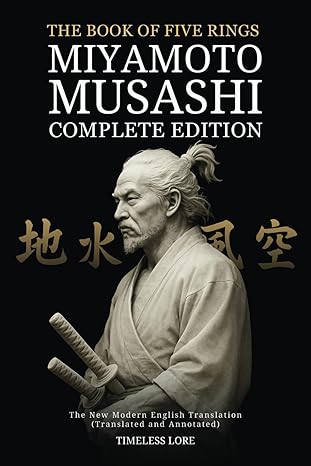
The Book of Five Rings Summary
By Miyamoto Musashi
A Classic Text on the Japanese Way of the Sword
Summary preview
I have walked the path of combat from youth to old age, and what I set down here is not fancy talk, not a courtly game, and not a scholar’s puzzle. It is a way for seeing clearly. The matter before us is strategy, but do not think strategy belongs only to men in armor with swords at their side. The same eye that reads an opponent on the battlefield can read the troubles of daily life, the pressures of work, the tricks of ambition, and the weakness that grows in an undisciplined heart. That is why this book endures. It teaches you how to stand in the world without confusion. Miyamoto Musashi speaks as one who tested every word against danger. He tells you he fought many duels from a young age and remained undefeated, yet he does not boast for the sake of praise. He offers his experience so you may learn the principles behind victory. He wants you to see that winning does not come from wild strength, pretty technique, or memorized forms. It comes from understanding timing, rhythm, distance, spirit, and the true shape of things. If your mind is clouded by preference, fear, haste, or vanity, you will miss what is right in front of you. If your mind is calm and exact, you can meet any challenge with freedom. The book is arranged as five scrolls, each named after an element. Earth gives the ground of the teaching, the broad outline of the Way. Water shows the flexible, living form of technique and attitude. Fire enters the heat of conflict itself, where decisions must be made in a breath. Wind examines other schools, not to gossip about them, but to reveal where people go astray when they cling to habits, decorations, or narrow rules. Void points toward the deepest level, where understanding becomes natural and unforced. This is not a manual of tricks. Again and again, the teaching turns you away from dependence on fixed patterns. You are urged to study broadly, train your body and mind, know your weapons, and polish your perception until nothing is hidden from you. A carpenter measures before building. A warrior measures before acting. A leader measures before deciding. Every craft has a Way, and the one who masters principles can move from one field to another without losing balance. So come to this book ready to work. Read it slowly. Look beyond the sword, though the sword is everywhere in it. What is offered here is a severe kind of kindness. It strips away illusion. It asks you to be honest. It says plainly that if you wish to prevail, first you must learn to see, then to practice, then to become one with what you know.
Sign up to continue reading
Get access to full book summaries, audio of the summaries, and many more.
Similar Books
Books with a similar vibe—explore more like this.

Sovereign Self
Acharya Shunya
Claim Your Inner Joy and Freedom with the Empowering Wisdom of the Vedas, Upanishads, and Bhagavad Gita
4.8 (114) mins

Uncle Tom's Cabin
Harriet Beecher Stowe
The Problem of Slavery and Its Treatment of Human Beings
4.7 (41)25 mins
Positively Energizing Leadership
Kim Cameron
Virtuous Actions and Relationships That Create High Performance
4.7 (147) mins
Guantánamo Diary
Mohamedou Ould Slahi, edited by Larry Siems
Guantanamo from the Inside
4.7 (3) mins
Sun Tzu and the Art of Business
Mark R. McNeilly
Six Strategic Principles for Manager
4.6 (638)24 mins

The Prince
Niccolò Machiavelli
Machiavelli’s classic text on leadership and politics
4.6 (973)37 mins

The Divine Comedy
Dante Alighieri
The Inferno, The Purgatorio, and The Paradiso
4.6 (457)27 mins

The Power Of Meaning
Emily Esfahani Smith
Crafting a Life That Matters
4.6 (126) mins

The Book of Genesis
The Holy Bible
In the beginning
4.6 (12) mins

The Book
Alan W. Watts
On the Taboo Against Knowing Who You Are
4.5 (540)26 mins