
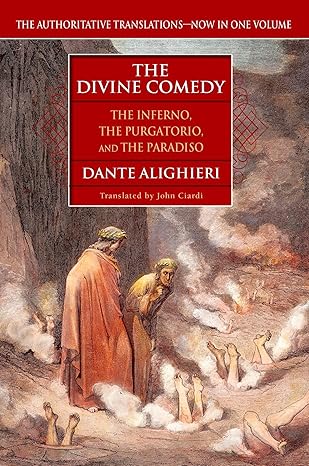
The Divine Comedy Summary
By Dante Alighieri
The Inferno, The Purgatorio, and The Paradiso
Summary preview
Midway through the journey of life, I wake to find myself lost in a dark wood. That opening feeling is the heartbeat of the whole poem. It is the shock of discovering that the road you trusted has vanished beneath your feet, that fear has entered the bones, and that the soul must either learn to see clearly or remain trapped in confusion. The Divine Comedy is not only a story of travel through the afterlife. It is a map of the human heart. It is a vision of sin, repentance, hope, love, justice, and the long hard work of becoming able to receive God. Dante Alighieri gives us a pilgrim who is both one man and every man. He trembles, delays, asks too many questions, pities where he should judge, hardens where he should weep, and slowly learns. He begins in error and ends in light. That movement from blindness to vision is the great motion of the book. First comes the descent through Hell, where every soul is fixed forever in the truth of what it chose. Then comes the climb of Purgatory, where suffering becomes medicine and desire is reshaped toward the good. At last comes Paradise, where the whole universe shines as an ordered expression of divine love. Yet this poem is never dry doctrine. It is crowded with faces, voices, arguments, tears, songs, prophecies, memories, and fierce recognitions. Popes, kings, lovers, traitors, friends, poets, saints, and enemies all appear. The realms of the dead become mirrors in which earthly life is judged. Politics enters the poem. So does personal grief. So does longing for justice. Again and again, the pilgrim meets people who explain by their condition what they made of freedom on earth. For example, the lustful are swept forever by winds that image the passions that once mastered them. The proud bend low under heavy stones until they learn humility. The blessed shine more brightly as they draw nearer to the source of all joy. What makes the poem endure is the union of tenderness and severity. It tells us our choices matter eternally. It also tells us we are made for more than fear. The journey is guided first by reason, then by grace, and finally by a love beyond language. Virgil leads through darkness and discipline. Beatrice leads toward the highest truth. At the summit, speech begins to fail, because the final reality is not an argument but a direct vision. So the poem asks the reader to travel too. It asks us to descend into what is twisted, to climb through what can still be healed, and to lift our eyes toward what is eternally beautiful. Under all its grandeur, the purpose is simple and urgent. Learn what destroys the soul. Learn what purifies it. Learn what gives it life.
Sign up to continue reading
Get access to full book summaries, audio of the summaries, and many more.
Similar Books
Books with a similar vibe—explore more like this.
Uncle Tom's Cabin
Harriet Beecher Stowe
The Problem of Slavery and Its Treatment of Human Beings
4.7 (41)25 mins
The Four Agreements
Don Miguel Ruiz & Janet Mills
A Practical Guide to Personal Freedom
4.3 (913)21 mins
Utilitarianism
John Stuart Mill
Explore a Timeless Ethics Classic
4.8 (46)24 mins
Hamlet
William Shakespeare
A Young Prince's Tragic Descend Into Madness and Revenge
4.8 (43) mins
Sovereign Self
Acharya Shunya
Claim Your Inner Joy and Freedom with the Empowering Wisdom of the Vedas, Upanishads, and Bhagavad Gita
4.8 (114) mins
The Epic of Gilgamesh
Anonymous
A timeless tale of friendship, mortality, and the search for meaning
4.8 (34) mins
The Midnight Library
Matt Haig
A Fantasy Novel About the Choices That Lead to a Life Well-Lived
4.7 (4782)32 mins
The Book of Five Rings
Miyamoto Musashi
A Classic Text on the Japanese Way of the Sword
4.7 (293)23 mins
Bedtime Biography: Isaac Newton
James Gleick
Learn the truth behind the legend
4.7 (45) mins
The Odyssey
Homer
The Ancient Greek Epic Poem About A Hero's Journey Home
4.7 (60)24 mins