
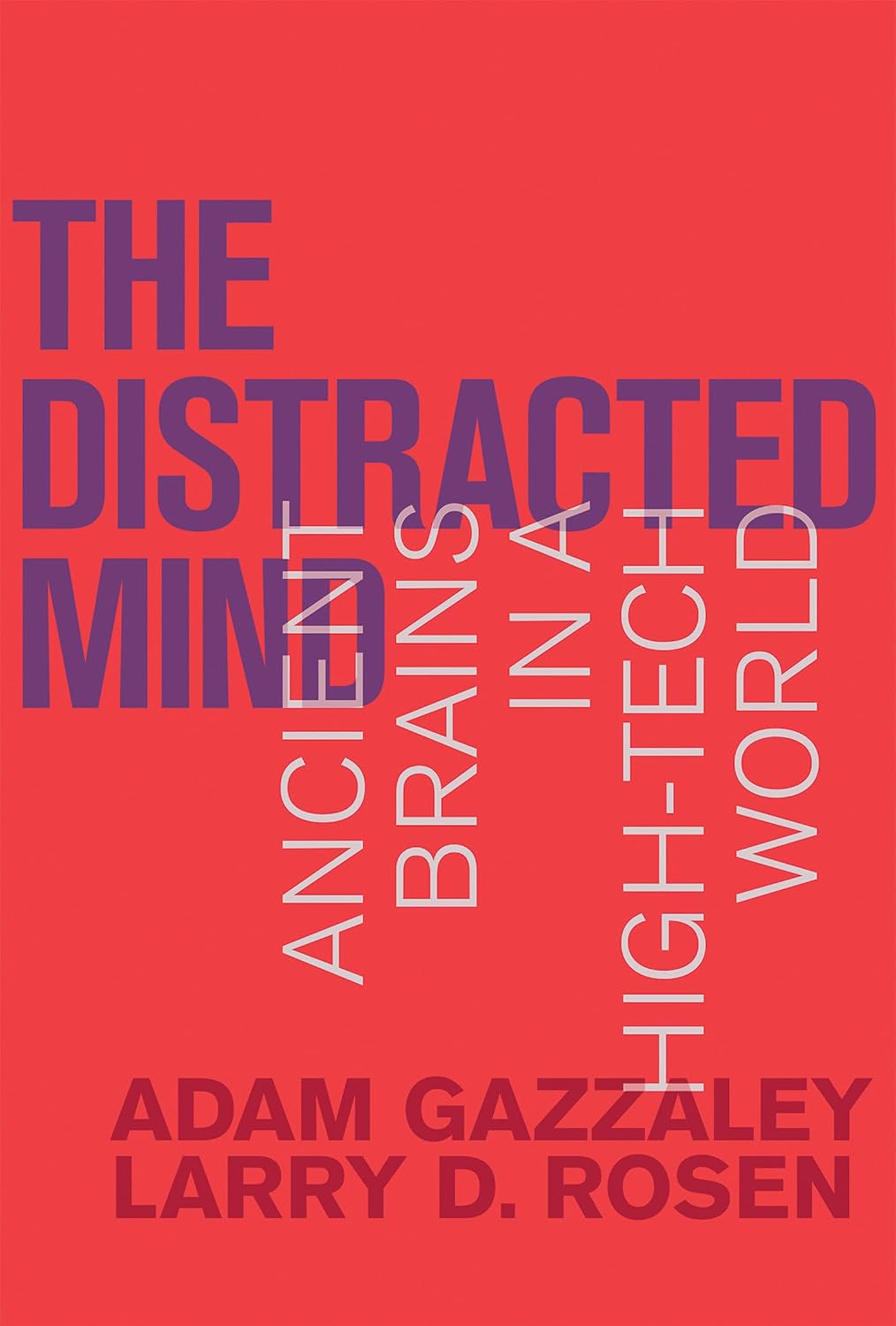
The Distracted Mind Summary
By Adam Gazzaley and Larry D. Rosen
Ancient Brains in a High-Tech World
Summary preview
Why do we so often feel split in two, pulled between what we want to pay attention to and what keeps stealing our attention away? That is the question at the heart of The Distracted Mind. Adam Gazzaley and Larry D. Rosen take a problem most of us feel every day and show that it is not just about weak willpower, bad habits, or rude gadgets buzzing in our pockets. It runs deeper than that. Our minds were not built for the nonstop flood of modern life, yet we keep asking them to do exactly that. The book begins with a simple but powerful idea. Humans are goal driven. We are always trying to focus on something that matters, whether that means writing a report, listening to a friend, driving through traffic, studying for an exam, or simply enjoying a quiet moment. But our goals constantly collide with interference. Some of that interference comes from the world around us, such as a ringing phone, a pop up message, or another person entering the room. Some of it comes from inside us, such as worrying thoughts, daydreams, old memories, urges, and habits. The distracted mind is what happens when these forces repeatedly break into our attempts to stay on track. What makes the book so useful is that it does not treat distraction as one single thing. It shows how attention, working memory, multitasking, interruption, and media use all fit together. It explains why we overestimate our ability to juggle tasks, why we check devices even when we know they are harming our performance, and why children, adults, and older people can all struggle in different ways. The authors want you to see that distraction is not a personal defect. It is the result of an ancient brain meeting a very new environment. At the same time, this is not a gloomy story about technology ruining us. The message is more balanced and more hopeful than that. Digital tools can disrupt us, yes, but they can also support us. The same science that reveals our limits can help us design better habits, better classrooms, better workplaces, and even better technologies. The key is to understand how cognition actually works instead of believing the comforting myth that we can do everything at once without cost. As the book unfolds, it moves from brain science to daily life, from evolutionary history to email and social media, from the classroom to the office to the family home. It asks you to look honestly at your own behavior and then offers practical ways to respond. The result is a clear, human guide to one of the defining struggles of our age, how to protect what matters in a world that is always trying to grab your mind.
Sign up to continue reading
Get access to full book summaries, audio of the summaries, and many more.
Similar Books
Books with a similar vibe—explore more like this.
The Science of Self-Discipline
Peter Hollins
Resist Temptation and Achieve Your Goals
4.7 (71)20 mins

The Emperor's New Mind
Roger Penrose
Concerning Computers, Minds, and the Laws of Physics
4.7 (64)29 mins
Your Brain at Work
David Rock
Strategies for Overcoming Distraction, Regaining Focus, and Working Smarter All Day Long
4.6 (1428)32 mins
Breaking The Habit of Being Yourself
Joe Dispenza
How to Lose Your Mind and Create a New One
4.5 (415)23 mins
How to Think More Effectively
The School of Life
A guide to greater productivity, insight and creativity
4.5 (909)23 mins
Productive Failure
Manu Kapur
Unlocking Deeper Learning Through the Science of Failing
4.5 (211)22 mins
When
Daniel H. Pink
The Scientific Secrets of Perfect Timing
4.5 (673)26 mins
The Future of the Mind
Michio Kaku
The Scientific Quest to Understand, Enhance, and Empower the Mind
4.5 (602)34 mins
What's Our Problem?
Tim Urban
A Self-Help Book for Societies
4.5 (158)23 mins
Million Dollar Habits
Brian Tracy
Proven Power Practices to Double and Triple Your Income
4.5 (389)24 mins