
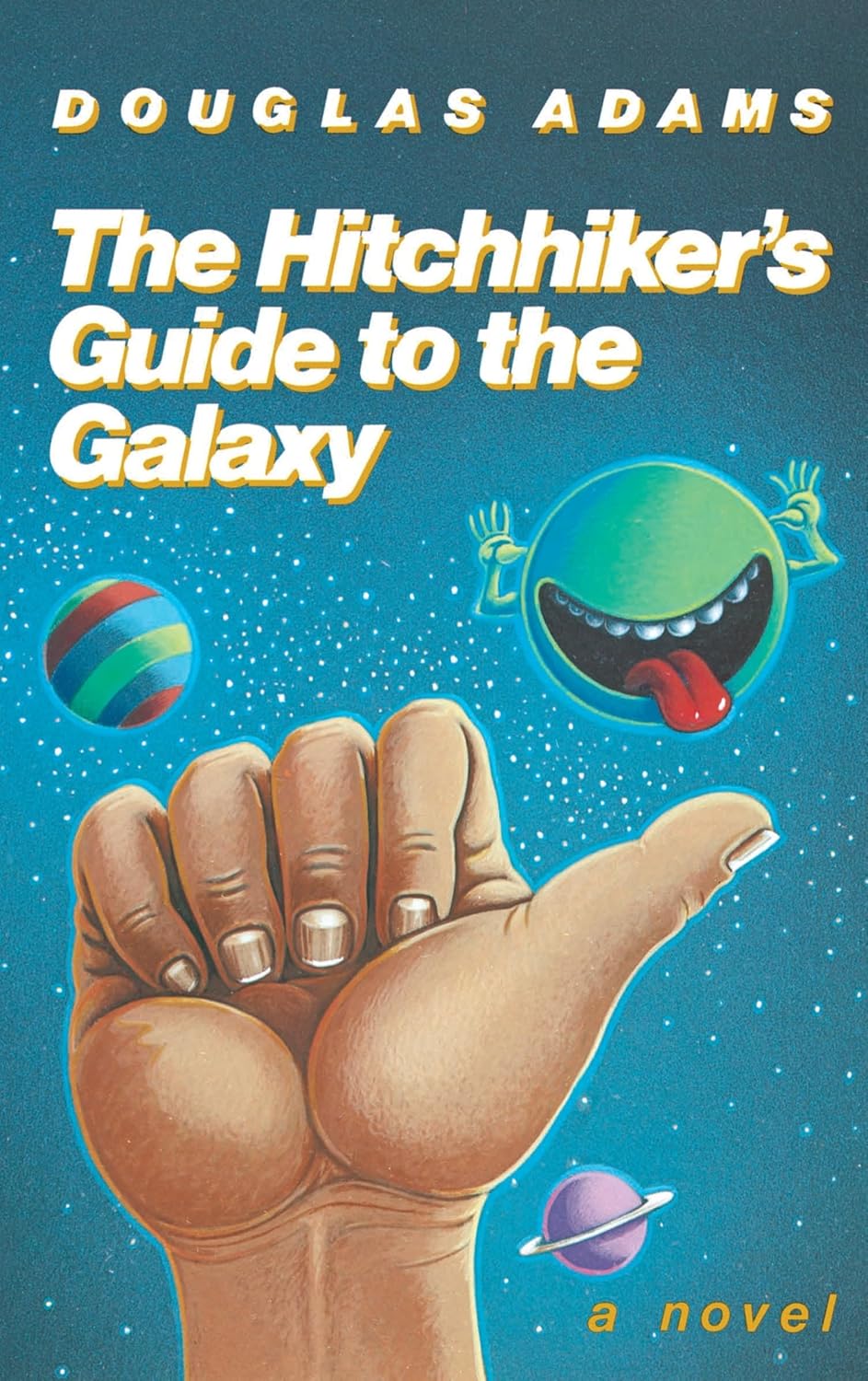
The Hitchhiker's Guide to the Galaxy Summary
By Douglas Adams
A Novel
Summary preview
Some books invite you into a world. This one pulls the floor away, demolishes your house, blows up your planet, and then offers you a towel. That is the basic shape of The Hitchhiker's Guide to the Galaxy, a comic science fiction adventure that treats the universe as a place of enormous size, baffling logic, and very poor planning. Douglas Adams takes what could have been a grand tale of cosmic discovery and turns it into something far stranger and far more human. It is a story about space travel, yes, but also about confusion, bureaucracy, friendship, bad timing, and the odd miracle of carrying on when absolutely nothing makes sense. At the center of the tale is Arthur Dent, a thoroughly ordinary Englishman whose biggest problem at the start is that his house is about to be knocked down. He is lying in front of a bulldozer in his dressing gown, trying in a muddled sort of way to defend his home. Within minutes, this local annoyance is eclipsed by a much larger civic improvement project. Earth itself is destroyed by aliens called Vogons to make way for a hyperspace bypass. Arthur survives only because his friend Ford Prefect turns out not to be from Guildford after all, but from somewhere much farther out among the stars, and has the good sense to hitch a ride off the planet. From there the book opens like a trapdoor into absurdity. Arthur and Ford are swept through one impossible situation after another. They endure Vogon poetry, which is said to be among the worst in the universe. They are rescued aboard the Heart of Gold, a stolen spaceship powered by the wildly improbable Infinite Improbability Drive. They meet Zaphod Beeblebrox, the two headed, three armed, spectacularly irresponsible President of the Galaxy, along with Trillian, the only other surviving human, and Marvin, a robot whose brain is vast and whose spirit is permanently crushed. Beneath all the comedy, the book keeps circling some very large questions. Why are we here. Does the universe have a plan. If there is an answer to life, the universe, and everything, what use is it if nobody knows the question. The great joke is that the cosmos may contain answers of breathtaking scale, yet the beings living in it remain distracted, vain, lonely, or hungry. The Guide itself, that cheerful electronic handbook for travelers, insists in large friendly letters, “Don’t Panic.” That advice is funny because panic is exactly what most creatures seem built for. What follows is not just a string of jokes, though the jokes come thick and fast. It is a wonderfully crooked voyage through wreckage, nonsense, and wonder, where the impossible happens so casually that it begins to feel almost practical. The book asks you to laugh at the universe, but also at yourself, which may be the only sensible response available.
Sign up to continue reading
Get access to full book summaries, audio of the summaries, and many more.
Similar Books
Books with a similar vibe—explore more like this.
Tomorrow, and Tomorrow, and Tomorrow
Gabrielle Zevin
A Novel
4.5 (4281)24 mins
Tomorrow and tomorrow and tomorrow
Gabrielle Zevin
A Novel
3.5 (11)22 mins
Nineteen Eighty-Four (1984)
George Orwell
A Dystopian Classic on the Dangers of Totalitarianism
4.9 (697)17 mins

The Song of Roland
Anonymous
Enter a World of Medieval Heroism, Where Honor Reigns Supreme
4.9 (3)20 mins
We Have Always Lived in the Castle
Shirley Jackson
Enter a Disturbing Labyrinth of Family Secrets and Dark Neurosis
4.8 (5)14 mins
Frankenstein
Mary Shelley
The Modern Prometheus
4.6 (419)24 mins

Silas Marner
George Eliot
Uncover a Rich Tapestry of Love, Hope, and Redemption
4.6 (7)22 mins
Macbeth
William Shakespeare
Regicide and Revenge in one of the World's Most Famous Tragedies
4.5 (49)24 mins
The Prince and the Pauper
Mark Twain
A Tale of Two Mirrored Fates
4.5 (82)18 mins

Madame Bovary
Gustave Flaubert
A Tale of Desire and Despair in the Search for Fulfillment
4.4 (20)21 mins