
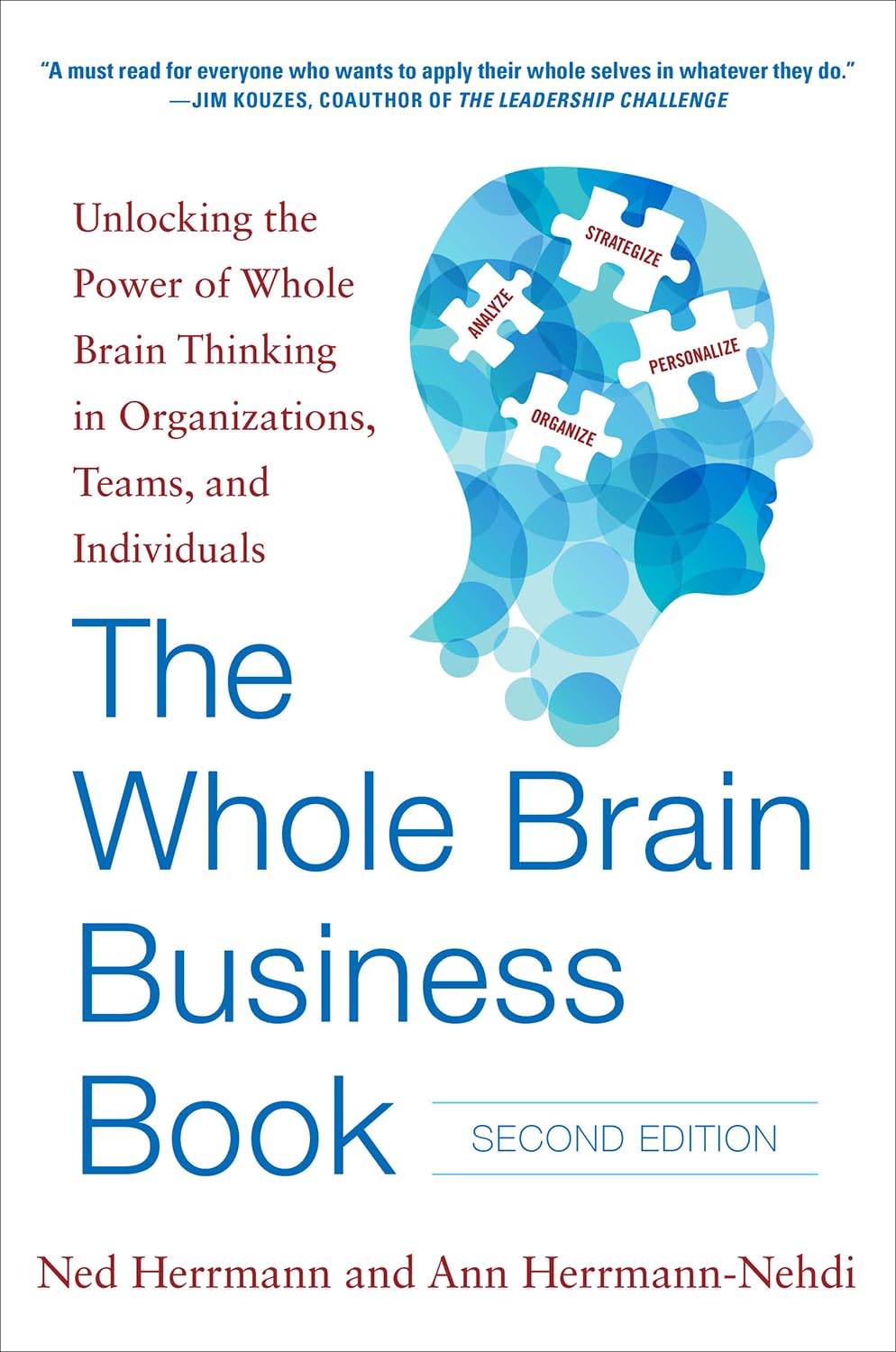
The Whole Brain Business Book Summary
By Ann Herrmann-Nehdi, Ned Herrmann
Unlocking the Power of Whole Brain Thinking
Summary preview
Business is full of smart people who still talk past each other, build plans no one uses, sell ideas that do not land, and lead teams that never quite click. The heart of this book is a simple but powerful truth. The problem is often not intelligence, effort, or even strategy. It is thinking. More precisely, it is the way different people prefer to think, decide, communicate, and act. When you can see those differences clearly, work changes. Meetings improve. Conflict becomes easier to handle. Innovation gets stronger. Leadership becomes more human and more effective. That is the promise behind The Whole Brain Business Book by Ann Herrmann Nehdi and Ned Herrmann. It takes the well known Whole Brain model and brings it into everyday business life. The model says that people have thinking preferences that tend to cluster in four broad areas. One area leans toward logic, analysis, numbers, and facts. Another likes organization, planning, details, and follow through. A third values relationships, feelings, teaching, and teamwork. The last one is drawn to big pictures, imagination, experimentation, and possibility. None of these is better than another. All are useful. All are needed. Yet most of us trust some kinds of thinking more than others, and that shapes everything we do. The book does not treat the brain as a dry theory or a neat label. It treats thinking as a living force that shapes culture, problem solving, selling, change, learning, hiring, and leadership. It asks you to notice your own patterns first. What kinds of tasks energize you. What kinds drain you. Where do you move quickly, and where do you hesitate. Then it invites you to look outward with fresh eyes. Why does one colleague want hard data before making a move while another wants to hear how the change will affect people. Why does one team love brainstorming but avoid execution, while another executes well but rarely invents anything new. As the ideas unfold, the book keeps bringing you back to one practical aim. Think bigger than your own preference. Learn to stretch. Build whole brain teams, whole brain messages, whole brain decisions, and whole brain organizations. That does not mean everyone must become the same. It means learning to value differences as assets and using them on purpose. The result is not only better business results. It is a more complete way of working, one that honors rigor and creativity, structure and empathy, action and reflection. Once you start seeing business through this lens, it becomes very hard to unsee it.
Sign up to continue reading
Get access to full book summaries, audio of the summaries, and many more.
Similar Books
Books with a similar vibe—explore more like this.
Next Play
Alan Stein Jr.
Improve Team Performance, Productivity, and Fulfillment
4.9 (34)26 mins
How to Be a Star at Work
Robert E. Kelley
9 Breakthrough Strategies You Need to Succeed
4.6 (34)28 mins
Mission Ready
Lindy Elkins-Tanton
How to Build Teams That Perform Under Pressure
4.5 (6)22 mins
The Art of Action
Stephen Bungay
How to Close the Gaps between Plans, Actions, and Results
4.4 (20)25 mins
Leveling Up
Ryan Leak
12 Questions to Elevate Your Personal and Professional Development
4.4 (22)28 mins
The 3.3 Rule
John Briggs
The New Workday Standard of Creating More by Working Less
3.8 (85)14 mins
Surrender to Lead
Jessica Kriegel, Joe Terry
The Counterintuitive Approach to Driving Extraordinary Results
4.9 (7)21 mins
The Gift of Struggle
Bobby Herrera
Life-Changing Lessons About Leading
4.8 (22)21 mins
The Score That Matters
Ryan Hawk, Brook Cupps
Growing Excellence in Yourself and Those You Lead
4.7 (368)17 mins

The Archetype Effect
James Root
Unlocking The Six Types of Motivation at Work
4.7 (18)22 mins