
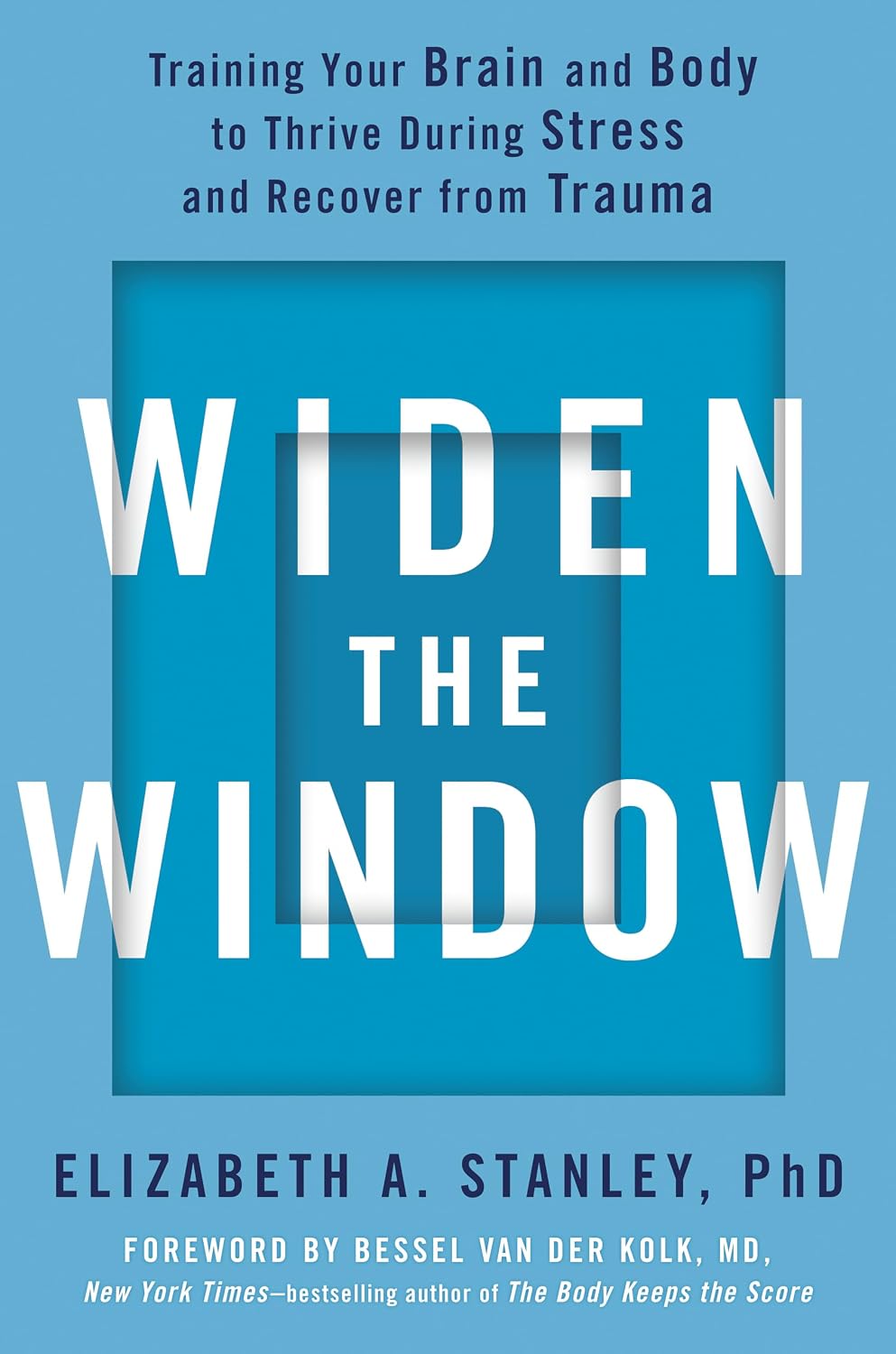
Widen the Window Summary
By Elizabeth A. Stanley
Training Your Brain and Body to Thrive During Stress and Recover from Trauma
Summary preview
Widen the Window is a book about what happens when stress stops being an occasional visitor and becomes the air we breathe. It asks a painfully honest question. Why do so many smart, caring, capable people feel stuck in cycles of anxiety, shutdown, anger, exhaustion, and disconnection, even when they are trying hard to heal and do better? The answer offered here is both simple and profound. Trauma and chronic stress change the brain and body in ways that are real, measurable, and often invisible to us while they are happening. If we want to live with more clarity, courage, and connection, we cannot think our way out of survival patterns alone. We have to work with the body, the nervous system, and the deep habits that stress has carved into us. Elizabeth A. Stanley writes from a rare place. She brings together years of scholarship on trauma, military institutions, and public leadership with the vulnerable honesty of someone who has lived through serious stress injury herself. That blend gives the book its heartbeat. You are not reading abstract theory from a distance. You are walking beside someone who learned, often the hard way, how high achievement can coexist with hidden distress, how old wounds can shape present choices, and how healing becomes possible when we stop treating symptoms as personal failures. At the center of the book is the idea of the window of tolerance, the range of activation in which you can stay present, think clearly, feel your feelings without being overwhelmed, and respond rather than react. When that window is narrow, life becomes harder than it needs to be. Small challenges can throw you into hyperarousal, where you feel anxious, restless, angry, or on edge. Or they can push you into hypoarousal, where you go numb, collapse, disconnect, or freeze. Many of us move between these states without understanding what is happening. We may blame ourselves, blame others, or keep pushing until something breaks. This book offers another path. It shows how stress accumulates, how trauma lives in the body, why resilience is trainable, and what kind of practice actually helps widen that window over time. The method at the heart of the book, mindfulness based mind fitness training, is not presented as a quick fix or a spiritual slogan. It is a disciplined way of retraining attention, increasing body awareness, and restoring choice under pressure. Along the way, the book explores family history, social systems, military culture, neuroscience, and the daily habits that either support or erode regulation. The invitation is practical and hopeful. If stress can reshape us, healing can reshape us too.
Sign up to continue reading
Get access to full book summaries, audio of the summaries, and many more.
Similar Books
Books with a similar vibe—explore more like this.
Re-Regulated
Anna Runkle
Set Your Life Free from Childhood PTSD
4.8 (10)21 mins
The Grieving Body
Mary-Frances O'Connor
How the Stress of Loss Can Be an Opportunity for Healing
4.7 (9)22 mins
The How of Happiness
Sonja Lyubomirsky
A New Approach to Getting the Life You Want
4.6 (309)27 mins
My Grandmother's Hands
Resmaa Menakem
Racialized Trauma and the Pathway to Mending Our Hearts and Bodies
4.6 (167)30 mins
Together
Vivek H. Murthy
The Healing Power of Human Connection in a Sometimes Lonely World
4.6 (820)23 mins
Overcoming Unwanted Intrusive Thoughts
Sally M. Winston, Martin N. Seif
A CBT-Based Guide to Getting Over Frightening, Obsessive, or Disturbing Thoughts
4.6 (17)23 mins
The 5 Resets
Aditi Nerurkar
Rewire Your Brain and Body for Less Stress and More Resilience
4.6 (61)22 mins
The Inflamed Mind
Edward Bullmore
A Radical New Approach to Depression
4.6 (71)29 mins
Successful Aging
Daniel J. Levitin
A Neuroscientist Explores the Power and Potential of Our Lives.
4.6 (62)30 mins
Positivity
Barbara L. Fredrickson
Top-Notch Research Reveals the 3 to 1 Ratio That Will Change Your Life
4.5 (984)26 mins